
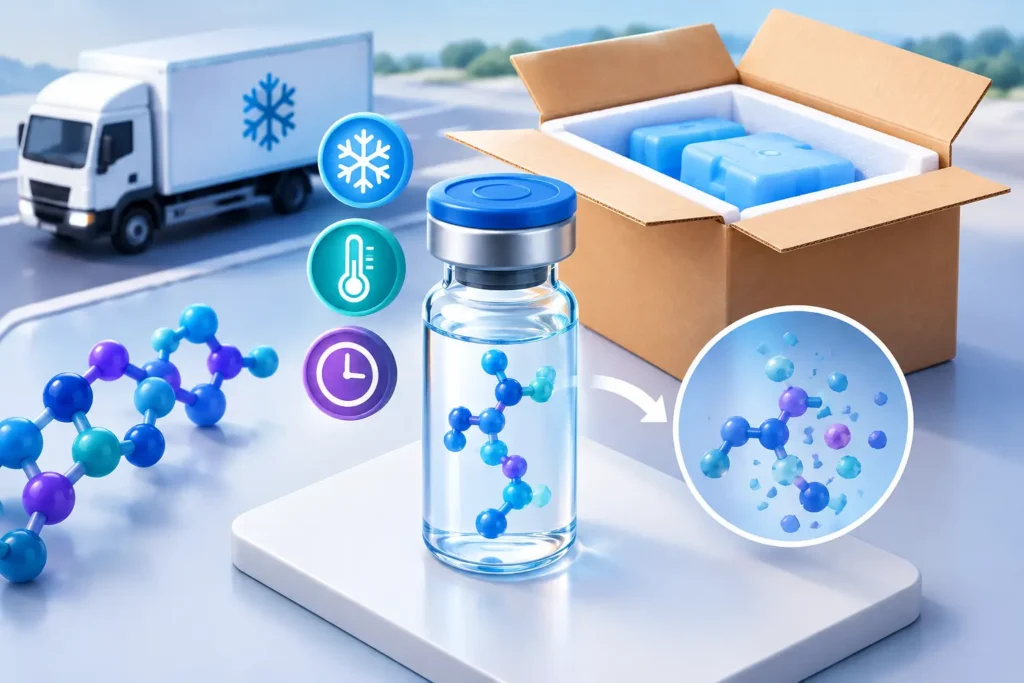
A lyophilized peptide may leave a facility with documented purity and still face conditions worth evaluating before it reaches the laboratory. So, can peptides degrade during shipping? Yes, they can, but degradation is not automatic, and the practical risk depends on the compound, its format, packaging, transit conditions, and receiving process.
For qualified research professionals, the question is not simply whether a shipment was warm or delayed. The more useful question is whether the material experienced conditions that could plausibly affect its identity, purity, physical state, or suitability for the intended in-vitro or educational application. A disciplined assessment begins with understanding what peptides are sensitive to and what shipping controls can, and cannot, accomplish.
Why Peptides Can Change in Transit
Peptides are chains of amino acids, and their stability is influenced by chemical structure and environment. Heat can accelerate degradation pathways. Moisture can be especially relevant for lyophilized materials because water exposure may promote hydrolysis, aggregation, or other unwanted changes. Oxidation may also be a concern for sequences containing susceptible residues.
That does not mean every temperature fluctuation produces measurable loss of quality. Many lyophilized peptide powders are more stable than reconstituted solutions, particularly when they remain dry, protected from light, and sealed in an appropriate vial. Still, stability is compound-specific. A shipping condition that is inconsequential for one peptide may be less acceptable for another, especially for materials with known sensitivity to heat, oxidation, or repeated temperature cycling.
Reconstituted materials generally require more caution than dry powders. Once a peptide is in solution, hydrolytic and chemical degradation pathways can become more relevant. For that reason, researchers should distinguish between the shipping requirements for a sealed lyophilized vial and those for a prepared research solution. They are not interchangeable formats.
Can Peptides Degrade During Shipping? The Main Variables
Shipping risk is best viewed as an interaction of exposure and time. A short period outside the preferred storage range does not carry the same implication as extended exposure during a multi-day delay. Likewise, an insulated mailer is not equivalent to active temperature-controlled shipping, particularly in extreme seasonal conditions.
Temperature exposure
Elevated temperature can increase the rate of several degradation reactions. The actual impact depends on peak temperature, duration, the peptide’s sequence, formulation, and whether the product remained dry. A package moving through a hot delivery vehicle or sitting outdoors can encounter higher temperatures than the general ambient weather report suggests.
Cold conditions can also matter. For many dry peptide powders, brief cold exposure may be less concerning than sustained heat, but this is not a universal rule. Freezing and thawing are more consequential for certain liquid formulations, where repeated cycling can affect solution uniformity or promote aggregation. The relevant question is always the labeled storage condition and the format received.
Humidity and package integrity
A properly sealed vial and moisture-barrier packaging reduce the chance that ambient humidity will reach a lyophilized powder. If outer packaging is visibly wet, damaged, or compromised, the issue is not merely cosmetic. Researchers should inspect the vial, cap, seal, and any desiccant or protective packaging before placing the material into storage.
A dry-looking vial does not prove that no change occurred, just as a damaged carton does not prove degradation. Visual inspection is an initial quality-control check, not a substitute for analytical testing. When the condition of a shipment creates a material concern, documentation and supplier communication are more useful than assumptions.
Light, handling, and transit duration
Some compounds are light-sensitive, making opaque secondary packaging meaningful during transport and storage. Physical handling matters as well. Broken vials, displaced stoppers, or evidence of leakage should be treated as receiving exceptions.
Transit duration increases opportunity for environmental exposure, especially when a package encounters a weekend hold, severe weather event, carrier interruption, or delivery attempt failure. Faster shipping is not inherently necessary for every lyophilized peptide, but avoiding unnecessary time in uncontrolled conditions is a sound procurement principle.
The difference between a COA and shipping validation
A Certificate of Analysis is essential lot-level documentation. It can provide confidence that a batch met stated analytical specifications at release, such as identity and purity. At PepAlphatides, accessible COAs and independently verified purity support transparent research-material sourcing.
However, a COA does not independently document every condition encountered after the package leaves the controlled release process. Researchers should treat batch verification and shipping-condition review as related but distinct parts of quality assurance. Both matter when maintaining a defensible chain of material handling.
What Responsible Packaging Is Designed to Do
Appropriate packaging is intended to reduce preventable exposure, not eliminate every variable in a carrier network. Depending on the material and expected conditions, protective measures may include sealed vials, light-limiting secondary packaging, desiccant, insulation, cold packs, or other temperature-management approaches.
Each method has trade-offs. Cold packs can moderate heat exposure, but their performance changes with route, package size, ambient conditions, and transit time. Insulation slows temperature change but does not indefinitely maintain a target range. More protective packaging can add cost and bulk, yet it may be justified for temperature-sensitive materials or challenging weather conditions.
The product format remains central. A sealed, lyophilized powder shipped in suitable protective packaging has a different risk profile than a solution requiring continuous cold-chain control. Researchers should review the product-specific storage instructions rather than applying one handling standard to every compound in the inventory.
A Practical Receiving Process for Research Materials
The most useful controls often occur when the shipment arrives. A consistent receiving procedure prevents uncertainty from becoming an undocumented gap in the laboratory record. Upon delivery, confirm that the shipping label, product label, lot identifier, and ordered material correspond. Then inspect the shipment before opening or transferring it to storage.
For a meaningful exception review, record four details: delivery date and time, visible package condition, apparent condition of the vial or container, and any unusual transit event such as a delay or weather exposure. Photographs can be helpful when damage, leakage, broken glass, or compromised seals are present.
Next, move the material to its specified storage condition without unnecessary delay. Avoid leaving research compounds in a mailbox, receiving area, vehicle, or loading dock while other tasks are completed. If the product instructions call for refrigerated or frozen storage, that transfer should be planned before the package arrives.
For lyophilized powders, inspect for expected physical appearance based on the product documentation. A cake, powder, or residue can vary by formulation and vial geometry, so visual appearance alone should not be overinterpreted. What warrants attention is a clear mismatch with expected condition, signs of moisture ingress, a loose closure, or a container failure.
When a Shipment Needs Further Review
Not every delay requires discarding a research material. Conversely, not every intact-looking package should be accepted without question if a substantial excursion is known. The appropriate response depends on available facts: the product’s storage guidance, the form of the material, the duration and severity of the event, and the requirements of the planned study.
When there is a concern, quarantine the material from active use until it can be evaluated. Retain all packaging, document the lot number, and contact the supplier with concise details about the event. For high-consequence experiments, researchers may determine that additional identity or purity testing is appropriate before proceeding. That decision belongs within the laboratory’s quality system and study requirements.
This approach is particularly relevant when comparing results across lots or when a project requires tight analytical consistency. A material may remain usable after a minor shipping event, but the decision should be evidence-based rather than driven by convenience or appearance alone.
Procurement Choices That Reduce Avoidable Risk
Shipping integrity begins before checkout. Order timing can matter more than many buyers expect. Avoiding shipments immediately before weekends, holidays, major storms, or known facility closures reduces the chance that materials remain in a carrier environment longer than planned.
Researchers should also ensure someone can receive the delivery and place materials into appropriate storage. For laboratories with formal inventory controls, the purchase record should connect the order, lot-specific COA, receiving notes, and storage location. This level of traceability supports repeatability and makes later troubleshooting far more efficient.
Sourcing from suppliers that clearly identify product format, storage expectations, lot information, and quality documentation helps researchers make proportionate shipping decisions. Transparent information does not remove every transit variable, but it provides the basis for handling materials responsibly.
A shipment should be treated as one link in the quality chain, not an afterthought. Clear product documentation, sensible delivery planning, prompt receiving, and careful records give researchers the context needed to decide whether a peptide is ready for research use or deserves a closer look.