Table of Contents
- What Makes High Purity Peptides Essential for Research
- Research-Grade Peptide Quality Standards You Should Expect
- Third-Party Peptide Testing Verification: Why It Matters
- How to Read Certificate of Analysis for Peptides
- Best Practices for Peptide Storage and Handling
- Purity vs. Potency: Understanding the Difference
- Custom Peptide Synthesis and Catalog Options
- What to Look for When Buying High Purity Peptides Online
- Frequently Asked Questions
Last Updated: September 20, 2026
What Makes High Purity Peptides Essential for Research
High purity peptides are critical for research because contamination or inconsistency undermines experimental results. Material quality determines whether findings are reliable or wasted effort.
High purity peptides online from reputable sources ensure batch-to-batch consistency and reproducible data. Impure compounds introduce uncontrollable variables that obscure actual results.
Research-grade peptides differ from lower-quality alternatives in more than purity percentages. Publishing findings or building on previous experiments requires materials meeting scientific standards your field expects.
At PepAlphatides, we understand this pressure. That’s why every batch undergoes independent third-party testing to verify purity levels exceeding 99%. This commitment to quality means researchers can focus on their science instead of worrying about material inconsistency.
Research-Grade Peptide Quality Standards You Should Expect
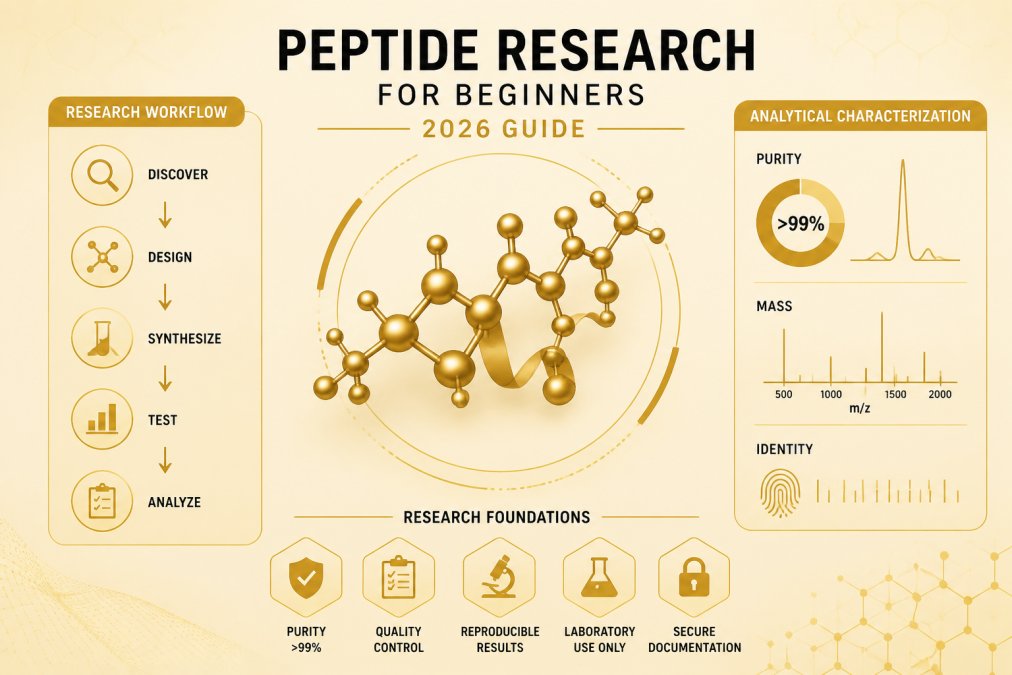
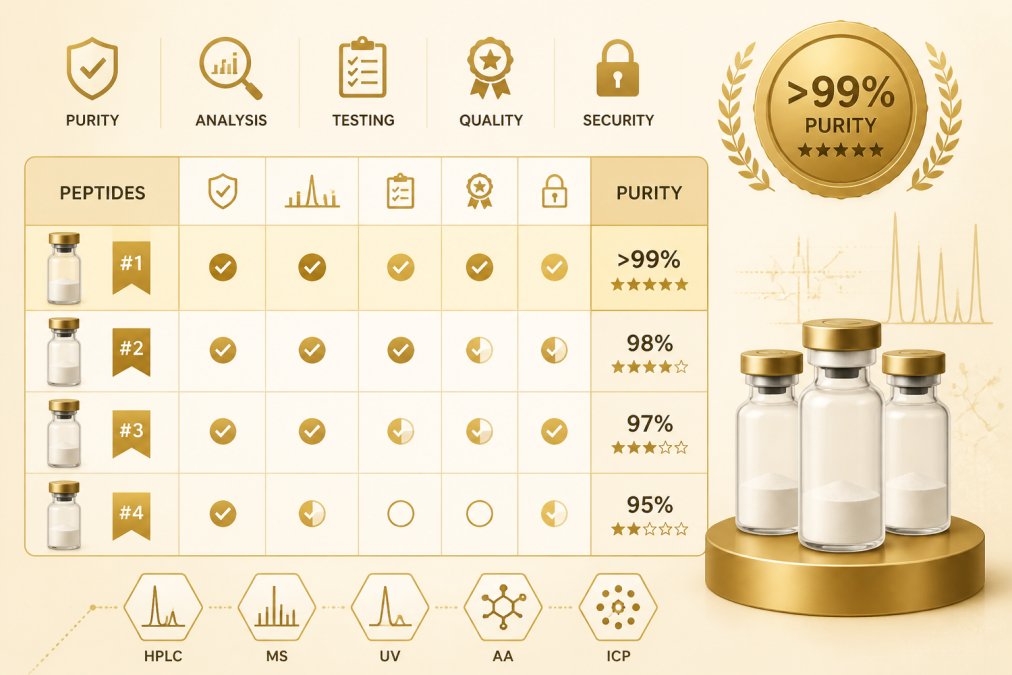
Research-grade peptides should exceed 99% purity, but that number alone reveals nothing about testing methodology or lab independence.
True research-grade quality includes several non-negotiable elements:
- High-purity composition verified through analytical testing like HPLC and mass spectrometry
- Third-party verification from a laboratory with no financial interest in the result
- Detailed documentation including lot numbers, testing dates, and specific analytical methods used
- Batch consistency so that ordering the same peptide multiple times yields identical material
- Sterility assurance for applications where contamination could compromise results
- Sequence verification confirming the amino acid chain matches specifications exactly
These standards separate legitimate research compounds from corner-cutting products. Suppliers claiming 99% purity without independent verification offer no proof. Research-grade materials require documentation.
Higher costs reflect testing infrastructure, quality assurance protocols, and documentation that make research defensible.
Third-Party Peptide Testing Verification: Why It Matters
Third-party testing is the only way to verify purity claims without conflict of interest. Suppliers testing their own products have financial motivation to report favorable results; independent labs do not.
Third-party peptide testing verification sends samples to an accredited lab with no relationship to the supplier. The lab runs standardized tests and reports findings directly to supplier and customer with binding, transparent results.
Research depends on trust. Published or cited studies require documentation proving material matches label claims. A Certificate of Analysis from a reputable third-party lab provides that proof.
Many suppliers skip third-party testing to save money and time, claiming high purity based on in-house testing alone. For serious research, this is a red flag.
How to Verify Third-Party Lab Accreditation
Before trusting a COA, verify the testing lab’s credentials:
Check for ISO 17025 accreditation. This international standard means the lab has undergone independent assessment of competence, equipment, and procedures. Verify through the American Association for Laboratory Accreditation (A2LA) or similar bodies. If a lab doesn’t mention ISO 17025, ask why.
Confirm the lab has no financial relationship with the supplier. Ask directly: “Is this lab independent, and do you have any financial relationship with them?” Legitimate suppliers answer clearly. Hedging is a warning sign.
Look for specific analytical method certifications. The lab should be accredited for specific methods (HPLC, mass spectrometry, etc.). The COA should state which methods are accredited.
Verify the lab’s scope of accreditation. Search the A2LA database or equivalent regulatory body to confirm accreditation for peptide analysis.
Cross-reference the lab name on the COA with public records. Search online for “ISO 17025” or “accreditation.” If you cannot find independent verification of the lab’s existence or credentials, the COA is suspect.
Red Flags in Third-Party Testing Claims
Some suppliers claim third-party testing but don’t actually use it. Watch for these warning signs:
- Generic lab names or vague descriptions. “Tested by an independent laboratory” without naming the lab is meaningless. Legitimate suppliers name the lab and provide contact information.
- No accreditation mentioned. If the COA doesn’t reference ISO 17025 or equivalent accreditation, the testing may not meet research standards.
- Testing dates that are months old. A COA dated six months before your order suggests the batch may have been sitting in storage, raising questions about stability and degradation.
- Purity claims without supporting data. The COA should include actual analytical results (chromatograms, mass spectra), not just a purity percentage. If the supplier won’t share the raw data, that’s a red flag.
- Identical results across multiple batches. If every batch shows exactly 99.5% purity with no variation, the testing may be formulaic rather than genuine. Real batches show minor variation (typically ±0.3-0.5%) due to synthesis and environmental factors.
PepAlphatides uses independent third-party laboratories for all testing. The lab name, accreditation status, and contact information are clearly stated on every COA. You can verify our lab’s credentials independently, and we encourage you to do so. This transparency is standard practice for research-grade suppliers and should be your baseline expectation.
How to Read Certificate of Analysis for Peptides
A Certificate of Analysis is straightforward once you know what to look for. Understanding how to read a COA verifies that what you ordered matches what you received.
Key Data Points in a COA
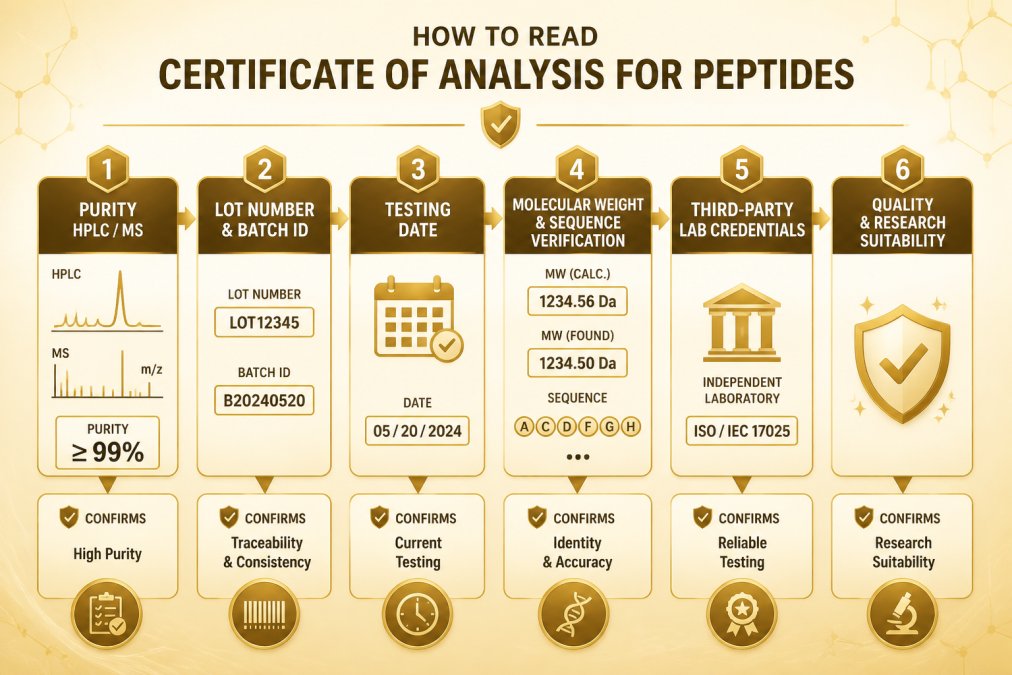
The COA contains several critical sections that directly impact whether the peptide is suitable for your research:
Purity percentage. Should be 99% or higher for research-grade materials. The measurement method (HPLC, mass spectrometry, or both) should be clearly stated.
Lot number and batch identifier. Ties the specific vial to testing data. Different lot numbers indicate different batches with specific test results.
Testing date. Confirms when analysis was performed. Testing should be recent, not months old.
Molecular weight and sequence. Mass spectrometry confirms the amino acid sequence is correct.
HPLC analysis results. A single dominant peak indicates a pure compound; multiple peaks suggest impurities.
Third-party lab name and credentials. The COA should clearly identify the independent laboratory. Reputable labs have ISO certifications or similar accreditation.
Verifying Batch Consistency and Lot Numbers
When reordering the same peptide, the lot number will be different. Verify that purity percentage and analytical results remain consistent across batches.
Compare COAs from different orders. If one batch shows 99.2% purity and another shows 97.8%, that’s a red flag. Reputable suppliers maintain batch-to-batch variation within 0.5% of target purity.
The lot number serves as a tracking mechanism for troubleshooting unexpected results.
Best Practices for Peptide Storage and Handling
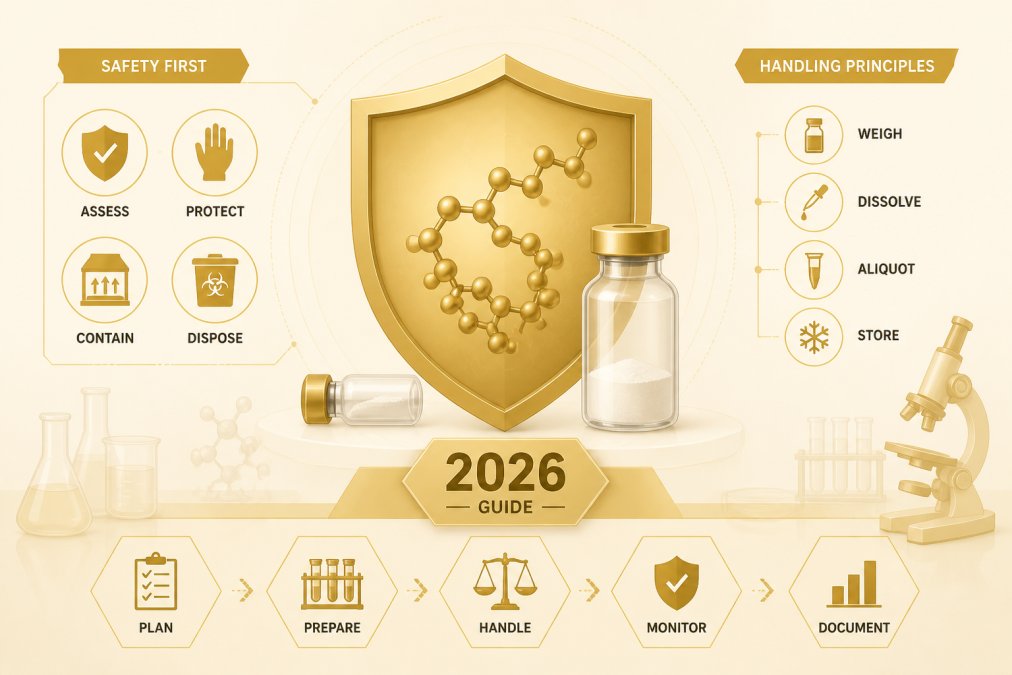
Storage directly impacts peptide stability and usability. Research-grade compounds are sensitive materials that degrade under certain conditions.
Store peptides in a cool, dry environment. Check the COA for specific storage recommendations.
Keep peptides in original containers with intact seals.
Avoid exposure to light, heat, and humidity. Store in a cabinet away from direct sunlight, not on benches or near windows.
Label vials with the date received and lot number for tracking storage duration and batch identification.
Purity vs. Potency: Understanding the Difference
Purity and potency are distinct concepts. Confusing them leads to dosing errors or experimental failures.
Purity measures the percentage of desired compound in the sample. A 99% pure peptide means 99% is the target peptide and 1% is other substances. Purity is measured through HPLC and mass spectrometry.
Potency refers to the biological activity or functional strength of the compound. A peptide can be 99% pure but have reduced potency if the amino acid chain has been slightly damaged or modified during synthesis, storage, or handling. Potency answers the question: “Does this peptide work as intended in my specific application?”
Why This Distinction Matters for Your Research
This scenario is why high-purity peptides alone don’t guarantee research success.
How Purity and Potency Are Measured Differently
Purity testing is standardized and routine. HPLC separates the peptide from impurities and measures the percentage of the main peak. Mass spectrometry confirms the molecular weight matches the expected sequence. These methods are fast, reproducible, and included with every research-grade peptide. The COA will always report purity.
Potency testing is application-specific and more complex. It depends on what you’re using the peptide for:
- Receptor binding assays measure how effectively the peptide binds to its target protein. This requires cell lines or purified receptors and is more expensive than purity testing.
- Cell proliferation assays measure whether the peptide triggers expected biological responses in cultured cells. This takes days or weeks and costs hundreds of dollars per test.
- Enzymatic activity assays confirm that enzyme-substrate peptides function correctly. These are highly specialized and vary by peptide type.
- Immunogenicity assays for vaccine or immunology research measure whether the peptide triggers expected immune responses.
When You Should Require Potency Testing
Potency testing becomes critical in these scenarios:
Clinical or therapeutic research. If your peptide will eventually be used in human studies or drug development, potency must be confirmed. Regulatory bodies like the FDA expect potency data alongside purity documentation.
Novel or modified sequences. If you’re using a peptide with non-standard amino acids, post-translational modifications, or a sequence not extensively published, potency testing validates that the modification works as intended.
Long-term storage studies. If you’re storing peptides for months or years and need to confirm they remain functional, potency testing at baseline and after storage provides that assurance.
High-stakes experiments. If your research depends on precise dose-response relationships or if negative results would be costly (failed grant applications, delayed publications), potency confirmation reduces risk.
Batch-to-batch consistency verification. If you’re reordering the same peptide over time and need to confirm that new batches perform identically to previous ones, potency testing across batches provides that proof.
For routine academic research using well-characterized peptides, purity testing alone is usually sufficient. The peptide has been used by hundreds of researchers, and its potency is well-established in literature. However, if your application is novel or your results depend critically on peptide function, discuss potency testing with your supplier before ordering.
Interpreting Potency Data on a COA
Transparency about the assay method helps you interpret the data correctly.
Practical Implications for Dosing
For PepAlphatides, purity testing is standard on all catalog peptides. Potency testing is available for custom synthesis orders and can be added to standard catalog orders upon request. Discuss your specific research needs with our technical team to determine whether potency confirmation is necessary for your application.
Custom Peptide Synthesis and Catalog Options
Catalog peptides are pre-synthesized compounds that are manufactured in bulk and tested regularly. These are faster to obtain, less expensive, and backed by extensive testing data. If a standard peptide meets your research needs, this is the most practical choice.
Custom synthesis is necessary when you need a specific peptide sequence not available in standard catalogs. Custom work takes longer (typically 4-8 weeks) and costs more because each synthesis is unique. However, it’s the only option for novel research requiring non-standard amino acid derivatives or specialized sequences.
PepAlphatides maintains an extensive catalog of research-grade peptides. For custom synthesis needs, our team can discuss your specifications and provide timelines and pricing.
What to Look for When Buying High Purity Peptides Online
Purchasing peptides online requires diligence because quality varies dramatically across suppliers. Several factors separate legitimate research compounds from substandard alternatives.
Transparency and Documentation
A reputable supplier makes it easy to verify product quality before you buy. Look for suppliers who provide:
- Full COAs available before purchase (not after)
- Clear descriptions of testing methods used
- Batch-specific documentation, not generic claims
- Easy access to analytical data through QR codes or secure portals
- Contact information for technical questions
If a supplier requires you to purchase before seeing documentation, that’s a warning sign. Legitimate vendors understand that researchers need proof of quality upfront.
Shipping and Fulfillment Logistics
Shipping conditions matter for peptide stability. Reputable suppliers use:
- Tracking systems so you know when material arrives
- Proper labeling indicating contents and handling requirements
Ask about typical shipping timelines before ordering.
Confirm that the supplier ships to your location and understands any regulatory requirements for your jurisdiction.
Research Member Benefits and Pricing
Many suppliers offer membership programs that provide discounts and additional benefits. PepAlphatides provides a 10% discount for research members, plus free shipping on orders over $250. These programs are designed to support ongoing research work without sacrificing quality.
When comparing suppliers, consider the total cost including shipping. Bulk discounts for larger orders also affect long-term research budgets.
Ask whether the supplier offers volume pricing for regular orders. If you’re conducting ongoing research that requires consistent material, establishing a relationship with a single supplier ensures batch consistency.
When you’re ready to purchase high purity peptides online, the decision comes down to three core questions: Can you verify the quality through independent testing? Is the documentation transparent and accessible? Does the supplier stand behind their material with clear guarantees?
At PepAlphatides, we’ve built our reputation on answering yes to all three. Every batch undergoes independent third-party testing, every COA is provided with secure QR-code access, and our research member program offers 10% discounts plus free shipping on orders over $250. If consistency and transparency matter to your research, explore our catalog and discover why researchers trust us for materials that deliver reliable results.
Frequently Asked Questions
How can I verify that high purity peptides are actually 99% pure before buying?
Legitimate suppliers provide an individual Certificate of Analysis (COA) for every batch, completed by an independent third-party laboratory. The COA includes HPLC analysis results, mass spectrometry data, and lot numbers. Request the full COA before purchase, reputable vendors display these transparently or make them accessible via secure QR codes on product vials. Third-party testing verification from accredited laboratories is the only reliable way to confirm purity claims.
What should I look for in a third-party peptide testing verification report?
A credible third-party testing report should include the lab’s accreditation status, specific analytical methods used (HPLC and mass spectrometry are standard), the exact purity percentage, and the peptide’s molecular weight. The report must show the lot number, testing date, and expiration date. Verify the testing laboratory is independent from the supplier and recognized in the research community. QR-coded reports that link to secure documentation add an extra layer of transparency.
Why do high purity peptides cost more than other suppliers?
Research-grade peptides with purity exceeding 99% require expensive analytical testing and rigorous quality assurance protocols. Independent third-party testing, individual COAs for every batch, and secure documentation systems increase production costs. Visit the supplier’s website for current pricing and volume-based options tailored to your budget.
How should I store high purity peptides after delivery to maintain quality?
Store lyophilized peptides in a cool, dry place away from direct sunlight. Check the storage conditions listed on the COA, as some peptide formulations have specific requirements.