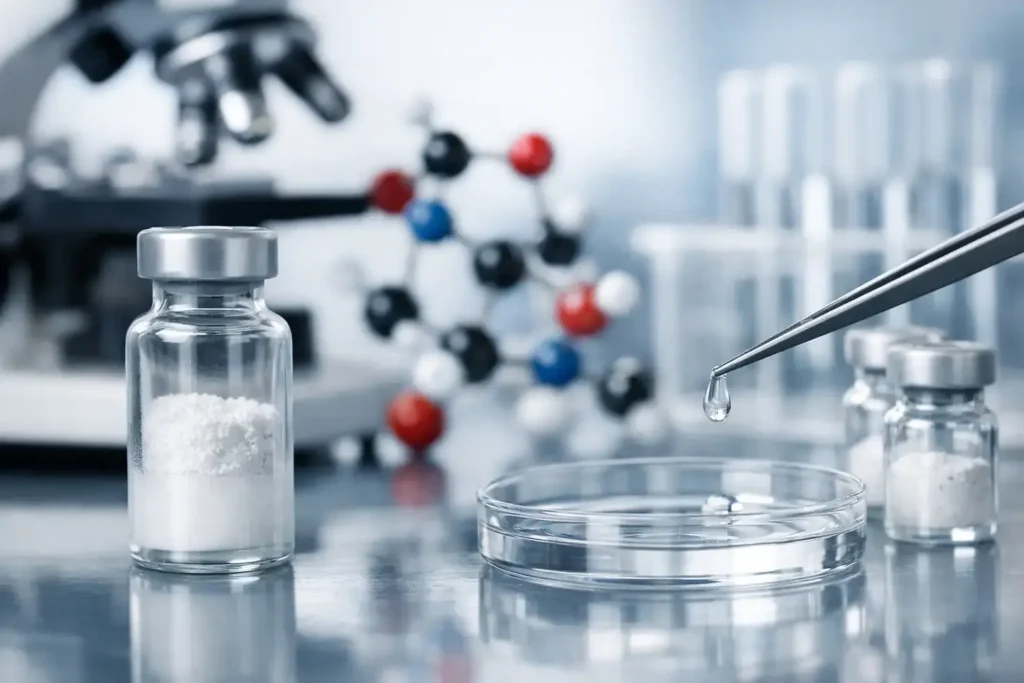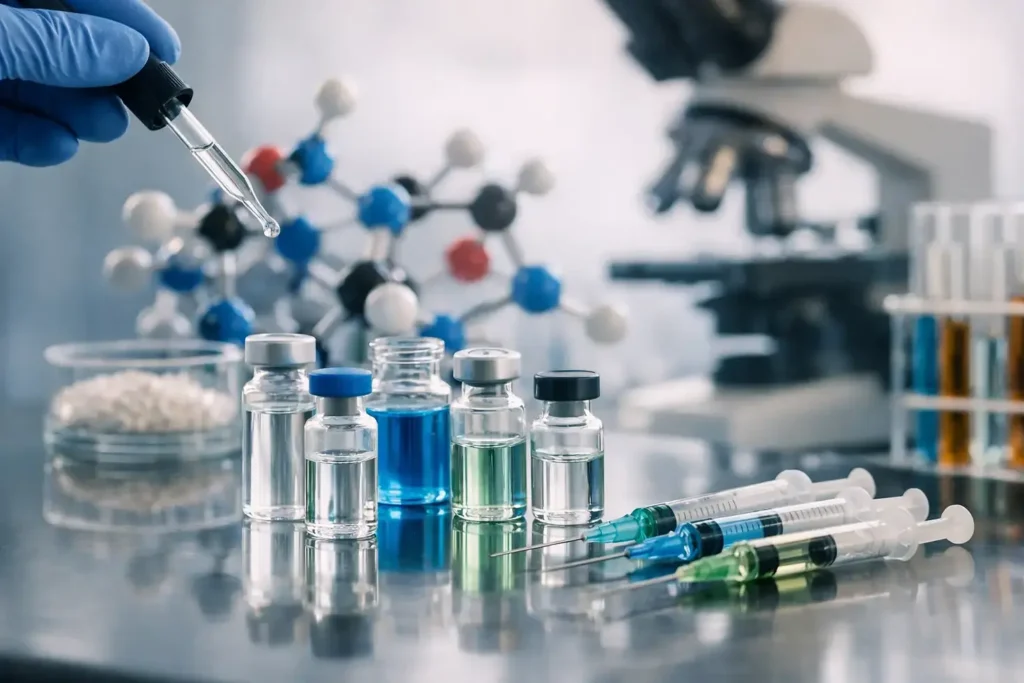
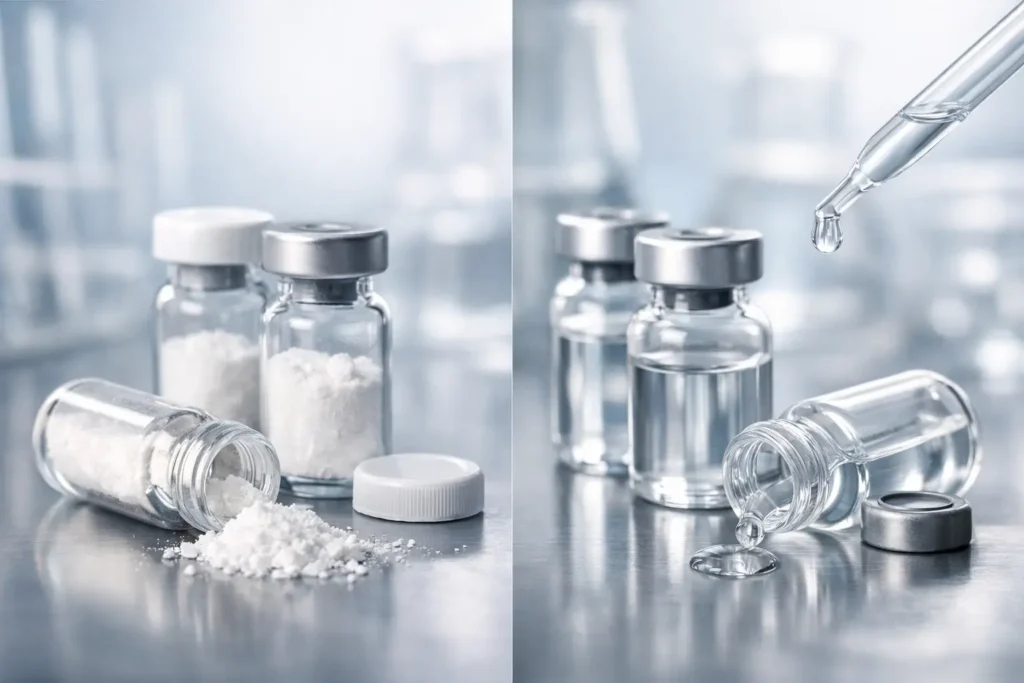
A vial that arrives as a dry cake and a vial that arrives as a prepared solution may represent the same named compound, but they do not carry the same practical considerations. When evaluating lyophilized versus liquid research compounds, the meaningful question is not which format is universally better. It is which format preserves material integrity and supports the workflow, storage controls, and documentation standards of a particular in-vitro laboratory or educational setting.
For qualified researchers, format is part of method design. It affects shipping risk, inventory planning, preparation steps, stability considerations, and the amount of confidence that can reasonably be placed in a material over time. The compound name and stated mass matter, but so do the conditions under which the material was formulated, transported, received, and handled.
Why compound format deserves careful review
Lyophilization removes water from a compound solution under controlled freezing and vacuum conditions, leaving a dry powder or porous cake. For many peptide materials and other moisture-sensitive research compounds, this format can reduce hydrolytic degradation during storage and transit. It also gives the laboratory control over when a solution is prepared and how it is incorporated into a validated research workflow.
A liquid research compound is supplied as a solution, usually in a selected solvent or buffer system. This can reduce preparation time and limit one handling step at the bench. However, the convenience of a ready-to-use solution comes with additional variables: solvent compatibility, concentration, temperature exposure, container interactions, and stability after the vial has been opened.
Neither format eliminates the need for good laboratory practice. A dry powder can lose quality through poor storage or repeated exposure to moisture. A liquid can be appropriate and reliable when it is supplied with clear concentration, solvent, storage, and lot-specific documentation. The format should be evaluated alongside the supplier’s quality system, not in isolation.
Lyophilized versus liquid research compounds: key differences
Stability and environmental exposure
Lyophilized materials are often selected because removing water can limit degradation pathways that depend on moisture. This is especially relevant for research peptides, where chemical and physical stability can be influenced by humidity, oxidation, pH, temperature, and repeated changes in environmental conditions.
The word “lyophilized” should not be treated as a blanket promise of indefinite stability. Residual moisture, formulation composition, packaging quality, stopper integrity, and storage temperature all affect the final result. A researcher should follow the product-specific handling and storage information rather than applying a single rule to every peptide or cofactor.
Liquid materials may be more vulnerable to degradation during extended storage because the compound is already in solution. Yet a properly formulated liquid can be the better operational choice for a time-sensitive workflow, a standardized teaching demonstration, or an assay that requires a defined solution composition from the outset. The relevant question is whether the available stability information supports the intended use period and conditions.
Shipping and receiving considerations
Dry, lyophilized formats are generally less dependent on the same degree of transit control as a solution, although shipping requirements always depend on the specific material. Their lower moisture content may make them better suited to inventory that cannot be used immediately after delivery.
Liquid compounds require closer attention at receiving. Inspect the shipment promptly, confirm that the vial remains intact, review any temperature-control materials where applicable, and compare the product label and lot identifier against the purchase documentation. A visible change in color, clarity, particulate appearance, or container condition should be documented and evaluated under the laboratory’s established procedures.
Receiving records matter for both formats. Record the date received, lot number, stated quantity or concentration, storage location, and any observed package condition before adding a compound to research inventory.
Preparation and concentration control
The main practical advantage of a liquid material is speed. If its concentration and solvent are compatible with the experimental design, researchers can avoid a reconstitution step and move directly into controlled dilution or assay preparation.
Lyophilized materials require careful reconstitution before use. That step creates flexibility, but it also introduces opportunities for error. The selected solvent, target concentration, mixing technique, container compatibility, and labeling process should align with the laboratory’s method and the compound-specific guidance. Researchers should not assume that a solvent appropriate for one peptide or cofactor is appropriate for another.
For applications that depend on tight concentration control, the dry format can be useful because the laboratory prepares a working solution to its own documented requirements. In contrast, a liquid may be preferable when consistency is better served by a supplier-provided concentration that has already been defined for a repeatable workflow.
Storage after opening
Once a lyophilized compound is reconstituted, it should be treated as a solution, with the associated attention to time, temperature, light exposure, and contamination control. Repeated opening and closing, avoidable warm-up cycles, and unclear labeling can undermine the advantages of starting with a dry material.
For either format, aliquoting may be appropriate when a validated laboratory procedure calls for it. The purpose is to limit repeated exposure of the primary container and keep sample history clear. Each aliquot should remain traceable to the original lot and be labeled with the compound identity, concentration when applicable, preparation date, storage conditions, and responsible researcher.
Documentation is as important as the vial
Format cannot compensate for incomplete quality information. Whether a compound is supplied as a lyophilized powder or liquid solution, qualified buyers should be able to review documentation that connects the vial in hand to a defined batch.
A Certificate of Analysis should identify the relevant lot and provide meaningful information about identity, purity or assay results where applicable, and the analytical basis for the stated claim. For research materials, transparent documentation helps laboratories assess whether a material is suitable for non-therapeutic in-vitro or educational work and supports internal inventory records.
Purity claims require context. A stated percentage is more useful when it is linked to a batch-specific COA and appropriate analytical reporting than when it appears only as general marketing language. At PepAlphatides, independently verified greater than 99% purity and accessible lot-level COAs are intended to give researchers a clearer basis for reviewing materials before they enter a study.
Researchers should also confirm the labeled amount for lyophilized products or the stated concentration and volume for liquid products. These details are not interchangeable. A milligram quantity describes mass, while a concentration describes mass per volume. Sound experimental planning requires knowing which one is being provided and what preparation steps remain under laboratory control.
Choosing the right format for the research plan
A lyophilized format is often a strong fit when long-term inventory flexibility, shipping resilience, and researcher-controlled solution preparation are priorities. It can be particularly useful for laboratories working with defined milligram quantities of peptide materials that will be prepared only as needed.
A liquid format may be more appropriate when the research method benefits from immediate use, a fixed concentration, or reduced preparation time. It may also support educational environments where controlled, pre-defined solutions simplify a demonstration, provided storage requirements and documentation are clear.
Before purchasing, match the format to the full workflow: expected delivery timing, storage capacity, solvent requirements, assay design, planned use window, and the laboratory’s traceability procedures. A lower price or faster preparation step has limited value if the material does not fit those conditions.
Responsible handling remains non-negotiable
Research compounds should be handled only by qualified personnel using appropriate laboratory practices and the product-specific information provided. They are not intended for human or animal consumption, diagnosis, treatment, cure, or disease prevention. A clear research-use-only boundary protects both the integrity of the work and the people involved.
The most useful format is the one that gives the research team a defensible chain from verified batch to documented preparation to controlled experimental use. Start with the format, but make the final decision based on the quality evidence and handling discipline that surround it.