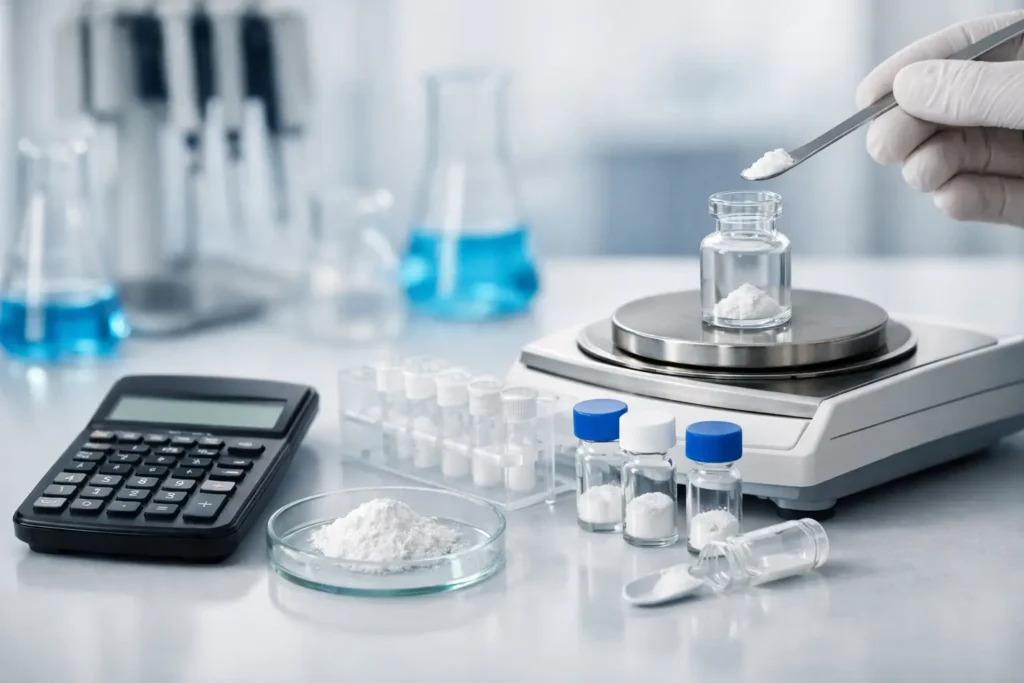
A peptide vial labeled 5 mg answers only one part of a research-planning question. Before preparing an in-vitro working solution, a researcher still needs to connect that labeled mass to the peptide’s molecular weight, the desired molar concentration, and the final assay volume. A peptide mass quantity calculator makes those relationships visible, helping turn a label quantity into a traceable experimental input.
For qualified research professionals, this is not merely a convenience calculation. It is part of sound experimental documentation. A small unit error can create a 10-fold or 1,000-fold difference in concentration, complicating comparisons between plates, studies, batches, or laboratories.
What a Peptide Mass Quantity Calculator Solves
A peptide mass quantity calculator converts between four variables: molecular weight, mass, concentration, and volume. When three are known, the fourth can generally be calculated. The most common use case is determining how much lyophilized peptide is needed to prepare a solution at a specified molar concentration.
The relationship is straightforward:
Mass (g) = Concentration (mol/L) × Volume (L) × Molecular Weight (g/mol)
The same relationship can be rearranged to calculate concentration:
Concentration (mol/L) = Mass (g) ÷ [Volume (L) × Molecular Weight (g/mol)]
For practical peptide work, the calculator should accept familiar laboratory units such as milligrams, micrograms, milliliters, microliters, millimolar, micromolar, and nanomolar. The calculation itself remains the same. Accuracy depends on converting each input into consistent base units before solving the equation.
A useful calculator also clarifies whether the user is working from an available mass or planning a required mass. These are different questions. One asks, “What concentration can this vial support at this volume?” The other asks, “How much material is required for this study design?”
Start With the Correct Molecular Weight
Molecular weight is the foundation of every mass-to-molarity calculation. It should be taken from the product-specific documentation, such as the Certificate of Analysis, product specification, or lot record. Do not assume that two similarly named materials necessarily have the same molecular weight.
Peptide identity can change through amidation, acetylation, salt form, counterions, conjugation, oxidation state, or other structural modifications. A calculator can only be as accurate as the molecular weight entered into it. For this reason, the value in a batch-specific COA should take precedence over an informal reference table when available.
This also matters when comparing materials from different suppliers or lots. A stated mass may look equivalent on paper, yet a different molecular form can alter the molar amount. Transparent lot-level documentation allows the calculation to be tied to the actual material being evaluated.
Average Mass Versus Monoisotopic Mass
Some technical documents report average molecular weight, while analytical contexts may refer to monoisotopic mass. For routine bulk solution planning, average molecular weight is commonly the relevant input because the weighed material represents a distribution of naturally occurring isotopes. For mass spectrometry interpretation, monoisotopic mass may be the appropriate reference.
The key is consistency. Use the molecular-weight convention that aligns with the intended calculation and document that choice in the experiment record.
A Practical Calculation Example
Consider a peptide with a documented molecular weight of 1,420 g/mol. A researcher needs 2 mL of a 100 µM solution for an in-vitro assay.
First, convert the inputs to base units. A 100 µM concentration equals 100 × 10⁻⁶ mol/L, or 0.0001 mol/L. Two milliliters equals 0.002 L.
Using the equation:
Mass = 0.0001 mol/L × 0.002 L × 1,420 g/mol
The result is 0.000284 g, or 0.284 mg. That is the theoretical peptide mass required to prepare 2 mL at 100 µM, assuming the molecular weight and material basis are correct.
The value should then be assessed against the available vial quantity and the practical limits of weighing. At sub-milligram levels, direct weighing may introduce avoidable error depending on the balance and laboratory procedure. In many workflows, preparing a documented stock solution from an appropriate quantity of lyophilized powder and then performing controlled dilutions is more reproducible.
From Vial Quantity to Usable Research Capacity
A calculator is equally useful in the opposite direction. If a vial contains 5 mg of the same 1,420 g/mol peptide, the total amount is approximately 3.52 µmol:
5 mg ÷ 1,420 g/mol = 0.00352 mmol = 3.52 µmol
That amount could theoretically produce about 35.2 mL of a 100 µM solution. This is a planning estimate, not a guarantee of usable experimental volume. Practical recovery can be affected by transfer loss, adsorption to surfaces, aliquoting strategy, stability, and the amount reserved for analytical confirmation or controls.
The distinction is especially relevant when planning multi-plate studies. A nominal vial quantity may appear sufficient for the assay wells alone, but preparation losses and replicate requirements can change the real material need. Build an operational margin into the plan rather than treating the theoretical calculation as the entire procurement calculation.
Unit Conversions That Prevent Major Errors
Most calculation failures are not advanced chemistry problems. They are unit problems. A peptide mass quantity calculator should make the following relationships easy to verify:
- 1 g = 1,000 mg = 1,000,000 µg
- 1 L = 1,000 mL = 1,000,000 µL
- 1 mM = 1,000 µM
- 1 µM = 1,000 nM
The prefixes carry the largest risk. A micromolar solution is 1,000 times more concentrated than a nanomolar solution, while a millimolar solution is 1,000 times more concentrated than a micromolar solution. Entering 10 mM when the intended value was 10 µM does not create a minor deviation. It changes the intended concentration by three orders of magnitude.
Use the calculator as a checkpoint, but retain the units in the written calculation. Recording only a final number without its unit makes later review much harder.
Purity, Salt Form, and What the Number Means
The theoretical calculation assumes that the stated mass corresponds entirely to the target peptide. In actual research materials, purity and composition determine how closely the weighed mass reflects the target analyte amount.
If a material is reported at 99% purity, the theoretical peptide content of 1.00 mg is approximately 0.99 mg before considering other material-specific factors. Whether to apply a purity correction depends on the purpose of the work, the analytical requirements, the assay sensitivity, and the laboratory’s established procedure. For comparative screening, researchers may use the labeled mass consistently across conditions. For work requiring tightly defined analyte quantities, a documented correction may be warranted.
Salt and counterion information require similar care. The molecular weight used in the calculator must correspond to the form represented by the supplied material. This is why accessible Certificates of Analysis are not a marketing extra. They support defensible calculations, traceability, and appropriate interpretation of results.
Build the Calculation Into the Research Record
A well-used calculator produces more than a single result. It creates a chain of inputs that another qualified researcher can review. Record the peptide name, lot number, molecular weight source, labeled vial quantity, purity information, solvent or vehicle, stock concentration, dilution path, final concentration, final volume, and calculation date.
For solution preparation, it is also useful to record the actual mass used rather than only the planned mass. If the protocol involves a stock solution, document its nominal concentration and any subsequent dilution factors. This makes it easier to investigate unexpected assay behavior without guessing whether the issue began at the preparation stage.
At PepAlphatides, material documentation and educational resources are intended to support this type of evidence-oriented laboratory workflow. Research-use-only materials should be handled only by qualified professionals and used exclusively for legitimate in-vitro laboratory and educational applications, never for human or animal consumption, diagnosis, treatment, cure, or disease prevention.
When a Calculator Is Not Enough
A correct arithmetic result does not validate an entire preparation method. Solubility, solvent compatibility, peptide aggregation, adsorption, freeze-thaw exposure, storage conditions, and analytical verification can all affect the behavior of a prepared solution. The appropriate approach depends on the specific peptide, assay system, concentration range, and laboratory protocol.
For example, a calculator may show that a very concentrated stock is mathematically possible, while the material may not remain adequately soluble or stable under the selected conditions. Conversely, an extremely dilute stock may be difficult to prepare accurately because pipetting variability becomes a larger proportion of the total volume. The useful target is not simply a number that works on paper. It is a preparation plan that fits the material and can be reproduced.
Before beginning an experiment, use the peptide mass quantity calculator to verify the required mass, then compare that result with the documented molecular weight, purity data, vial quantity, and practical preparation limits. That extra minute of review helps keep every downstream result anchored to a quantity that can be explained, repeated, and trusted.