
Table of Contents
- Why Peptide Purity Verification Matters for Research
- Step 1: Read the Peptide Certificate of Analysis Interpretation
- Step 2: Understand HPLC vs Mass Spectrometry for Peptides
- Step 3: Evaluate Third-Party Peptide Testing Services
- Step 4: Assess Batch-to-Batch Consistency and Traceability
- How to Verify Peptide Purity Levels Without a Lab
- Common Mistakes and Bad Advice to Avoid
- Frequently Asked Questions
Last Updated: September 19, 2026
Why Peptide Purity Verification Matters for Research
Learning how to verify peptide purity levels protects your research from bad data and bad actors. A vial labeled “99% pure” means nothing without proof; independent testing is the only way to confirm what’s inside.
Step 1: Read the Peptide Certificate of Analysis Interpretation
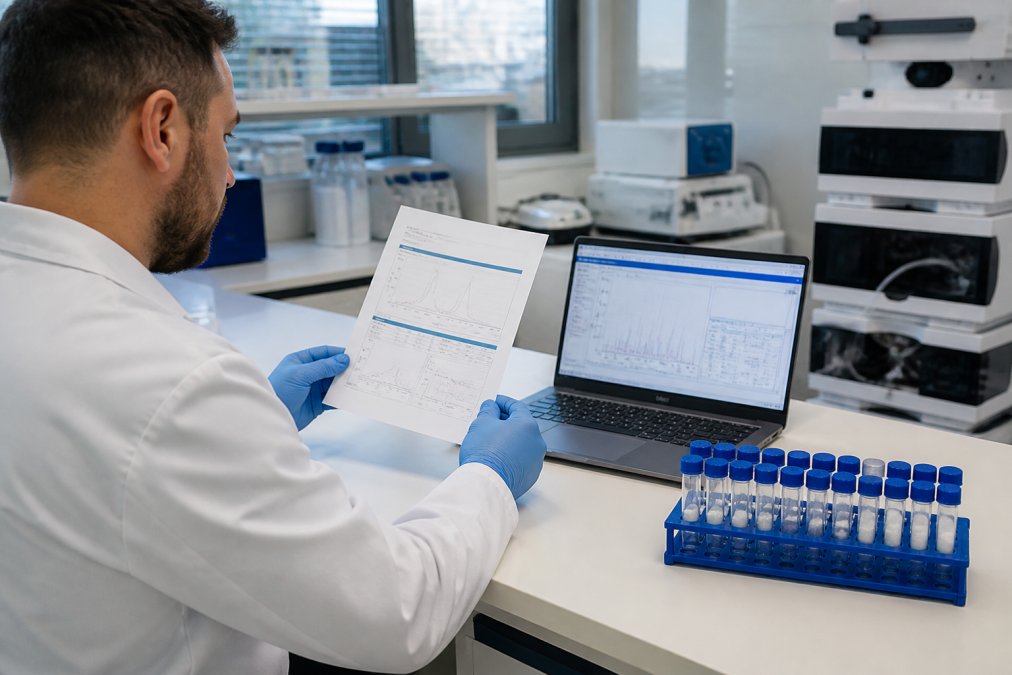
A Certificate of Analysis (COA) is a lab report documenting a batch’s identity, purity, and test methods. Peptide certificate of analysis interpretation is the fastest way to separate real suppliers from pretenders.
What a Legitimate COA Must Include
A real COA gives enough detail to trust the label. Look for:
- Batch or lot number that matches the vial you received
- Peptide sequence and molecular weight
- Purity percentage from a named method (usually HPLC)
- Test method details, including the instrument used
- Date of analysis and lab name
- Analyst signature or verifiable report ID
Red Flags in a False COA
Fake reports follow easy-to-catch patterns.
- Identical purity numbers across every product (real batches vary)
- No chromatogram image, or a blurry one with no axis labels
- A lab name that doesn’t exist or can’t be found online
- Missing retention time or column details
- Copy-pasted formatting errors between different products
A COA without a batch number cannot be traced to your vial. If a supplier reuses one report for an entire product line, you have no way to confirm that your specific batch was ever tested.
Step 2: Understand HPLC vs Mass Spectrometry for Peptides
HPLC and mass spectrometry answer two different questions: HPLC tells you how pure a sample is, while mass spectrometry confirms it’s the right molecule. Comparing HPLC vs mass spectrometry for peptides shows why you need both.
What HPLC Reveals About Peptide Purity
HPLC separates your peptide from everything else in the vial, producing a chromatogram of peaks.
What Mass Spectrometry Confirms About Identity
HPLC can’t tell you if the main peak is actually your peptide. That’s where LC-MS comes in.
Ask for both HPLC and LC-MS data. A purity number alone proves nothing about identity. A supplier that only offers one test is hiding half the picture.
Step 3: Evaluate Third-Party Peptide Testing Services
Third-party peptide testing services give you an independent check on a supplier’s claims. A lab paid directly by the seller has an incentive to keep the seller happy, and a supplier that controls the lab controls the narrative.
What “Accredited” Actually Means
In the United States, laboratory accreditation is a voluntary credential issued by private nonprofit bodies, not a government license. The two cited most often on peptide COAs are:
- ISO/IEC 17025, the international standard for testing and calibration labs. It covers technical competence, method validation, and traceability of measurements. An ISO 17025 certificate is issued by an accreditation body, not by the lab itself.
- cGMP (current Good Manufacturing Practice), a manufacturing quality framework, not a testing credential. A supplier claiming “cGMP-tested” is conflating two different things. Testing labs are not cGMP-certified; manufacturers are.
How to Verify a Lab Exists
Fabricated labs are common; a few minutes of checking catches most of them:
- Search the lab name plus “ISO 17025” and see whether the accreditation body’s public directory returns a match.
- Look up the lab’s address on a mapping service. A residential address or a mailbox store is a red flag.
- Check whether the lab has a real website with a method list, instrument list, and named technical staff, not just a contact form.
- Call the phone number. Fabricated labs often route to the supplier’s own line.
A COA is only as trustworthy as the lab that issued it. If you cannot independently confirm the lab exists, the report is decoration. This is the single most common failure point in the peptide supply chain.
What to Ask the Lab Directly
If a supplier names a real lab, contact it and ask:
- Do you have a record of testing this batch number?
- What instrument model produced the chromatogram?
- Can you confirm the report ID on this COA?
Instrumentation and Method Disclosure
A real analytical report shows its work. Look for:
- HPLC column chemistry (typically C18 reverse-phase for peptides) and dimensions
- Mobile phase composition and gradient program
- Detection wavelength (214 nm is standard for the peptide bond; 220 nm and 280 nm appear for aromatic residues)
- LC-MS ionization mode (electrospray ionization, or ESI, is standard for peptides) and the observed mass-to-charge values
If the COA shows a purity number but no column, wavelength, or gradient, the number wasn’t produced by a method you can audit, the difference between a lab report and a marketing sheet.
Chain of Custody and Sample Handling
Independence is only meaningful if the sample the lab tested is the sample you received. Ask how it traveled from the supplier to the lab:
- Was it shipped sealed with a tamper-evident label?
- Does the COA reference a sample receipt date separate from the analysis date?
- Is there a documented handoff between the supplier and the lab?
The Practical Move
For researchers, the practical move is to buy from suppliers who use independent labs and publish the results, then verify the lab independently. PepAlphatides structures its testing this way: every batch is verified by an outside lab, and each vial carries a QR code linking to its full report.
Step 4: Assess Batch-to-Batch Consistency and Traceability
Batch-to-batch consistency is the difference between a one-time good result and a reliable research material, and traceability is how you prove it. This isn’t a paperwork exercise, it’s a chemistry problem, and understanding the chemistry tells you what to look for.
Why Batches Drift
Solid-phase peptide synthesis, used for nearly all research peptides, is a stepwise process: each amino acid is added in a separate reaction cycle, and each cycle has a yield. A 30-residue peptide with 99% coupling efficiency per step yields roughly 74% full-length product before purification. Small changes in any step shift the impurity profile:
- Coupling efficiency varies with reagent quality, temperature, and reaction time. A new lot of activator or resin can shift deletion-sequence impurities.
- Deprotection completeness affects whether the next amino acid can attach. Incomplete deprotection creates truncated sequences.
- Purification gradient on the preparative HPLC column determines how tightly the target peak is cut. A wider cut raises yield and lowers purity.
- Lyophilization and packaging affect moisture content and, over time, degradation products.
What Normal Variance Looks Like
A supplier with tight process control shows purity values clustering within a narrow band across batches, often within a percentage point or two for the same peptide. Loose control shows wider swings. If every batch reports identical purity to two decimal places, that’s not tight control; that’s a copied number. Real analytical data has variance.
Watch for these patterns across a supplier’s published COAs:
- Identical purity across chemically different peptides. Different sequences have different synthesis difficulty. A 10-mer and a 40-mer should not both report 99.8%.
- Missing batches. If a supplier publishes COAs for batches 001, 002, and 005, ask where 003 and 004 went.
- Date clustering. Multiple batches analyzed on the same day by the same lab may indicate one submission was split across labels.
- Retention time drift with no method change. Retention time should be stable for a given method. If it moves, either the method changed or the data came from somewhere else.
Pull the last six to twelve COAs from a supplier’s product page and compare them side by side. The pattern across batches tells you more about quality control than any single report.
Traceability: From Vial to Report
Traceability means your vial’s batch number matches a specific, dated lab report tied back to a specific synthesis run. The chain has four links:
- Vial label, batch or lot number printed on the vial itself, not just the outer box.
- COA, the same batch number appears on the report, with an analysis date.
- Lab record, the issuing lab can confirm the report ID if contacted.
- Synthesis record, the supplier can state when the batch was made and from which raw material lots.
QR Codes and What They Actually Prove
A QR code on a vial is only useful if it resolves to a batch-specific report you can verify. One that opens a generic product page or a PDF with no batch number proves nothing. Test it: scan the code, confirm the PDF’s batch number matches your vial, and confirm the named lab is one you can independently find.
The Consistency Test You Can Run
You don’t need a lab to assess consistency. You need the supplier’s published record:
- Request COAs for the last several batches of the peptide you’re buying.
- Compare purity values, retention times, and analysis dates.
- Confirm each report has a distinct batch number and a distinct lab report ID.
- Contact the lab on one report and ask them to confirm it.
Consistency and traceability are the two hardest things to fake. A supplier that publishes per-batch data, with distinct batch numbers, distinct report IDs, and a contactable lab, is almost always the safer choice. A supplier that publishes one polished COA for an entire product line is not.
How to Verify Peptide Purity Levels Without a Lab
You can’t run HPLC at home, but you can verify a supplier’s claims using their documentation. Here’s a practical checklist.
- Match the batch number on your vial to the COA.
- Confirm the COA shows both HPLC purity and LC-MS identity data.
- Scan the QR code or verify the report ID with the lab.
- Check that retention time and molecular weight match the expected values.
- Compare purity numbers across recent batches for consistency.
- Look for a lab name you can independently confirm exists.
A quick comparison of what each document proves:
| Document | What It Confirms | What It Can’t Prove |
|---|---|---|
| HPLC chromatogram | Purity percentage | Correct identity |
| LC-MS report | Molecular weight and identity | Full purity profile |
| COA summary | Batch traceability | Raw data accuracy |
| QR-coded report | Batch-specific verification | Lab independence |
Common Mistakes and Bad Advice to Avoid
The biggest mistake is trusting a purity percentage without the data behind it. A number on a label is a claim, not proof.
Other common errors researchers make:
- Accepting a COA with no batch number
- Skipping identity verification and checking purity alone
- Assuming a “research grade” label means tested
- Buying from the cheapest source without checking testing practices
- Ignoring batch-to-batch variation over time
Frequently Asked Questions
How do I know if my peptides are pure?
Check the Certificate of Analysis from an independent lab. A legitimate COA should show purity above 99% via HPLC, confirm molecular weight with mass spectrometry, and include a batch number matching your vial. Look for the chromatogram and the specific retention time. If the COA lacks raw data or comes from an in-house lab, treat the purity claim as unverified. PepAlphatides provides QR-coded COAs for every batch so you can trace results before purchasing.
Is there a way to test peptide purity at home?
No reliable home test exists for peptide purity levels. DIY methods like visual inspection or solubility checks cannot detect synthesis by-products, degradation products, or incorrect peptide sequences. Professional analytical testing with HPLC and LC-MS is required to get accurate purity percentages. Attempting to assess purity without instrumentation gives false confidence and risks using contaminated material in your research.
What is the difference between HPLC and mass spectrometry in peptide testing?
HPLC separates compounds in a sample and measures absorbance at 214 nm to calculate purity percentage. Mass spectrometry (LC-MS) identifies the molecular weight of the peptide to confirm its identity. HPLC tells you how much of the sample is your target peptide; mass spectrometry tells you whether that peptide is actually the correct sequence. Both are needed for a complete purity verification.
Why is third-party testing important for research peptides?
Third-party peptide testing services provide an unbiased verification of purity and identity. When a supplier tests its own products, there is no independent check on the results. An outside lab has no incentive to inflate purity numbers, so its COA carries more weight. For researchers, this transparency is essential for reproducibility, batch-to-batch consistency, and safety. Always confirm the testing lab is accredited and not affiliated with the supplier.