Table of Contents
- What Is a Certificate of Analysis
- Key Components of a Peptide Certificate of Analysis
- Understanding HPLC Purity Results
- HPLC vs Mass Spectrometry for Peptides
- Peptide Purity Standards and What They Mean
- Verifying Batch Numbers and Traceability
- Red Flags: Identifying Incomplete or Fraudulent COAs
- Third-Party Lab Verification and Sample Integrity
- Common Abbreviations and Technical Terms Explained
- Step-by-Step: Reading Your Peptide COA
- Frequently Asked Questions
Last Updated: October 2, 2026
What Is a Certificate of Analysis
A certificate of analysis is an official document that reports the test results for a research peptide batch. It verifies what’s actually in the vial, purity level, molecular weight, identity, and more. Think of it as a report card for your compound.
Every reputable peptide supplier should provide one with each order. At PepAlphatides, we include a secure QR-coded COA with every batch so you can verify exactly what you’re working with.
The certificate tells you whether the peptide meets quality standards and whether it’s safe to use in your experiments. It’s your proof that the compound is what the label says it is.
Key Components of a Peptide Certificate of Analysis
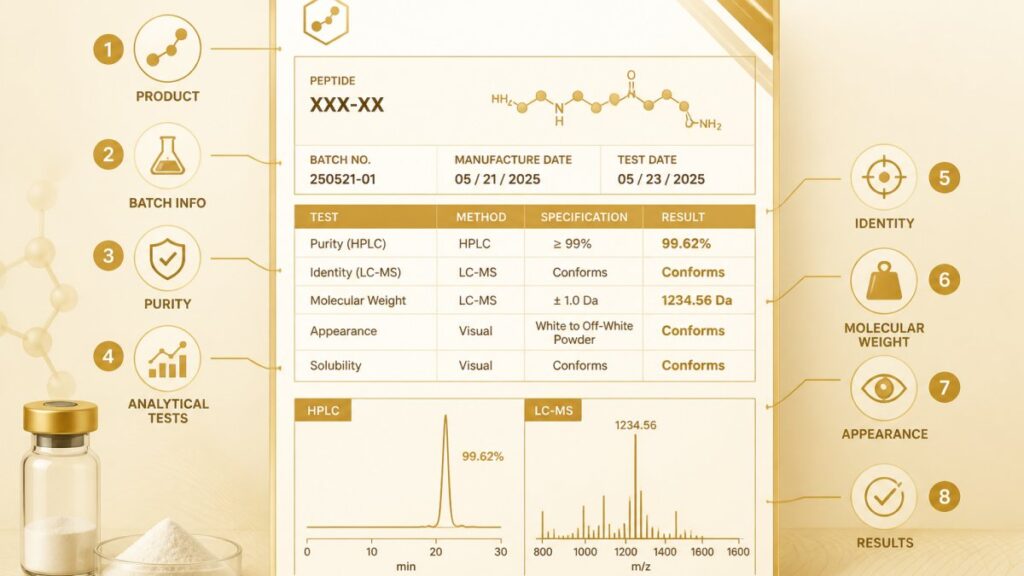
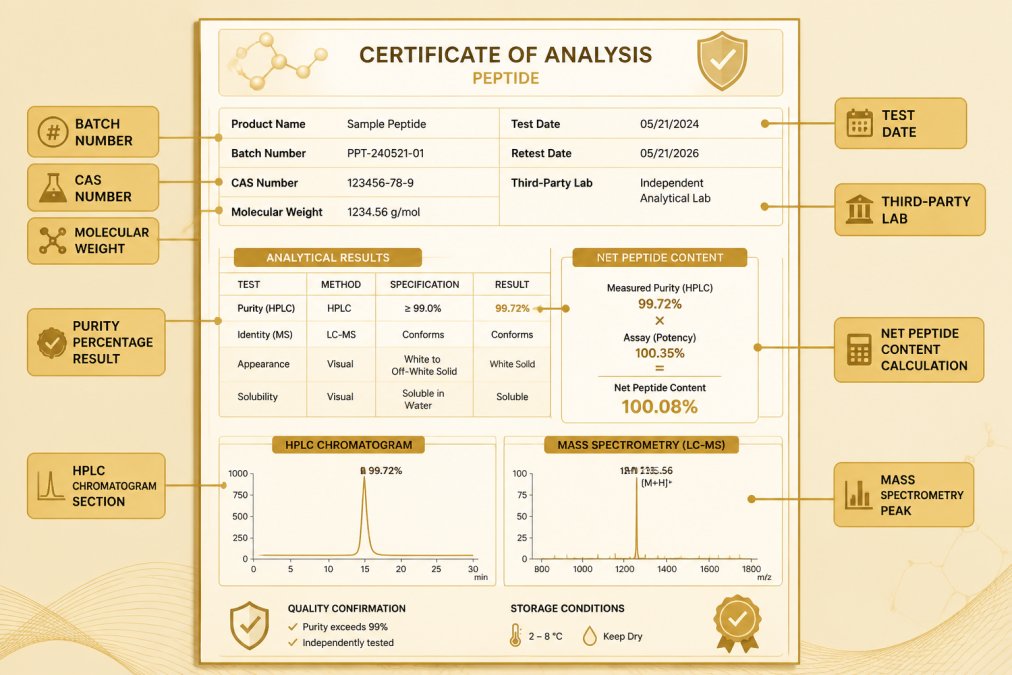
A peptide COA contains several critical sections. Understanding each one helps you spot quality issues immediately.
Batch and Lot Numbers
Every batch gets a unique identifier. The batch number or lot number tracks that specific production run. This number matters because it ties your vial to the exact testing data on the certificate.
Write down the batch number before you use the peptide. If something goes wrong during your research, you can trace it back to that specific batch. Manufacturers use batch numbers for quality control and traceability. If a batch fails testing, they can identify all affected customers.
The batch number should appear in at least two places on the COA: at the top and in the test results section. Mismatches between these are a red flag.
Molecular Weight and CAS Number
The molecular weight tells you the mass of a single peptide molecule. This number is critical for calculating dosages and understanding how your peptide behaves in experiments.
The CAS number is a unique identifier assigned by the Chemical Abstracts Service. It’s like a fingerprint for that specific compound. A legitimate COA always lists the CAS number. If it’s missing, question the document’s authenticity.
Both values should match published chemical databases. You can verify them independently online. This cross-check is one of the easiest ways to spot a fake COA.
Purity Percentage and Net Peptide Content
Purity percentage tells you what fraction of your sample is actually the peptide you ordered. The rest is water, salts, or other byproducts from synthesis.
A purity of 99% means 99% of the sample is your target peptide. That’s excellent. Anything below 95% raises concerns. Most research-grade peptides should exceed 95% purity.
Net peptide content is different. It accounts for the weight of counterions (like acetate or chloride) attached to the peptide. A peptide with 98% purity and acetate counterions might have only 85% net peptide content by weight. This matters if you’re measuring by weight rather than by molecule count.
Always check both numbers. They tell different stories about what you’re actually getting.
Understanding HPLC Purity Results
HPLC stands for high-performance liquid chromatography. It’s the gold standard for measuring peptide purity. The test separates your sample into individual compounds and measures how much of each one is present.
The HPLC result appears as a chromatogram, a graph showing peaks. Each peak represents a different compound in your sample. The largest peak should be your target peptide. Smaller peaks are impurities.
Look for one dominant peak. Multiple large peaks suggest contamination or a degraded sample. The report should list the retention time for your peptide, the point in the test where it appears. This helps confirm identity.
HPLC gives you a purity percentage based on peak area. If the main peak covers 99% of the total area, your purity is 99%. This is the most reliable purity measurement available.
HPLC vs Mass Spectrometry for Peptides
Both tests verify peptide quality, but they answer different questions.
HPLC measures purity by separating compounds physically. It tells you the percentage of your target peptide versus impurities. This is your primary purity check.
Mass spectrometry identifies compounds by their molecular weight. It confirms that the peak in your HPLC run is actually your peptide, not something else that happens to elute at the same time. Mass spec provides sequence verification for peptide identity.
A complete COA uses both tests. HPLC gives you purity. Mass spectrometry confirms identity. Together, they prove you have what you ordered and it’s pure.
Peptide Purity Standards and What They Mean
Research-grade peptides typically meet these standards:
- 95-98% purity: Acceptable for many applications. Some impurities are present but won’t significantly affect most experiments.
- 98-99% purity: High quality. Suitable for sensitive research where trace impurities could interfere.
- 99%+ purity: Pharmaceutical grade. Used when purity is critical to results.
Your choice depends on your research needs. A simple binding assay might tolerate 95% purity. A detailed kinetics study needs 99%+.
Check what your protocol requires before ordering. PepAlphatides supplies peptides exceeding 99% purity as standard.
Anything below 90% purity is suspect. Question whether the supplier tested it properly or whether degradation occurred during storage.
Verifying Batch Numbers and Traceability
The batch number is your anchor point for verification. Use it to confirm three things:
- The number appears consistently across the COA (header, results section, test dates)
- It matches the label on your vial exactly, including hyphens and letters
- The lab name and date align, the batch number should correspond to a specific test date and lab facility
Traceability means you can follow the peptide from manufacture to delivery. A complete COA shows the synthesis date, testing date, and lab name. Gaps in this timeline suggest missing steps or falsified records.
PepAlphatides uses QR codes on vials that link directly to the full analytical report. Scan the code and verify the batch number matches. This prevents substitution or tampering.
Red Flags: Identifying Incomplete or Fraudulent COAs
Watch for these warning signs:
- Missing HPLC chromatogram or mass spec data. A legitimate COA always includes the actual test graphs, not just summary numbers.
- Vague purity claims like “high purity” without a percentage. Real results are specific.
- No batch or lot number. Every batch must be traceable.
- Inconsistent numbers across the document. If purity is listed as 98% in one place and 99% elsewhere, something’s wrong.
- No third-party lab name. The testing should be done by an independent lab, not the supplier itself.
- Outdated test dates. If a COA is months old and the peptide was just shipped, the sample may have degraded.
- Photocopied or low-resolution images. Professional labs provide clear, digital documents.
- Missing CAS number or molecular weight. These are basic identifiers that should always be present.
Detecting Document Forgery and Tampering
Beyond missing data, fraudulent COAs often show signs of digital manipulation. Here’s how to spot them:
Font and formatting inconsistencies. Legitimate lab reports use consistent fonts, spacing, and alignment throughout. Forged documents often mix font sizes or use different typefaces in the header versus the results section. Compare the letterhead font against the body text, they should match. Check whether the lab name, address, and accreditation numbers are aligned uniformly. Misaligned text or varying line heights suggest the document was assembled from multiple sources.
Chromatogram artifacts. HPLC graphs generated by analytical instruments have specific visual signatures. The baseline (the flat line between peaks) should be smooth and consistent. Forged chromatograms often show jagged baselines, sudden jumps, or unrealistic peak shapes. Real peaks have gradual slopes; artificially edited peaks appear sharp or blocky. If a chromatogram looks “too clean” with perfectly symmetrical peaks and zero noise, it may be fabricated. Legitimate lab data always contains minor instrumental noise.
Signature and seal verification. Professional COAs include a signature or digital signature from the lab director or authorized analyst. Forged documents may have blurry signatures, signatures that don’t match the printed name, or missing initials. Some labs use embossed seals or watermarks, these are difficult to replicate convincingly. If you receive a digital COA, ask the lab to verify it through their official website or by email from their registered domain. Scammers often use similar-looking domain names (e.g., “labanalysis.net” instead of “labanalysis.com”).
Molecular weight and CAS number cross-checks. This is your fastest fraud detection tool. Look up the peptide’s CAS number in the National Center for Biotechnology Information (NCBI) PubChem database or the Chemical Abstracts Service registry. The molecular weight on the COA must match the published value exactly, within 0.01 Daltons for peptides. If the numbers don’t align, the COA is either for a different compound or fabricated. Scammers often reuse COAs from legitimate batches and change only the batch number and date, leaving the molecular weight and CAS number intact but mismatched to the actual peptide ordered.
Batch number patterns. Legitimate suppliers use consistent batch numbering systems. If you’ve ordered from a supplier before, compare the batch number format on your new COA against previous orders. A sudden change in format (e.g., from “PEP-2024-001” to “001-2024-PEP”) is suspicious. Cross-reference the batch number with the supplier’s internal records if possible. Some suppliers publish batch numbers on their website for verification. If a batch number doesn’t appear in their system, the COA is likely counterfeit.
Lab accreditation verification. The COA should list the lab’s accreditation body, typically ISO/IEC 17025 for analytical labs in the United States, or equivalent certifications. Visit the accrediting organization’s website directly (not a link provided by the supplier) and search for the lab name. Verify that the accreditation is current and covers the specific tests listed (HPLC, mass spectrometry, etc.). Many forged COAs list accreditations that don’t exist or cite expired certifications. The lab’s accreditation number should be verifiable through official channels.
Retention time consistency. For a given peptide, the HPLC retention time should be reproducible across batches from the same lab using the same equipment and method. If you have multiple COAs for the same peptide from the same supplier, the retention times should be nearly identical (within ±0.5 minutes). A significant deviation suggests either a different testing method, different equipment, or a forged document. Ask the lab for their standard operating procedure (SOP) for that peptide, legitimate labs provide this upon request.
Fraudulent COAs often look visually similar to real ones but contain subtle errors. Compare the document against published data for that peptide. Molecular weight and CAS number should match chemical databases exactly. When in doubt, contact the lab directly using contact information from their official website (not from the supplier’s email) and ask them to confirm the batch number and test results.
Third-Party Lab Verification and Sample Integrity
Independent third-party testing is non-negotiable. When a supplier tests their own products, they have an incentive to report favorable results.
A legitimate third-party lab:
- Has no financial stake in the supplier’s success
- Maintains accreditation or certification in analytical chemistry
- Uses standardized testing protocols (USP, EP, or similar)
- Issues reports with the lab’s official letterhead and signature
- Maintains sample integrity through documented chain of custody
Ask your supplier which lab performed the testing. Verify the lab’s credentials independently. Many reputable labs publish their accreditations online.
PepAlphatides partners with certified independent laboratories that maintain strict quality standards. Every batch undergoes third-party testing before it ships.
Sample integrity matters too. The lab should document how the sample was stored, transported, and tested. Peptides degrade over time, especially if exposed to heat or light. A proper COA notes storage conditions and recommends how long the sample remains stable.
Common Abbreviations and Technical Terms Explained
- HPLC: High-performance liquid chromatography, the primary test for purity
- Mass spec: Mass spectrometry, confirms peptide identity by molecular weight
- Chromatogram: The graph produced by HPLC showing peaks for each compound
- Retention time: The point in an HPLC run where a compound appears
- Peak area: The size of a peak on a chromatogram, used to calculate purity percentage
- CAS number: Chemical Abstracts Service number, unique identifier for a compound
- Molecular weight (MW): The mass of one molecule, usually measured in Daltons
- Counterion: An ion attached to the peptide (acetate, chloride, etc.) that affects net weight
- Net peptide content: Purity adjusted for counterion weight
- Impurity profile: The list of contaminants and their percentages
- Batch number / Lot number: Unique identifier for a production run
- Endotoxin levels: Measure of bacterial contamination (critical for some applications)
- Lyophilized powder: Freeze-dried peptide, the standard form for shipment
- Sequence verification: Confirmation that the amino acid sequence is correct
Step-by-Step: Reading Your Peptide COA
Follow these steps every time you receive a new peptide:
Step 1: Check the header information
Verify the peptide name, batch number, and test date. Confirm the batch number matches your vial label exactly.
Step 2: Locate the purity percentage
Find the HPLC purity result. It should be a single number, typically 95-99%+. Write it down.
Step 3: Review the HPLC chromatogram
Look at the graph. One peak should dominate. If you see multiple large peaks, the sample is contaminated or degraded.
Step 4: Check molecular weight and CAS number
Compare these values against published data for that peptide. They must match exactly.
Step 5: Verify net peptide content
If the COA lists this separately, note it. This is your actual peptide weight after accounting for counterions.
Step 6: Confirm third-party lab name
The lab should be independent. Verify its credentials if you don’t recognize the name.
Step 7: Review mass spectrometry data (if provided)
The peak should match your expected molecular weight. This confirms identity.
Step 8: Check test dates
The testing date should be recent (within weeks of shipment). Note the recommended storage conditions and expiration guidance.
Step 9: Look for red flags
Compare your document against the warning signs listed above. If anything seems off, contact the supplier before using the peptide.
Step 10: Store the COA securely
Keep a copy with your research records. You’ll need it if you publish results or troubleshoot experiments later.
Reading a peptide certificate of analysis protects your research. A complete COA proves purity, confirms identity, and provides traceability. When you order from PepAlphatides, every batch includes a detailed analytical report with third-party verification and a secure QR code for instant access. This transparency lets you research with confidence, knowing exactly what you’re working with. Get started with PepAlphatides and access verified, high-purity peptides.
Frequently Asked Questions
What should I look for first when I receive a certificate of analysis?
Start by confirming the batch or lot number matches your order and vial label. Next, check the test date to ensure the COA is recent and the purity percentage is listed clearly. Verify the compound name and molecular weight match what you ordered. Finally, confirm the lab name and that results include both HPLC and mass spectrometry data. A complete COA will have all these elements present and easy to locate.
Why is the difference between HPLC and Mass Spectrometry results important?
HPLC measures the percentage of your compound at a specific retention time, while mass spectrometry confirms the molecular weight and compound identity. HPLC tells you purity by separation; mass spec confirms what you actually have. Together, they provide independent verification. If HPLC shows 99% purity but mass spec doesn’t match the expected molecular weight, that’s a red flag. Both methods should align for a trustworthy result.
What does net peptide content mean, and how is it different from purity percentage?
Purity percentage is the amount of your target compound detected by HPLC, often expressed as 99% or higher. Net peptide content accounts for water, counterions (like acetate or TFA), and other non-peptide mass in the sample. A sample might be 99% pure by HPLC but have only 85% net peptide content if it contains significant water or acetate. This matters because you’re dosing based on actual peptide mass, not total weight. Always check both numbers.
How can I verify that a certificate of analysis is legitimate and not altered?
Check for consistent formatting, correct lab contact information, and a specific test date. Verify the batch number matches your vial’s label and that the CAS number or sequence matches your order. Look for the lab’s official letterhead, signature or seal, and accreditation details. Cross-reference the lab’s name with its official website to confirm it’s a real facility. Third-party labs like those used by PepAlphatides provide secure QR codes linked to the full report, making verification straightforward and tamper-evident.