Table of Contents
- What 99% Purity Means for Research Peptides
- Why Third-Party Testing and Batch COAs Matter
- How to Read a Peptide Certificate of Analysis
- Identifying Reputable Peptide Vendors
- Best Practices for Peptide Storage and Handling
- Evaluating Cost vs. Quality When Buying Peptides
- Research Use Only: Understanding Legal and Regulatory Compliance
- Chemical Stability and Batch Validation
- Frequently Asked Questions
Last Updated: October 4, 2026
What 99% Purity Means for Research Peptides
When you buy 99 percent peptides for research, this 99% purity is a measurement standard that reflects the concentration of your target compound within a batch. It means that 99 out of every 100 molecular units in the vial are the peptide you ordered, the remaining 1% consists of residual solvents, byproducts from synthesis, or other minor contaminants.
This threshold matters because even small impurities can skew experimental results. A peptide batch at 95% purity introduces variability that compounds across multiple experiments. At 99% purity, you’re working with material consistent enough to produce reproducible data. Researchers who need reliable, repeatable outcomes depend on this standard to validate their findings.
The difference between 99% purity and lower grades isn’t just academic. When you’re testing a peptide’s bioavailability, stability, or interaction with other compounds, contamination introduces noise into your measurements. Higher purity means cleaner signals in your analytical testing. This is why serious research operations insist on lab-tested, HPLC-verified batches.
PepAlphatides ensures every batch exceeds 99% purity through independent third-party testing. Each product comes with its own Certificate of Analysis documenting the exact purity percentage, so you’re never guessing about what you’re receiving.
Why Third-Party Testing and Batch COAs Matter
Independent testing is the only credible way to verify purity claims. A supplier saying “our peptides are 99% pure” means nothing without external validation. Third-party laboratories have no financial incentive to inflate numbers, they’re hired specifically to provide unbiased analytical results.
A Certificate of Analysis (COA) is the documentation that proves testing occurred. It includes the batch number, testing date, purity percentage, and the specific analytical methods used (typically HPLC or mass spectrometry). When you receive a batch COA, you’re holding evidence that an independent lab actually tested that specific batch.
Here’s what makes this critical: without a COA, you’re purchasing on faith. With one, you’re purchasing on data. The difference shapes whether your research is reproducible or questionable.
Many suppliers skip third-party testing because it adds cost. They’ll test internally or not test at all. This approach keeps prices lower but introduces risk, you have no independent verification. Reputable vendors understand that researchers will pay a premium for proof.
At PepAlphatides, every batch undergoes independent third-party testing before shipment. You receive a secure, QR-coded analytical report specific to your order. This transparency isn’t optional, it’s foundational to how we operate.
How to Read a Peptide Certificate of Analysis
A COA can look overwhelming if you’re reading one for the first time. Most include technical data, chemical formulas, and abbreviations that aren’t immediately clear. Understanding the key sections and learning what to scrutinize takes just a few minutes and can reveal whether a batch is genuinely high-quality or borderline.
The top of the document lists basic information: the compound name, batch number, date tested, and the testing laboratory. This tells you what was tested, when, and by whom. Always verify the batch number matches your vial, different batches can have slightly different purity levels. A red flag: if the batch number on your vial doesn’t appear anywhere on the COA, the document may not correspond to your actual product.
The purity section is typically expressed as a percentage. You’ll see something like “Purity: 99.2% (HPLC).” This is the headline number. HPLC stands for High-Performance Liquid Chromatography, the most common method for peptide purity analysis. The percentage tells you the concentration of your target compound. Watch for vague language like “approximately 99%” or “greater than 98%”, reputable labs report exact percentages to one or two decimal places. Imprecise reporting suggests the lab didn’t run rigorous analysis.
Below that, you’ll find detailed analytical data. HPLC results show a chromatogram, essentially a graph showing peaks that represent different compounds in the sample. The largest peak is your peptide. Smaller peaks represent impurities. A critical detail: check the peak integration method. Labs should use consistent integration parameters across batches. If the report doesn’t specify the integration method or threshold (e.g., “peaks >0.05% area excluded”), ask the vendor, inconsistent methods can inflate purity numbers artificially.
Mass spectrometry data confirms the molecular weight of your compound, validating that you received what you ordered. The reported molecular weight should match the theoretical weight within 0.1 Daltons for peptides under 5 kDa. If the difference is larger, the peptide may contain unexpected modifications or degradation products. Some COAs include fragmentation patterns; these confirm the peptide’s amino acid sequence is intact.
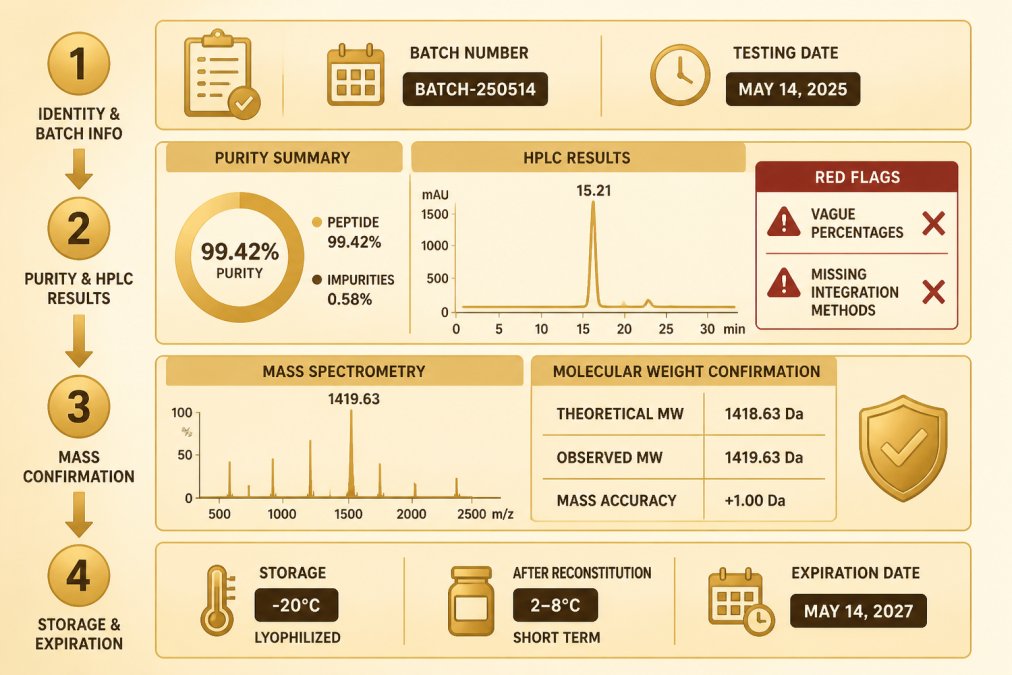
The document also lists storage conditions and stability data. This tells you how long the peptide remains stable under specific conditions, typically refrigerated storage at 2-8°C for extended shelf life. Some COAs include shelf-life projections, showing how purity degrades over time if stored improperly. A strong COA will include data points at multiple time intervals (e.g., purity at 0 months, 6 months, 12 months) rather than a single projection. This demonstrates the lab actually tracked degradation, not just estimated it.
When evaluating a COA, check these five things:
- Does the purity meet your threshold? (99% or higher for research-grade work)
- Are the testing methods appropriate? (HPLC for purity, mass spectrometry for molecular weight confirmation)
- Is the document recent enough? Batches degrade over time; a COA from 18 months ago may not reflect current purity if the peptide has been stored improperly.
- Are numbers precise or vague? Exact percentages (99.2%) signal rigor; ranges or approximations signal corner-cutting.
- Does the lab identify itself clearly? The testing facility should be named, not hidden behind a vendor’s generic “third-party tested” claim. You should be able to verify the lab exists and holds relevant accreditations (ISO 17025 for analytical testing is the standard).
Common red flags in COAs:
- Missing batch number on the document or mismatch with your vial
- No testing date or a date older than 18 months
- Purity reported as a range (“98-99%”) rather than a specific value
- No chromatogram image or mass spectrum data, only a summary number
- Storage conditions listed as “room temperature” for peptides that typically require refrigeration
- No mention of the integration method or detection wavelength used in HPLC
- Lab name is generic or unlisted, “Independent Testing Lab” instead of an actual facility name
PepAlphatides provides QR-coded COAs that you can access instantly. Scan the code on your vial, and you’re viewing the full analytical report for that specific batch, including chromatograms and mass spectra. No waiting for email responses or digging through file systems. Each report includes the testing lab’s name, accreditation status, and the exact methods used.
Identifying Reputable Peptide Vendors
Not all peptide suppliers operate with the same standards. The difference between a reputable vendor and a questionable one often comes down to transparency and testing practices.
A reputable supplier makes their testing transparent. They provide COAs before purchase, not after. They publish their analytical methods openly. They explain why they chose HPLC or mass spectrometry for specific compounds. They answer technical questions from researchers without deflecting.
Documentation and traceability are non-negotiable. Every batch should have a unique identifier. You should be able to trace your vial back to the exact synthesis run, the exact testing date, and the exact lab that performed the analysis. This traceability matters when you’re publishing research, you need to document exactly what material you used.
Look for vendors who source research-grade materials consistently. This means they’re not mixing high-purity batches with lower-grade inventory. They maintain quality standards across their entire catalog, not just flagship products.
Documentation and Transparency Standards
Transparency starts with access to information before you buy. Reputable vendors publish purity data, synthesis methods, and storage recommendations on their product pages. You shouldn’t have to email support to learn basic facts about what you’re purchasing.
The best vendors also publish information about their supply chain. Where did they source raw materials? Which synthesis method did they use (solid-phase synthesis is standard for peptides, but details matter)? Which third-party labs do they partner with for testing?
A vendor that hides these details is a red flag. They may be cutting corners on synthesis, using questionable raw materials, or skipping proper testing. Transparency costs nothing, it’s a choice.
PepAlphatides publishes COAs publicly. Our product pages include synthesis details, storage recommendations, and links to our testing partners. You can verify our claims before placing an order.
Quality Assurance and Lab Testing Methods
The lab testing method you choose determines the reliability of your purity data. HPLC is the standard for peptide purity analysis because it separates compounds by chemical properties and quantifies each one. If a vendor uses HPLC testing, they’re following best practices.
Mass spectrometry is a complementary technique that confirms molecular weight. A reputable vendor uses both methods, HPLC for purity, mass spectrometry for identity confirmation. This dual approach catches errors that single-method testing might miss.
Ask vendors about their lab partnerships. Are they using accredited facilities? Do those labs maintain ISO certifications? How often do they rotate between labs to prevent bias? These questions separate serious operators from casual ones.
Quality assurance also includes batch-to-batch consistency. A vendor that maintains tight purity ranges (99.1% to 99.4%, for example) is more reliable than one with wide variation (98.5% to 99.8%). Consistency signals process control.
Best Practices for Peptide Storage and Handling
How you store peptides after purchase determines how long they remain at claimed purity. Poor storage degrades your material and wastes your investment.
Most research-grade peptides are stable at 2-8°C (refrigerated) for extended periods, often 12-24 months, depending on the specific compound. Some peptides remain stable at room temperature for shorter periods. Your COA should specify the recommended storage temperature.
Keep peptides in their original containers in a dark location. Light exposure degrades many peptides. Moisture is also problematic, condensation inside a vial can trigger degradation. Store vials upright, sealed tightly, away from direct sunlight.
If you’re not using a peptide immediately, consider freezing it at -20°C or below. This dramatically extends shelf life. Just avoid repeated freeze-thaw cycles, which can damage peptide structure. Freeze once, thaw once, use, don’t refreeze.
Label vials with the purchase date and opening date. This helps you track how long material has been in use. If you open a vial and don’t use it for weeks, the remaining material may have degraded, especially if stored improperly.
Evaluating Cost vs. Quality When Buying Peptides
Price varies significantly across vendors when you buy 99 percent peptides, and the lowest price rarely indicates the best value. A cheaper peptide from an untested supplier introduces risk, your research could be compromised by impurities you didn’t detect.
Evaluate cost in context of what you’re getting. Does the price include a COA? Is testing by an independent lab? What’s the purity percentage? How quickly does the vendor ship? Does the vendor offer bulk discounts for research teams?
The real cost of a peptide includes not just the purchase price but also the cost of failed experiments due to poor material quality. If a low-cost peptide introduces contamination that invalidates your results, you’ve lost far more than you saved.
Reputable vendors often charge more because they invest in proper testing, quality control, and supply chain transparency. This premium is justified when it ensures your research succeeds.
PepAlphatides offers a 10% discount for research members and free shipping on orders over $250.
Research Use Only: Understanding Legal and Regulatory Compliance
Peptides sold for research use are labeled “Research Use Only” (RUO) because they haven’t undergone the regulatory approval process required for pharmaceutical or dietary supplement use. This designation is critical to understand.
RUO materials are intended for laboratory and analytical purposes only. They’re not approved for human consumption, injection, or therapeutic application. Using RUO peptides outside of research contexts violates regulations and creates legal liability.
The distinction exists because peptide synthesis doesn’t guarantee pharmaceutical-grade purity or safety testing. Research-grade materials meet analytical standards but haven’t been tested for human safety, sterility, or endotoxin levels. These additional tests are required for pharmaceutical use.
Reputable vendors clearly label all products as RUO and include this designation on invoices and shipping documentation. They also include disclaimers about intended use. This protects both the vendor and the researcher.
If you’re working with peptides in a research institution, your facility likely has compliance requirements around chemical storage, handling, and documentation. Vendors that provide detailed COAs and documentation make compliance easier, you have the records you need to demonstrate proper handling.
Chemical Stability and Batch Validation
Peptide stability isn’t just about storage temperature. It’s about understanding how your specific compound degrades over time, under what conditions, and how to read the stability data in your COA to predict whether your batch will remain usable throughout your research timeline.
Most peptides degrade through three primary mechanisms: oxidation, hydrolysis, or aggregation. Oxidation occurs when the peptide reacts with oxygen in the air, especially problematic for peptides containing methionine or cysteine residues, these amino acids are particularly vulnerable to oxidative damage. Hydrolysis happens when water breaks peptide bonds, typically accelerated by heat or extreme pH; this is why peptides stored at room temperature degrade faster than refrigerated ones. Aggregation occurs when multiple peptide molecules clump together, changing their chemical properties and making them unsuitable for precise dosing or analysis.
Your COA should include stability data showing how purity changes over time under standard storage conditions. This is where many researchers miss critical information. A strong stability section in a COA will show:
- Time-point data: Purity measurements at 0 months, 6 months, 12 months, and sometimes 24 months. For example: “Month 0: 99.4% | Month 6: 99.1% | Month 12: 98.7%” tells you the peptide loses approximately 0.35% purity per six months under refrigeration.
- Storage condition specificity: The exact temperature range tested (e.g., “2-8°C” not just “refrigerated”) and humidity conditions if relevant.
- Degradation rate projection: Some labs calculate the slope of degradation and project when purity will fall below 95% or your minimum acceptable threshold. This helps you plan experiments around material shelf life.
If your COA only states “Stable for 12 months at 2-8°C” without time-point data, you’re missing actionable information. Ask the vendor for the underlying stability study data. Reputable labs will provide it; vendors who refuse are hiding something.
Understanding your peptide’s degradation profile is essential for experimental planning. If you’re running a 6-month study and your peptide degrades 0.5% per month, you need to account for the fact that material tested at the start may be 3% less pure by the end. This affects your controls, your dosing precision, and your ability to publish reproducible results.
Batch Validation: Confirming Your Material Matches the COA
Batch validation means confirming that your received material actually matches what the COA claims. The COA is a promise; validation is verification.
Simple visual checks catch obvious problems before you invest significant research time:
- Color consistency: Most peptides have a characteristic color (white, off-white, or slightly yellow depending on the compound). If your vial contains a dramatically different color, the material may have degraded or been contaminated. Compare the vial color to the COA description or photos from the vendor’s product page.
- Appearance: The peptide should be a powder or crystalline solid, not clumpy, wet, or discolored. Clumping suggests moisture exposure; discoloration suggests oxidation or contamination.
- Vial integrity: Check that the vial seal is intact and hasn’t been tampered with. A compromised seal means the peptide has been exposed to air and moisture, degrading purity regardless of what the COA claims.
For critical experiments, consider running a spot-check HPLC analysis on a small sample when the batch arrives. This costs $100-$300 but eliminates uncertainty. If your research depends on material quality or you’re publishing results, this investment is worthwhile. A spot-check should confirm:
- Purity is within 0.5% of the COA value (e.g., if the COA says 99.2%, your spot-check should show 98.7-99.7%)
- The major impurity profile matches the COA (same peaks in the chromatogram, not new contaminants)
- Molecular weight matches the mass spectrometry data from the original COA
If your spot-check reveals purity 2-3% lower than the COA, the batch may have degraded during shipping or storage. Contact the vendor immediately with your data. Reputable vendors will replace the batch or issue a refund; vendors who dispute your results or refuse to investigate are unreliable.
For long-term storage, freeze a portion of your batch immediately upon arrival at -20°C or below. This preserves a reference sample at the claimed purity level. If you later discover degradation in your working sample, you have a frozen backup that matches the original COA. Label the frozen sample with the purchase date, batch number, and COA purity percentage.
Batch-to-batch consistency also matters. If you’re running a multi-month study, try to source all your peptide from the same batch number. Different batches, even from the same vendor, may have slight purity variations (99.1% vs. 99.4%) that introduce experimental noise. If you must use multiple batches, document the batch numbers and purity percentages for each experiment so you can account for variation in your analysis.
Frequently Asked Questions
How do I verify that a peptide supplier’s 99% purity claims are legitimate?
Request the Certificate of Analysis (COA) for each batch before purchase. A legitimate supplier provides third-party testing results showing HPLC-verified purity percentages, batch numbers, and testing dates. Look for independent lab credentials and QR-coded documentation that traces directly to the analytical results. Reputable vendors make COAs accessible without requiring you to buy first, demonstrating confidence in their quality assurance protocols.
What should I look for when identifying reputable peptide vendors?
Check for third-party laboratory testing, transparent batch documentation, and research-grade certification. Reputable suppliers provide individual COAs for every batch, maintain clear traceability through secure QR codes, and operate under documented quality assurance standards. Verify that they comply with regulations for research use only, offer secure shipping with proper handling protocols, and have established processes for batch validation and chemical stability analysis.
Why does peptide purity matter for research accuracy?
Purity directly affects experimental reproducibility and data reliability. Contaminants or impurities can interfere with analytical results, skew bioavailability measurements, and compromise the validity of your research. 99% purity ensures you’re working with a standardized compound that meets research-grade specifications. Third-party testing confirms actual purity levels rather than relying on supplier claims alone, protecting the integrity of your study.
How should I store peptides to maintain their stability and integrity?
Store peptides in cool, dry conditions, typically between 2-8°C for most lyophilized compounds, though specific requirements vary by peptide sequence and synthesis method. Keep them in airtight, light-protected containers away from moisture and direct sunlight. Verify storage conditions in your supplier’s documentation, and monitor batch stability over time using the analytical data from your COA. Proper storage prevents chemical degradation and extends shelf life for long-term research projects.