Table of Contents
- Peptide Research Legal Status in 2026
- The Difference Between Research Peptides and Pharmaceutical Drugs
- FDA Peptide Regulation in 2026: What Changed
- Research Use Versus Human Use: The Critical Legal Distinction
- Third-Party Testing Requirements for Peptides
- Compounding Pharmacies and Legal Access
- State-by-State Differences in Peptide Regulation
- Which Peptides Face FDA Restrictions
- Importing and Shipping Research Peptides
- Compliance and Documentation for Researchers
- Frequently Asked Questions
Last Updated: October 5, 2026
Peptide Research Legal Status in 2026
The legal landscape for peptide research in 2026 depends on intended use, the specific peptide, your location, and your regulatory obligations. At PepAlphatides, we work with researchers who understand that research use and human use operate under entirely different legal frameworks. This guide clarifies what’s legal, what’s restricted, and how the rules differ from a few years ago.
The FDA’s approach has shifted: what was permitted in 2024 may now face restrictions or proposed reclassification. Understanding these changes is essential whether you conduct academic research, run a commercial laboratory, or source materials for experimental work.
The single most important distinction: research use only labeling means the product is sold explicitly for laboratory analysis and scientific study, not for consumption or application to humans. This distinction carries legal weight and defines your compliance obligations.
The Difference Between Research Peptides and Pharmaceutical Drugs
Research peptides and pharmaceutical drugs are governed by different regulatory frameworks. A research peptide is synthesized for laboratory analysis or scientific experimentation, labeled and sold “for research use only.” A pharmaceutical drug is FDA-approved for human administration, with demonstrated safety and efficacy in clinical trials.
Research-labeled peptides are not approved for human use and cannot be marketed, distributed, or consumed as treatments. Pharmaceutical peptide drugs have undergone FDA approval and are legally prescribed by licensed healthcare providers.
Many suppliers blur this line intentionally, marketing research compounds with health claims or language implying human benefit. This is illegal. Research-grade materials must maintain strict separation from any suggestion of human application, and legitimate suppliers reinforce research-use-only status through labeling, documentation, and sales terms.
A peptide’s regulatory status depends on whether it has been approved as a pharmaceutical drug. Some, like semaglutide (Ozempic) or tirzepatide (Zepbound), are FDA-approved medications. Others exist only in research form, never having completed clinical trials or FDA review.
FDA Peptide Regulation in 2026: What Changed
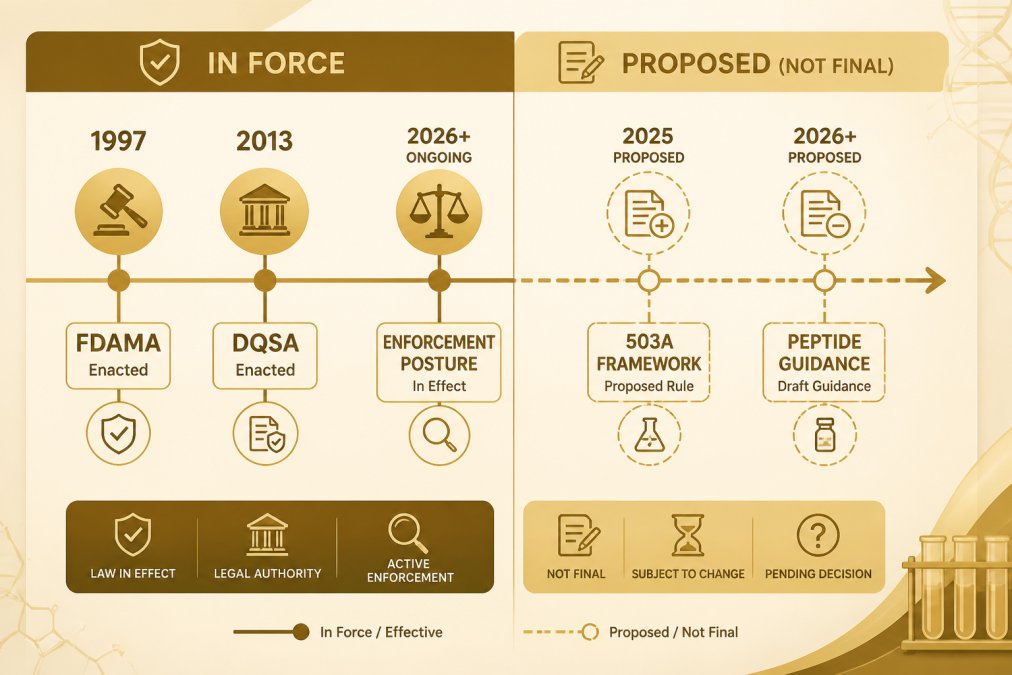
Most guides blur three things together: rules currently in force, rules proposed but not finalized, and enforcement trends that reflect agency priorities rather than new regulations. That blur is the biggest source of bad decisions by researchers and suppliers. This section separates them so you can tell what binds you today versus what might bind you later.
The Statutory Baseline (Unchanged)
The foundation has not moved. Under the Federal Food, Drug, and Cosmetic Act (FD&C Act), a peptide marketed for human use without FDA approval is an unapproved drug, regardless of purity, source, or labeling. The FDA’s authority over unapproved, misbranded, and adulterated products applies to peptides the same way it applies to any other active pharmaceutical ingredient.
Two related statutes matter for researchers and suppliers:
- The Food and Drug Administration Modernization Act of 1997 (FDAMA) created the 503A traditional compounding framework and the statutory basis for certain compounded preparations.
- The Drug Quality and Security Act of 2013 (DQSA) created the 503B outsourcing facility category and tightened track-and-trace expectations for prescription drugs.
Neither statute exempts research-labeled peptides from unapproved-drug rules when marketed for human use. The research-use-only designation is a labeling and intended-use boundary, not a statutory safe harbor.
Status-and-Effective-Date Table
Use the table below to evaluate any claim that “the rules changed.” Confirm the status column before acting on a headline.
| Item | Type | Status as of 2026 | What it means for you |
|---|---|---|---|
| Unapproved-drug prohibition under the FD&C Act | Statute in force | Enacted, currently enforced | Peptides marketed for human use without approval are unlawful |
| 503A traditional compounding framework | Statute in force | Enacted (FDAMA 1997) | Licensed pharmacies may compound certain preparations under prescription |
| 503B outsourcing facility framework | Statute in force | Enacted (DQSA 2013) | Registered outsourcing facilities face stricter cGMP-style requirements |
| FDA category 2 “do not compound” list | Agency list, in force | Maintained and updated | Listed peptides cannot be lawfully compounded under 503A or 503B |
| Reclassification of specific peptides (e.g., BPC-157, TB-500) | Proposed / under review | Not a final rule unless published as one | Treat as a risk factor, not as current law |
| Narrowing of 503A/503B compounding scope | Proposed | Not final unless published | Verify against the current Federal Register before relying on it |
Before you treat any peptide as restricted or permitted, check three sources in this order: (1) the current Federal Register for final rules, (2) the FDA’s category lists for compounding status, and (3) FDA warning letters for enforcement signals. A news article is not a primary source.
FDA unapproved drugs overview
FDA compounding categories and 503A/503B guidance
Federal Register search for peptide-related final rules
What Actually Changed Versus What Was Proposed
For 2026, the statutory baseline has not changed, but two things have shifted in practice:
- Enforcement attention has increased. The FDA has issued warning letters to compounding pharmacies and online sellers that market peptides with human-use claims. Warning letters are enforcement signals, not new regulations, but they tell you where the agency is looking.
- Compounding scope has narrowed for specific peptides. The FDA’s category 2 list (sometimes called the “do not compound” list) removes certain peptides from lawful compounding under 503A and 503B. Being on that list is a current restriction, not a proposal.
What has not happened, unless a final rule is published: a blanket reclassification of all research peptides, a ban on research-use-only sales to qualified laboratories, or a new statutory category for peptides. Headlines implying otherwise usually describe proposals, requests for comment, or enforcement actions.
How to Verify a Claim in Under Ten Minutes
A repeatable verification routine protects you from stale or misread information:
- Search the Federal Register for the peptide name and the phrase “final rule.” If nothing appears, there is no new binding rule.
- Check the FDA’s compounding category page for the specific peptide. Category 2 means compounding is not permitted; category 1 means it may be, subject to other requirements.
- Search FDA warning letters for the peptide name and for the supplier name. A warning letter is evidence of enforcement posture, not of a new rule.
- If a state pharmacy board has published guidance, read it directly. State guidance can be stricter than federal rules.
- Date-stamp your notes. A finding from 2024 may not reflect the current list.
Why the Distinction Matters Operationally
For researchers, compliance obligations flow from intended use and labeling, not from whether a peptide is “newly restricted.” A peptide not on any restricted list is still an unapproved drug if marketed or used for human application. A peptide on the category 2 list cannot be compounded even with a prescription. Conflating these two rules is how suppliers and researchers get into trouble.
Do not rely on a single article, forum post, or supplier page to determine whether a peptide is restricted. Verify against the Federal Register, the FDA’s current category lists, and your state pharmacy board. If a supplier tells you a peptide is “legal in 2026” without citing a primary source, treat that as a marketing claim, not a legal conclusion.
Research Use Versus Human Use: The Critical Legal Distinction
This distinction is where most confusion and legal risk originates. The difference between legitimate laboratory research and using research-labeled products in people is not a gray area, it’s a legal boundary with real consequences.
Research use means the peptide is used in a controlled laboratory setting for scientific analysis or experimental work. The researcher has formal training, works within an institutional framework, maintains proper documentation, and uses the compound solely for its scientific purpose. Research-use peptides are not consumed, injected, or applied to human bodies.
Human use means the peptide is administered to a person for any purpose, including self-administration. Human use requires FDA approval unless under a clinical trial protocol or specific regulatory exemption. Buying a research-labeled peptide and injecting it into yourself is human use regardless of the label.
The label “for research use only” is not a legal loophole. It defines how the product can be lawfully sold and used. Using a research compound on humans violates federal law even if the compound is high-purity and well-characterized; the violation stems from unauthorized human use, not compound quality.
Purchasing research peptides with the intent to use them on humans is a federal violation. Sellers who knowingly sell research compounds for human use also violate federal law. Both parties face enforcement action, fines, and potential criminal charges. The “research use only” label does not protect you legally if you use the product on yourself or others.
Legitimate researchers maintain this distinction rigorously. Academic institutions, commercial research organizations, and legitimate suppliers all operate with clear protocols separating research use from human application. This is the foundation of legal compliance.
Third-Party Testing Requirements for Peptides
Legitimate research peptides must be independently tested to verify purity, identity, and absence of contaminants. Third-party testing is a fundamental quality control measure and compliance signal for credible suppliers.
What third-party testing verifies:
- Purity levels (typically 98% or higher for research-grade materials)
- Peptide identity (confirmation that the compound is what the label claims)
- Absence of heavy metals, bacterial endotoxins, and other contaminants
- Moisture content and other physical properties relevant to research use
A legitimate supplier provides a Certificate of Analysis (COA) for every batch, including the testing laboratory’s name, credentials, and signature. At PepAlphatides, every batch undergoes independent third-party testing, with individual COAs and secure QR-coded vials for batch transparency.
When evaluating a supplier, verify the testing is truly independent, conducted by a laboratory with no financial stake in the sale. Some suppliers test their own products, creating a conflict of interest. Third-party testing means an external accredited laboratory performs the analysis and issues the COA.
Ask suppliers for proof of testing before purchasing. Legitimate organizations provide COAs transparently. If a supplier refuses or delays documentation, that’s a red flag: research-grade materials require documentation, and its absence signals the supplier either doesn’t test or doesn’t want scrutiny.
Compounding Pharmacies and Legal Access
Licensed compounding pharmacies occupy a specific regulatory niche: they prepare customized medications from bulk pharmaceutical ingredients under a licensed pharmacist’s supervision and a physician’s prescription.
Under FDA regulations 503A (traditional compounding) and 503B (outsourcing facilities), compounding pharmacies can prepare certain peptides for prescription use in limited circumstances. This is legal provided the pharmacy is properly licensed, the prescriber is a licensed physician, and the peptide is not explicitly prohibited from compounding.
However, compounding access to peptides is narrowing. Many peptides are now restricted from compounding due to safety concerns or lack of efficacy evidence. The FDA has moved several peptides to “do not compound” lists, meaning pharmacies cannot legally prepare them even with a prescription.
If seeking peptide access through a compounding pharmacy, verify:
- The pharmacy is licensed and accredited (check state pharmacy board records)
- The specific peptide is not on the FDA’s restricted compounding list
- You have a valid prescription from a licensed physician
- The pharmacy provides documentation of quality and purity
Compounding access is legitimate for approved-use cases but not a workaround for research peptides or unapproved compounds. Pharmacies marketing peptides as wellness or performance-enhancement products without prescriptions operate illegally, regardless of licensing status.
State-by-State Differences in Peptide Regulation
Federal law sets the floor, not the ceiling. States layer additional requirements on top of the FD&C Act, and those layers surprise most researchers and suppliers. The variation clusters around four regulatory levers.
The Four Levers States Actually Pull
- Controlled substance scheduling. A state can schedule a compound under its own controlled substances act even if the federal CSA does not, triggering possession, prescribing, and recordkeeping rules that don’t exist federally for that compound.
- Pharmacy practice and compounding rules. State boards of pharmacy can restrict which preparations a licensed pharmacy may dispense, independent of FDA category lists. A federally compoundable peptide may still be off-limits under a state board rule.
- Prescriber and dispensing requirements. Some states require in-person examination before prescribing, restrict telehealth prescribing of certain compounds, or limit dispensing to in-state pharmacies.
- Consumer protection and marketing enforcement. State attorneys general can bring unfair-or-deceptive-practices actions against sellers marketing research-labeled peptides with human-use claims. This channel is separate from the FDA and often moves faster.
How to Check Your State in Practice
No single national database consolidates peptide-specific state rules. Check three sources in your state:
- State board of pharmacy. Look for compounding guidance, restricted-formulary lists, and peptide-specific bulletins. Many boards publish these as PDFs, so search the site directly.
- State controlled substances schedule. Confirm whether the peptide or its class appears on your state’s schedule. Don’t assume federal scheduling controls the answer.
- State attorney general consumer protection actions. Search for enforcement actions against peptide sellers, which reveal what the state considers an unlawful human-use marketing claim.
If you operate in more than one state, build a simple matrix: rows are peptides, columns are states, cells are one of three values, “no additional state rule found,” “state rule restricts compounding,” or “state rule restricts possession or prescribing.” Date-stamp every cell and re-check quarterly. This is the same approach institutional compliance offices use.
National Association of Boards of Pharmacy member board directory
Patterns Worth Knowing
A few patterns recur across states, though specifics differ:
- States with active compounding oversight publish explicit restricted lists and audit pharmacies more frequently. A dedicated compounding division means more scrutiny.
- States that have acted on GLP-1 compounding are more likely to have peptide-specific guidance on file, because the same board staff handle both.
- States with strict telehealth rules can block access to compounded peptides even when federal rules allow it, because the prescription cannot be lawfully issued.
- States with aggressive consumer protection offices pursue sellers more than buyers, changing the risk profile by role.
Role-Based Implications
State variation affects roles differently:
- Academic researchers. Your compliance office tracks state requirements wherever you ship, store, or use materials. Confirm before cross-state sourcing.
- Commercial laboratories. Procurement and shipping records should reflect rules for both ship-to and ship-from locations. A compound lawful in your state may be restricted at the destination.
- Compounding pharmacies. Your state board license is the binding constraint. Federal compounding permission does not override a state board restriction.
- Individual purchasers. For research-labeled peptides, the state where you receive the shipment governs possession and consumer protection questions, not the supplier’s state.
What This Section Does Not Tell You
This section deliberately avoids naming specific states or peptides, because state rules change and a stale list is worse than none. Use the verification routine above: check your state board of pharmacy, controlled substances schedule, and attorney general’s enforcement record, and re-check on a schedule. If a supplier or forum post claims a peptide is “legal in your state” without citing one of those three sources, treat it as unverified.
A peptide that is lawful to research in one state can be restricted in another. Do not assume that a federal research-use-only label resolves state-level possession, compounding, or prescribing questions. Those are separate legal questions with separate answers.
Which Peptides Face FDA Restrictions
Several peptides have faced increased FDA scrutiny or explicit restrictions as of 2026, with the agency citing safety concerns or insufficient evidence of safety outside controlled clinical trials.
Peptides commonly subject to restrictions or enforcement action include:
- BPC-157 (body protection compound)
- TB-500 (thymosin beta-4)
- Certain GLP-1 analogs not yet approved as pharmaceutical drugs
- Melanotan and analogs
- Selective androgen receptor modulators (SARMs) marketed as peptides
The FDA’s position: these compounds are unapproved drugs when marketed for human use. Research-labeled versions may be legally sold for laboratory use, but marketing suggesting human benefit violates federal law.
The restriction list is not static. The FDA regularly reviews peptides and updates enforcement priorities: a currently unregulated peptide may face restrictions in 2027, while some previously restricted compounds may move into clinical trials or approval pathways.
Staying current is essential for suppliers and researchers. The agency publishes warning letters and enforcement actions regularly; subscribe to FDA updates or consult legal counsel if sourcing compounds that have drawn regulatory attention.
Importing and Shipping Research Peptides
Importing research peptides involves customs, international shipping regulations, and cross-border compliance issues, making logistics more complex than domestic sourcing.
When importing from international suppliers, U.S. Customs and Border Protection (CBP) may inspect shipments. CBP applies federal law: a peptide classified as an unapproved drug under FDA rules can be seized at the border even if labeled for research use. The research-use label alone does not guarantee clearance.
Legitimate international suppliers understand these requirements and provide proper documentation, COAs, research-use-only labeling, and evidence the buyer is a qualified research organization. This helps facilitate customs clearance but does not guarantee it.
Domestic shipping is generally straightforward if both supplier and buyer maintain proper documentation and research-use-only protocols. Interstate shipment of research materials is legal provided neither party uses the compound for human purposes.
Cross-border sourcing from Canada, the EU, the UK, or Australia adds complexity: each country has its own framework, and a peptide legal to research in Canada may be restricted in the U.S. Verify international supplier compliance with both their home country’s rules and U.S. federal law before purchasing.
Compliance and Documentation for Researchers
Researchers and research organizations must maintain clear documentation to demonstrate compliance with federal law and FDA regulations, protecting both researcher and supplier.
Essential compliance documentation includes:
- Proof of institutional affiliation or research organization status
- Written protocol describing the intended research use
- Purchase records showing research-use-only labeling and terms
- Certificates of Analysis for all materials received
- Laboratory records documenting how the compound was used
- Inventory records tracking material receipt and use
Academic institutions typically have compliance offices overseeing this documentation; commercial organizations should establish similar protocols. Independent researchers should maintain meticulous records showing all peptides were used solely for research purposes.
Expect suppliers to request documentation of your research status and intended use. Legitimate suppliers verify buyer credentials before shipping, protecting both parties by establishing the transaction is for legitimate research.
Documentation also protects you during a regulatory inquiry: clear records showing research-only protocols and institutional oversight demonstrate compliance, while lack of documentation creates legal vulnerability.
Navigating peptide research legality in 2026 requires understanding the regulatory framework, maintaining clear research-use protocols, and sourcing from suppliers committed to compliance. At PepAlphatides, we support legitimate research by providing high-purity compounds with independent third-party testing, transparent Certificates of Analysis, and secure batch documentation. Our commitment to research integrity means every product is rigorously tested and documented for laboratory use.
Frequently Asked Questions
Is peptide research legal in the United States in 2026?
Peptide research is legal when conducted for legitimate laboratory and analytical purposes. The FDA permits research-grade peptides labeled and sold strictly for research use only, not for human consumption. However, regulatory status depends on the specific peptide, the research organization’s credentials, and compliance with FDA guidelines. Peptides approved as pharmaceutical drugs or restricted by the FDA face different rules. Always verify the regulatory status of your specific peptide and ensure your research organization meets federal documentation requirements.
What does third-party testing requirements for peptides actually prove?
Third-party testing verifies purity, identity, and absence of contaminants through independent laboratory analysis. A Certificate of Analysis (COA) documents that a peptide batch meets stated specifications, typically confirming purity levels and confirming the compound is what the seller claims. For research-grade materials, third-party testing ensures consistency across batches and provides the documentation trail regulators expect. This testing does not certify safety for human use, only that the compound’s chemical composition and purity match research standards.
Can I buy research peptides online legally?
You can purchase research peptides online from suppliers that clearly label products for research use only and comply with FDA regulations. Legitimate providers require customers to acknowledge the research-only designation and typically operate under strict quality and documentation standards. Avoid suppliers making health claims, offering peptides without purity documentation, or shipping to states where specific peptides are restricted. Verify the supplier’s compliance history and request Certificates of Analysis before purchase to confirm legitimacy.
What is the difference between research peptides and pharmaceutical drugs?
Research peptides are compounds labeled and sold exclusively for laboratory and analytical use, not for human consumption. Pharmaceutical drugs are FDA-approved medications tested for safety and efficacy in humans, with established dosing, side effect profiles, and clinical data. Research peptides bypass human trials and carry no approval for human use; using them outside research settings violates federal law. The legal distinction hinges on labeling, intended use, and the seller’s compliance with research-only sales requirements. Compounding pharmacies operate under a separate regulatory framework and can prepare FDA-approved peptide drugs with a prescription.