Table of Contents
- What Research Peptides Are and How They’re Marketed
- Regulatory Status: Why Unapproved for Human Use Matters
- Research Peptide Purity Testing: What the Numbers Actually Mean
- How to Verify a Peptide Certificate of Analysis
- Peptide Identity Testing Methods and What They Reveal
- Research Peptide Supplier Red Flags: What to Watch For
- Contamination, Impurities, and Sterility: Observable Warning Signs
- Storage, Shipping, and Stability Failures That Compromise Quality
- Building a Practical Checklist for Assessing Peptide Quality
- Frequently Asked Questions
Last Updated: October 7, 2026
What Research Peptides Are and How They’re Marketed
Research peptides are synthetic peptides manufactured for laboratory and analytical use, marketed for scientific study rather than human consumption. Vendors label them “for research use only” and sell to academic institutions, independent researchers, and biohacking communities.
The peptide research market has grown significantly, with suppliers ranging from established chemical manufacturers to newer e-commerce platforms. Many claim high purity and third-party testing, but the lack of FDA oversight means quality varies dramatically between vendors.
At PepAlphatides, we prioritize transparency: every batch undergoes independent third-party testing to verify purity exceeds 99%, and each product includes a secure QR-coded Certificate of Analysis for complete batch traceability.
The key question researchers ask: How do I know what I’m actually buying? Understanding the difference between legitimate research-grade peptides and low quality research peptides starts with knowing what to look for.
Regulatory Status: Why Unapproved for Human Use Matters
Research peptides are unapproved for human use. The FDA has not authorized these compounds for consumption, injection, or any human application, meaning there are no government safety standards, purity requirements, or manufacturing controls mandated for vendors.
Unapproved compounds exist in a gray zone where vendors can make broad claims without the accountability required for approved pharmaceuticals, creating risk for researchers who may not fully understand what they’re purchasing.
The regulatory status reflects that these compounds have not undergone formal approval, not a judgment on peptide science itself. The problem arises when vendors blur the line between research-grade compounds and products implied to be safe for human use.
Low quality research peptides often come from suppliers who downplay or ignore the regulatory reality entirely. They may use vague language, omit warnings, or imply efficacy without evidence. Legitimate suppliers, by contrast, are explicit: these compounds are for research purposes only, period.
Research Peptide Purity Testing: What the Numbers Actually Mean
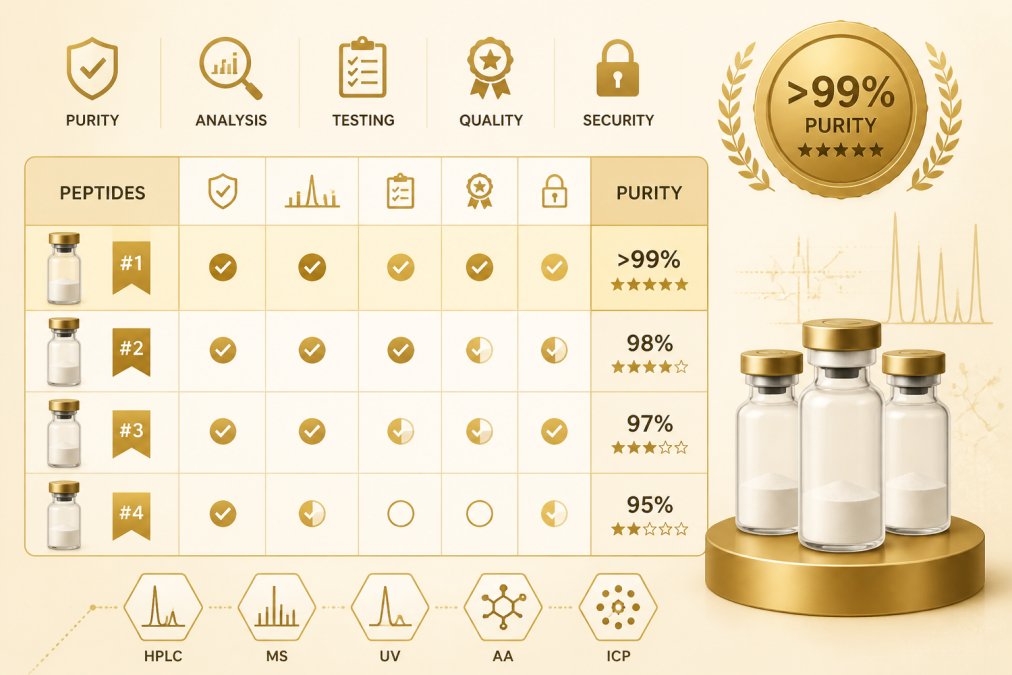
Purity claims are everywhere in the peptide market. A vendor might state “99% pure” or “98.5% pure,” but these numbers mean nothing without context about how they were tested and by whom.
Purity testing measures the percentage of the intended peptide versus contaminants, byproducts, or other compounds. Legitimate tests use analytical methods like high-performance liquid chromatography (HPLC) or mass spectrometry, which provide reproducible, verifiable results.
The problem: low quality research peptides often come with purity claims lacking supporting documentation. A vendor might claim 99% purity but provide no Certificate of Analysis, testing method, or batch-specific data, making the claim meaningless.
When evaluating purity numbers, ask these questions:
- Was the testing done by an independent third-party laboratory?
- Does the Certificate of Analysis specify the analytical method used (HPLC, mass spectrometry, etc.)?
- Is the COA batch-specific, not a generic template?
- Can you access the full chromatogram or analytical data, not just a summary?
Legitimate vendors provide detailed documentation because they stand behind their products. Low quality research peptides are typically sold with minimal or no supporting evidence.
How to Verify a Peptide Certificate of Analysis
A Certificate of Analysis is only as good as the verification behind it. The gap between a real COA and a decorative one comes down to four checks: batch matching, laboratory identity, test method, and raw data.
Step 1: Match the Batch, Not the Product
A COA is batch-specific: the batch or lot number on the document must match the vial label, outer box, and packing slip. If any disagree, stop. A common pattern with low quality research peptides is a single COA reused across dozens of listings, a template, not a test result.
Ask yourself:
- Does the batch number on the COA match the vial exactly, including any prefix or suffix?
- Is there a manufacturing date and a separate testing date?
- Does the testing date fall after the manufacturing date, and within a plausible window (usually days to a few weeks)?
A COA dated before the batch was manufactured, or one with no dates at all, is not verifiable.
Step 2: Confirm the Laboratory Is Real and Independent
A COA should name the testing laboratory, not just say “third-party tested.” A legitimate analytical lab will have a public website, physical address, phone number, and often an accreditation listing such as ISO/IEC 17025.
Then contact the lab directly using contact information you found independently, not the phone number or email printed on the COA, which a fraudulent vendor controls. Ask them to confirm they tested that batch number for that vendor. If the lab has never heard of the vendor, the COA is fabricated.
ISO/IEC 17025, General requirements for the competence of testing and calibration laboratories
Step 3: Read the Test Method, Not Just the Number
“99% pure” is meaningless without the method. The two most common methods are:
- HPLC (high-performance liquid chromatography): Separates compounds by how they interact with a column. Purity is reported as the area percentage of the target peak relative to all peaks. A 99% HPLC purity means 99% of the UV-absorbing material eluted as the target peak, it does not mean 99% of the vial is the peptide.
- Mass spectrometry (MS): Confirms molecular weight. This is an identity test, not a purity test. A COA that lists only MS and calls it “purity” is mislabeling the test.
A complete COA typically reports both: HPLC for purity, MS for identity. If only one appears, ask why.
Step 4: Look at the Chromatogram, Not the Summary
A summary line saying “Purity: 99.2%” is easy to type; a chromatogram, the actual graph of detector response over time, is harder to fake. Request the full chromatogram, not just the summary page.
When you look at it:
- The main peak should be sharp and symmetrical. A broad, split, or shouldering peak suggests impurities or degradation.
- The baseline between peaks should be flat. A rising or noisy baseline can indicate column problems or contamination.
- The retention time should be consistent with the reference standard for that peptide.
- The y-axis scale should be labeled. An unlabeled or suspiciously compressed axis can hide small impurity peaks.
A COA is a document, not a guarantee. Even a genuine, batch-matched COA with a clean chromatogram does not establish sterility, absence of endotoxin, correct potency, or suitability for human use. It confirms identity and purity of the tested sample only.
What a Real COA Verification Looks Like End to End
- Pull the batch number off the vial.
- Open the COA and confirm the batch number matches character for character.
- Confirm manufacturing and testing dates are present and in order.
- Identify the testing laboratory by name.
- Independently locate the lab’s contact information and confirm the test.
- Confirm the COA lists both a purity method (HPLC) and an identity method (MS or NMR).
- Request and review the full chromatogram.
- Note what the COA does not cover, sterility, endotoxin, potency, heavy metals, residual solvents.
If a vendor cannot complete steps 1 through 7, the documentation is not verifiable, and the product should be treated as unverified regardless of the purity number printed on it.
Peptide Identity Testing Methods and What They Reveal
Identity testing confirms the compound you received is actually the peptide you ordered, separate from purity testing. A batch could be 99% pure but still be the wrong compound entirely.
Common identity testing methods include:
- Mass spectrometry: Identifies the exact molecular weight and structure of the compound. This is highly accurate and difficult to fake.
- Nuclear magnetic resonance (NMR): Provides detailed structural information about the molecule.
- HPLC with UV detection: Confirms the compound’s retention time and spectral properties match the reference standard.
Low quality research peptides often lack identity confirmation. A vendor might provide a purity number but skip identity testing, leaving no proof the compound is what it’s labeled as.
When reviewing a Certificate of Analysis, look for the identity testing method. It should be listed separately from purity. If identity testing is missing, ask the vendor why. A legitimate supplier will have this data. If they can’t provide it, the product is not research-grade.
Research Peptide Supplier Red Flags: What to Watch For
Not all vendors are created equal. Identifying red flags before you buy protects your research and your budget.
Watch for these warning signs:
- No Certificate of Analysis available before purchase. Legitimate vendors provide batch-specific COAs upfront. If a supplier says “we’ll send it after you order,” that’s a red flag.
- Generic or templated COAs. If the COA looks identical across multiple batches, it’s likely a template, not a real test result.
- Missing batch numbers or dates. Real COAs are specific to a batch with clear manufacturing and testing dates.
- Vague testing claims. Phrases like “laboratory tested” or “verified quality” without specific methods or data are red flags.
- No third-party testing. Low quality research peptides are often tested only by the vendor itself, if at all. Independent testing is the standard.
- Unclear vendor information. Legitimate suppliers have verifiable business addresses, contact information, and a track record. Vendors with no clear identity or history are risky.
- Pressure to buy quickly or claims of limited stock. This is a classic sales tactic used to bypass careful evaluation.
A supplier should be willing to answer detailed questions about testing, sourcing, and quality control. If they become defensive or evasive, look elsewhere.
Contamination, Impurities, and Sterility: Observable Warning Signs
Appearance is the weakest possible quality signal. A vial can look perfect and still contain endotoxin, residual solvents, or the wrong peptide. Use visual inspection as a first filter, then rely on documentation and testing for anything that matters.
What You Can Actually See (and What It Does Not Prove)
Visual inspection catches gross problems. It does not confirm quality.
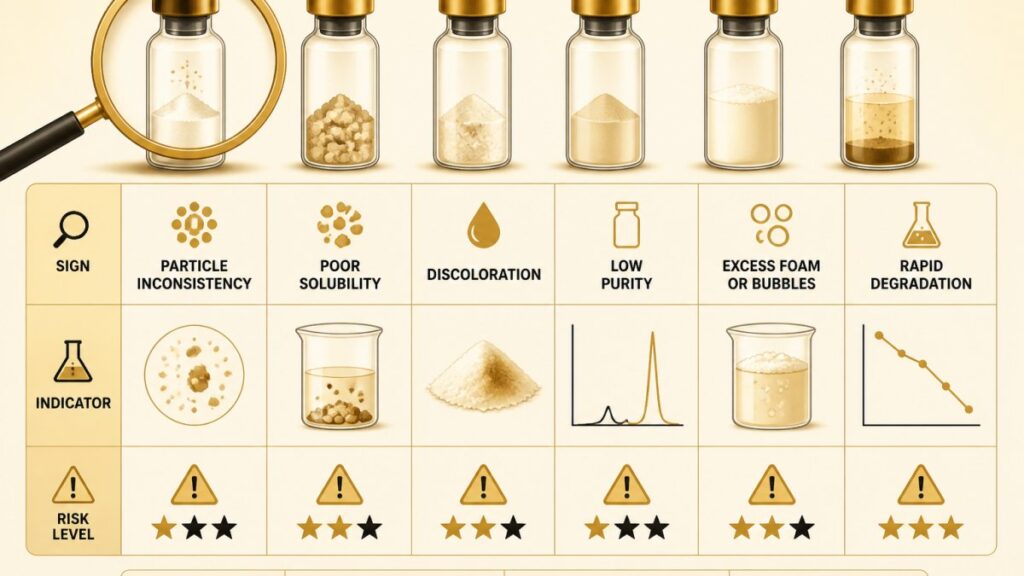
- Discoloration. A lyophilized peptide is typically a white to off-white powder. Yellow, brown, or dark coloration suggests oxidation, degradation, or contamination, but some peptides are naturally off-white, so compare against the vendor’s own reference photos and the COA description.
- Clumping or crystallization. Freeze-dried powder should be loose and free-flowing. Hard clumps or a glassy cake suggest moisture exposure during shipping or storage.
- Unusual odor. Most peptides are odorless or nearly so. A sharp, chemical, or sulfurous smell can indicate residual solvents or degradation.
- Visible particles or debris. Any particulate in the vial points to a manufacturing or packaging failure.
- Cracked or compromised stopper. A damaged septum or loose crimp means the vial was not sealed properly, sterility cannot be assumed.
Visual inspection can only rule a product out. It can never rule a product in. A clean-looking vial tells you nothing about sterility, endotoxin, or identity.
The Tests That Actually Detect Contamination
A COA reporting only HPLC purity is silent on contamination. These tests separate a real analytical panel from a purity-only summary.
- Sterility testing. Required for any product intended for injection. The standard method is a 14-day incubation in two media (soybean-casein digest and fluid thioglycollate) to detect bacterial and fungal growth. A COA that claims “sterile” without a sterility test method and incubation period is making an unsupported claim.
- Endotoxin testing (LAL). The Limulus Amebocyte Lysate assay detects bacterial endotoxin, measured in endotoxin units per milliliter (EU/mL). Endotoxin is not visible and is not removed by filtration at the point of use. A product can be 99% pure by HPLC and still carry a dangerous endotoxin load.
- Residual solvents. Peptide synthesis uses organic solvents. USP <467> sets limits for residual solvents in pharmaceutical materials. A COA that does not mention residual solvent testing leaves that risk unaddressed.
- Heavy metals. Elemental impurities are covered by USP <232> and <233>. These are not detectable by eye or by HPLC purity testing.
- Water content (Karl Fischer). Moisture accelerates degradation. A Karl Fischer titration result tells you whether the lyophilization was done properly.
Why “99% Pure” Says Nothing About Sterility or Safety
Purity and sterility are orthogonal. Purity measures how much target peptide is present relative to other peptide-related material; sterility measures absence of viable microorganisms; endotoxin measures bacterial cell-wall fragments. None substitute for the others.
A batch can be:
- 99% pure by HPLC and non-sterile
- 99% pure by HPLC and endotoxin-positive
- 99% pure by HPLC and the wrong peptide (if identity testing was skipped)
- 99% pure by HPLC and contaminated with residual solvents
This is why a purity number alone is not a quality claim. It is one data point among several, and it addresses only one dimension of the product.
Storage and Shipping as Contamination Vectors
Contamination and degradation often happen after manufacturing, during shipping and storage.
- Temperature excursions. Most lyophilized peptides are stable at room temperature for short periods but should be stored at 2-8°C (refrigerated) or -20°C (frozen) for long-term stability. A shipment that arrives warm after days in transit has likely degraded.
- Moisture ingress. A vial that was not properly sealed or was opened in a humid environment will absorb water. This shows up as clumping and accelerates hydrolysis of the peptide.
- Light exposure. UV and visible light break down many peptides. Opaque or amber vials and light-blocking secondary packaging are the standard.
- Freeze-thaw cycling. Each thaw-and-refreeze cycle damages the peptide. A shipment that partially thawed and refroze in transit has effectively been cycled.
When a shipment arrives, document the condition before opening: exterior packaging integrity, presence of cold packs, any temperature indicator, and the physical state of the vial. If the packaging looks like standard mail with no thermal protection, treat the product as degraded regardless of what the COA says.
What to Do If You Suspect Contamination
If a vial shows visible contamination, arrived warm, or came with a COA that does not address sterility or endotoxin:
- Do not use the product in any application involving injection or human exposure.
- Preserve the vial, packaging, COA, and order records, do not discard them.
- Photograph the vial, label, batch number, and packaging condition.
- Contact the vendor in writing and request a replacement COA with the full analytical panel.
- If exposure has already occurred and you experience symptoms, seek qualified medical advice and bring the product documentation with you.
Do not attempt to “clean,” filter, or re-sterilize a suspect research peptide for personal use. These products are not approved for human use, and home sterilization does not address endotoxin, residual solvents, or identity errors.
Storage, Shipping, and Stability Failures That Compromise Quality
A high-quality peptide can become low quality research peptides through poor shipping and storage handling. Stability failures are often invisible but real.
Peptides degrade when exposed to:
- Heat. Peptides should be stored and shipped at cold temperatures, typically 2-8°C (refrigerated) or -20°C (frozen). Room-temperature shipping degrades peptides rapidly.
- Light exposure. Peptides break down under UV and visible light. Proper packaging uses opaque, light-blocking materials.
- Moisture. Freeze-dried peptides absorb moisture from air. Improper packaging allows moisture infiltration, causing clumping and degradation.
- Repeated thawing. If a frozen peptide thaws during shipping and refreezes, the freeze-thaw cycle damages the compound. Each cycle degrades quality.
Low quality research peptides often arrive in conditions that guarantee degradation:
- Shipped in standard packaging without insulation or ice packs
- Stored in warehouses at room temperature before shipping
- Packaged in materials that don’t protect against light or moisture
- No tracking of temperature during transit
When your peptide arrives, inspect the packaging. Was it insulated? Did it include ice packs or thermal protection? If the packaging looks like it held regular mail, the contents were likely exposed to damaging conditions.
Building a Practical Checklist for Assessing Peptide Quality
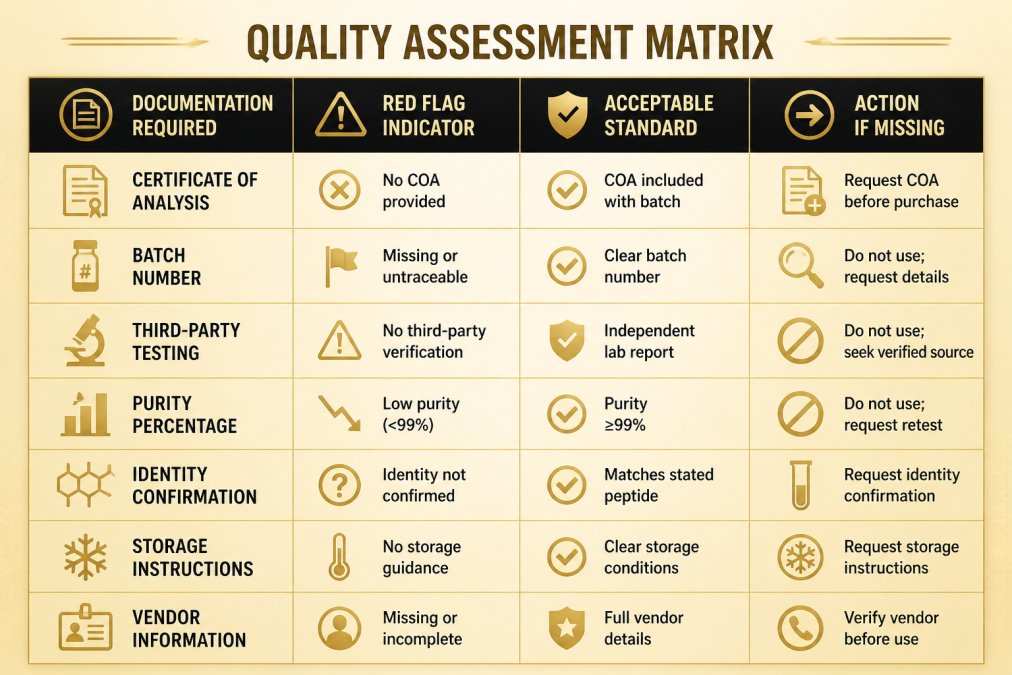
Use this checklist to evaluate any research peptide supplier before you buy. A legitimate vendor meets all criteria; low quality research peptides typically fail several.
| Documentation Required | Red Flag Indicator | Acceptable Standard | Action if Missing |
|---|---|---|---|
| Certificate of Analysis | Generic or undated | Batch-specific with date | Request before purchase |
| Batch Number | Missing or unclear | Matches vial and COA | Do not purchase |
| Third-Party Testing | Vendor-only testing | Independent laboratory | Verify lab contact info |
| Purity Percentage | No method listed | HPLC or mass spectrometry specified | Ask for testing method |
| Identity Confirmation | Skipped entirely | Confirmed via mass spec or NMR | Request identity data |
| Storage Instructions | Vague or missing | Specific temperature and light protection | Follow provided guidelines |
| Vendor Information | Anonymous or unclear | Verifiable business address and history | Research vendor reputation |
When evaluating a vendor, use this process:
- Request the Certificate of Analysis before placing an order
- Verify the batch number matches your intended purchase
- Check that the COA lists specific testing methods and laboratory information
- Contact the testing laboratory to confirm they performed the analysis
- Ask about storage and shipping conditions
- Review the vendor’s return or quality guarantee policy
Legitimate suppliers welcome these questions. They understand that researchers need to verify quality. If a vendor becomes evasive or refuses to provide documentation, that’s your answer.
Assessing low quality research peptides requires attention to detail, but it’s time well spent. At PepAlphatides, every batch undergoes independent third-party testing, every product includes a batch-specific Certificate of Analysis with a secure QR code, and every researcher gets complete transparency. When quality matters, verification matters. Choose a supplier that proves it.
Frequently Asked Questions
How can you tell if a research peptide is low quality?
Low quality research peptides often lack batch-specific certificates of analysis, show unusually low prices, come from vendors with limited transparency, or display signs of improper storage like discoloration or crystallization. Missing documentation, vague labeling that avoids ‘research use only’ disclaimers, and suppliers unwilling to provide third-party testing results are major red flags. Physical signs like weak packaging, moisture damage, or inconsistent appearance also suggest quality issues.
What should a peptide certificate of analysis include?
A complete certificate of analysis must include the specific batch number, testing date, purity percentage with analytical method used (HPLC or mass spectrometry), identity confirmation results, sterility or contamination screening data, and the third-party laboratory’s credentials and contact information. The COA should be batch-specific, not a generic template. Secure documentation like QR codes linking to batch reports ensures traceability. Missing any of these elements indicates incomplete quality verification.
How do you verify a peptide test report is for the specific batch?
Match the batch number on the product vial or packaging to the batch number listed on the certificate of analysis. The testing date should be recent and precede your purchase. Request the full COA directly from the vendor before buying, not after. Legitimate suppliers provide batch-specific documentation with QR codes or secure links that connect to individual test results. If a vendor offers only a generic purity statement without batch numbers or recent testing dates, the report likely doesn’t apply to your specific product.
What are common red flags when evaluating a research peptide supplier?
Red flags include reluctance to provide certificates of analysis, pricing significantly below market rates without justification, vague or missing ‘research use only’ labeling, no transparent information about third-party testing, lack of batch-specific documentation, poor website security or unprofessional presentation, no clear contact information or customer support, and claims of FDA approval or human safety. Suppliers who cannot explain their testing methods, offer no traceability through batch numbers, or ship in inadequate packaging are also high-risk sources.