Table of Contents
- Why Third Party Peptide Testing Decides Whether Your Research Data Holds Up
- What Is a Certificate of Analysis and What Belongs In One
- In-House vs Third Party Peptide Testing: Where Conflicts of Interest Hide
- How to Read a Peptide COA Without a Chemistry Degree
- HPLC Peptide Purity Testing Explained in Plain Terms
- Mass Spectrometry and Sequence Verification: Confirming Identity, Not Just Purity
- Heavy Metals, Residual Solvents, and the Impurity Profile That Purity Percentages Miss
- Batch-to-Batch Consistency: The Test Most Suppliers Never Show You
- The Chain of Custody Process From Synthesis to Your Bench
- How to Interpret a Failed Test Result (And What It Says About the Supplier)
- Red Flags: Spotting Fake or Recycled Third Party Peptide Testing Reports
- How to Verify a Supplier’s Testing Claims Before You Order
- Pros and Cons of Third Party Testing Requirements for Buyers
- Frequently Asked Questions
Last Updated: September 25, 2026
Why Third Party Peptide Testing Decides Whether Your Research Data Holds Up
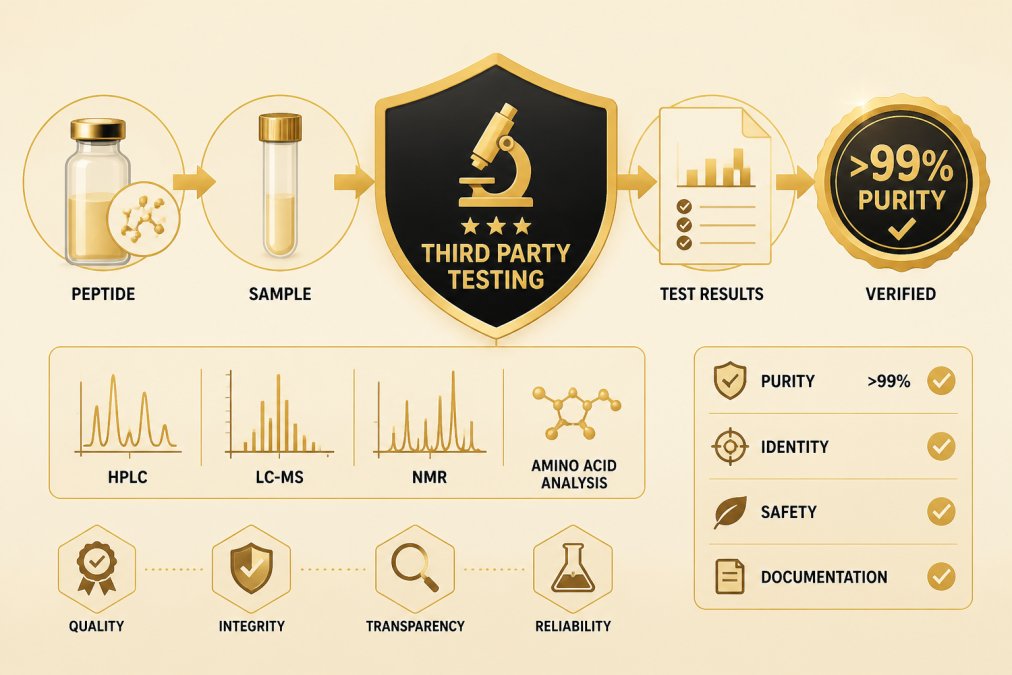
Third party peptide testing is the independent analytical verification of a peptide’s identity, purity, and safety by a laboratory with no financial stake in the synthesis or sale of that compound. At PepAlphatides, every batch undergoes independent third-party testing to verify purity levels exceeding 99%.
Here’s the uncomfortable truth: the difference between a study that replicates and one that quietly falls apart often comes down to a single unverified vial. If your starting material is 87% pure and you believe it’s 99%, every downstream measurement inherits that error. Confounding variables multiply. Results that looked promising become noise.
This guide breaks down how third party peptide testing works, how to read the documentation it produces, where suppliers cut corners, and how to verify claims before you spend a dollar. We’ll also cover the parts most guides skip: batch-to-batch consistency, chain of custody, and what a failed result actually tells you about who you’re buying from.
The stakes are simple. Analytical testing is the only mechanism that separates a research compound from an unverified powder in a vial.
What Is a Certificate of Analysis and What Belongs In One
A certificate of analysis (COA) is a formal document issued by a testing laboratory that reports the measured results of specific analytical tests performed on a specific batch of material. It is the primary evidence that a compound is what the label claims.
A legitimate COA is not a marketing sheet.
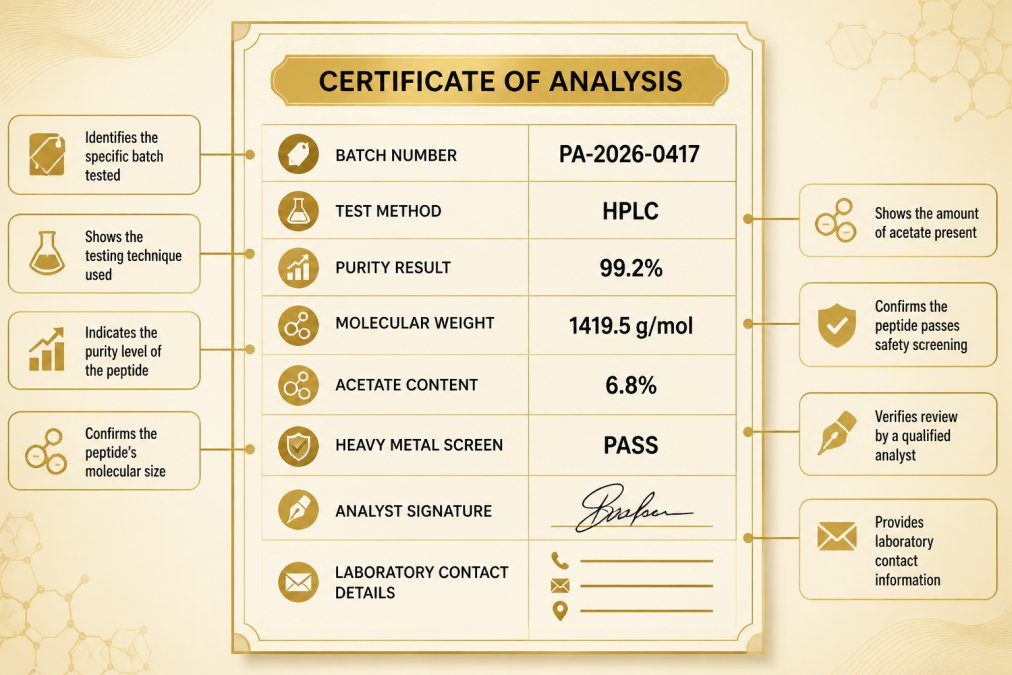
Required Fields: Batch Number, Methods, Results, and Signatures
Most credible COAs share a common skeleton. When you’re evaluating one, check for these fields:
- Batch or lot number that matches the vial label exactly
- Test methods named specifically, such as high-performance liquid chromatography or mass spectrometry, not “lab analysis”
- Measured results with units, including purity percentage, molecular weight, and acetate content where relevant
- Analyst name and signature, plus the testing laboratory’s name and contact details
- Date of analysis, so you know how current the data is
- Sample receipt and testing dates, which reveal turnaround and storage handling
A COA that lists results but no batch number, method, or analyst signature cannot be tied to your material. Suppliers recycle these documents across multiple batches because nothing on the page contradicts the claim. If you can’t match the numbers to your vial, you have no verification at all.
In-House vs Third Party Peptide Testing: Where Conflicts of Interest Hide
The core argument for independent verification is structural, not moral. A laboratory owned by the seller has a financial incentive in the result. That doesn’t make in-house testing fraudulent, but it does make it unverifiable by the buyer.
- The “independent” lab shares an address, phone number, or ownership with the supplier
- The lab only ever tests for one company, which is unusual for a commercial analytical laboratory
- Results are reported as a range or a threshold rather than a measured value
How to Read a Peptide COA Without a Chemistry Degree
You don’t need to run the assay yourself to judge whether a COA is credible. You need to know which fields carry weight and which are filler.
Reading Purity, Molecular Weight, and Acetate Content Values
Purity is reported as a percentage from a chromatographic method. It tells you what fraction of the detected material is your target peptide. A high number is good, but it says nothing about what the remaining fraction is.
When comparing two COAs for the same peptide, put the molecular weight and acetate values side by side first. Suppliers rarely fabricate these consistently across batches, so mismatches between the label, the COA, and the theoretical value surface faster here than in the purity percentage.
HPLC Peptide Purity Testing Explained in Plain Terms
High-performance liquid chromatography (HPLC) is the standard method for measuring peptide purity. It separates the components of a sample by how they interact with a stationary phase and a moving solvent, then measures how much of each component is present.
Mass Spectrometry and Sequence Verification: Confirming Identity, Not Just Purity
Purity tells you how much of the material is your target compound. Mass spectrometry tells you whether the target compound is actually the right one.
Heavy Metals, Residual Solvents, and the Impurity Profile That Purity Percentages Miss
A purity percentage is a single number, and single numbers hide detail. The impurity profile is the fuller picture: what the non-target material actually is.
Two categories deserve specific attention.
Purity and safety are separate questions. A peptide can be 99% pure and still carry a heavy metal contaminant, because the contaminant may be part of the 1%. Always look for a dedicated elemental analysis and residual solvent screen, not just a purity figure.
Batch-to-Batch Consistency: The Test Most Suppliers Never Show You
A single good COA proves one batch was good. It says nothing about the next order. Batch-to-batch consistency is the pattern of results across multiple production runs, and it’s the only evidence that a supplier’s process is controlled rather than lucky. Most guides stop at “ask for a COA.” This section goes further: how to actually run the comparison, what to measure, and what the numbers should look like when a process is under control.
Why One COA Is Not Evidence of Quality
Analytical testing is a snapshot. A purity result of 99.1% on batch A tells you that batch A met the supplier’s specification on the day it was tested. It tells you nothing about batch B, C, or the one that ships next month. If the supplier’s synthesis, purification, and lyophilization steps drift, different reagent lots, a column that needs replacing, a freeze-dry cycle that runs long, the next batch can land at 94% while the marketing page still shows the 99.1% certificate.
What to Request and How to Compare It
Ask the supplier for COAs covering at least three to five recent batches of the same peptide, ideally produced within the last six to twelve months. Then build a simple comparison table with one row per batch and these columns:
- Batch or lot number, confirm the sequence is logical and the dates are chronological
- Date of analysis, flag any gap longer than the supplier’s stated production cadence
- Purity percentage, the headline number, but not the only one
- Molecular weight (observed vs. theoretical), identity should hold steady across batches
- Acetate or counterion content, a value that swings widely suggests inconsistent salt conversion
- Heavy metal and residual solvent results, should be reported per batch, not just once
What a Controlled Process Actually Looks Like
A supplier with a well-controlled process typically shows purity results that sit within a narrow band, often a point or two of each other, across consecutive batches. Molecular weight values match the theoretical mass within a small tolerance every time. Acetate content stays in a consistent range. Batch numbers follow a predictable sequence, and the time between batches matches the supplier’s stated production schedule.
Plot purity against batch date on a simple line chart. A flat line with small variation is what a controlled process looks like. A jagged line with swings of several percentage points is a warning sign, even if every individual COA technically passes.
The Question That Separates Serious Suppliers From the Rest
Most suppliers will show you one COA. The ones confident in their process will show you several without hesitation. Ask this directly: “Can you send me the COAs for the last four batches of this peptide, including any that failed specification?” The answer tells you more than the documents themselves. A supplier who sends four clean certificates and one failed batch with a note explaining the corrective action is demonstrating a functioning quality system.
How to Document Consistency for Your Own Records
If your research requires traceability, for publication, replication, or internal audit, keep a running log of the COAs you receive. Record the batch number, test date, purity, molecular weight, and any contaminant results. Over time, this log becomes your own longitudinal dataset. If a supplier’s quality drifts, you will see it in your records before it ruins an experiment. If a supplier maintains consistency, you have documented evidence you can attach to a methods section or a materials provenance statement.
The Chain of Custody Process From Synthesis to Your Bench
Chain of custody is the documented record of who handled a sample, when, and under what conditions, from the moment it was drawn to the moment it was tested. It’s the mechanism that prevents a result from being attached to the wrong batch.
A defensible chain of custody includes:
- Sample collection at the synthesis or fill site, with a unique identifier assigned
- Sealed, labeled transfer to the testing laboratory, with dates recorded
- Laboratory receipt confirmation, noting sample condition
- Testing under the assigned identifier, with results tied to that identifier
- Archived records linking the identifier to the final product batch
How to Interpret a Failed Test Result (And What It Says About the Supplier)
A failed result is not automatically a dealbreaker. How a supplier handles it tells you more than the failure itself. But most guides stop there. The practical question is: what do you actually do when a COA lands in your inbox and one of the numbers is out of spec? This section walks through the interpretation, the decision points, and the documentation you should keep.
What “Failed” Actually Means on a COA
A failed test result means one or more measured values fell outside the specification the supplier set for that product. Specifications vary, but common failure triggers include:
- Purity below the supplier’s stated minimum, for example, a product advertised at ≥98% that tests at 95.2%
- Identity mismatch, observed molecular weight outside the acceptable tolerance from theoretical mass
- Contaminant above limit, a heavy metal or residual solvent result exceeding the supplier’s own threshold
- Missing or incomplete data, a certificate that omits a required field is functionally a failed report, even if the numbers shown look fine
The Three Responses That Define a Functioning Quality System
Suppliers who take quality seriously do three things when a batch fails:
- Quarantine the batch and stop shipping it. The material should be pulled from inventory, not sold at a discount or quietly shipped to buyers who don’t ask.
- Investigate the cause. Was it a synthesis issue, a purification problem, a handling error, or a testing artifact? A serious supplier can tell you what they found.
- Disclose the failure to affected buyers and either replace or refund. Disclosure is the hard part. Many suppliers will not volunteer a failure unless asked directly.
A Decision Framework for Researchers
When you receive a COA with a failed value, work through these questions in order:
- Which specification failed? A purity miss of half a percentage point is different from an identity mismatch. Identity failures are more serious because they suggest the material may not be the compound you ordered.
- Is the failure isolated or part of a pattern? Check the supplier’s other recent batches. One outlier is a data point. Three outliers in a row is a process problem.
- Did the supplier disclose it proactively, or did you have to ask? Proactive disclosure is a positive signal. Reluctant disclosure is a warning.
- What is the supplier’s corrective action? A specific answer, “we traced it to a column that needed replacement and re-ran the batch”, is credible. A vague answer, “we’ve addressed it”, is not.
- Does the failure affect your use case? If your work is exploratory and the purity miss is small, you may proceed with a note in your records. If your work is headed toward publication or replication, a failed identity or contaminant result should stop the order.
What a Documented Failure Tells You About the Supplier
A documented failure with a documented response is a sign of a functioning quality system. It means the supplier is testing honestly, catching problems, and telling buyers about them. That is more reassuring than a supplier who claims a perfect record, because a perfect record across many batches is statistically unlikely for any real manufacturing process.
Be cautious of suppliers who offer to “re-test” a failed batch without explaining what changed. Re-testing the same sample with the same method should produce the same result. If the second test passes, either the first test was flawed or the sample was different. Ask which, and ask for the raw chromatograms from both runs.
How to Document a Failed Result for Your Own Records
If you receive a failed COA, keep it. Record the batch number, the failed specification, the supplier’s response, and your decision. If you proceed with the material anyway, note why. If you reject it, note that too. Over time, this log becomes a record of which suppliers handle problems well and which ones don’t, information that is far more useful than any single certificate.
Red Flags: Spotting Fake or Recycled Third Party Peptide Testing Reports
Fake and recycled COAs are common enough that you should assume nothing until you’ve checked.
Watch for these patterns:
- Identical results across different batches, down to the decimal, which suggests the document was copied
- No batch number, or a batch number that doesn’t match the vial
- A testing laboratory with no verifiable web presence or contact information
- Method names that don’t exist, or vague descriptions like “advanced analysis”
- Purity reported without a method, making the figure unverifiable
- Signatures that are images pasted onto multiple documents
- Dates that don’t line up, such as a test date before the synthesis date
How to Verify a Supplier’s Testing Claims Before You Order
Verification is a process, and it takes about ten minutes per supplier once you know what to look for.
- Request the COA for the specific batch you’re buying, not a sample document. A supplier who can only provide a generic COA is telling you something.
- Confirm the testing laboratory exists. Search the lab name independently. Check that it has a real address and a history of testing for multiple clients.
- Check the batch number on the COA against the batch number on the product listing or vial.
- Look for the method names. HPLC and mass spectrometry should appear explicitly. If they don’t, ask.
- Ask for a second batch’s COA and compare the two. Consistency across batches is the strongest signal available to a buyer.
- Scan any QR code provided and confirm it resolves to a batch-specific record, not a generic page.
Researchers who need to document starting-material quality for publication, replication, or regulatory traceability, and who want batch records they can verify independently before ordering.
Pros and Cons of Third Party Testing Requirements for Buyers
Independent verification isn’t free, and it isn’t instant. Being honest about the trade-offs helps you decide what you’re willing to accept.
Pros:
- Evidence that the material is what the label claims, from a source with no stake in the sale
- Documentation you can attach to research records and defend if questioned
- Early detection of contaminants that a purity figure alone would hide
- A supplier filter: vendors who resist testing tend to have reasons
Cons:
- Cost, which shows up in the price of the compound, since testing isn’t free
- Turnaround time, because a batch can’t ship until results come back
- No universal standard, so you still have to judge method quality yourself
- Some suppliers test selectively, so a COA on one batch doesn’t guarantee the next
Frequently Asked Questions
What does third party testing mean for research peptides?
Third party testing means an analytical laboratory with no financial stake in the supplier performs the quality checks. The lab runs methods like HPLC for purity and mass spectrometry for identity, then issues a certificate of analysis signed by an analyst. Because the lab does not profit from a passing result, its findings carry more weight than a supplier’s own in-house report. This independence is the core reason third party peptide testing matters for reproducible research.
What is the most accurate lab test for peptides?
No single test covers everything. HPLC with UV detection at 214 nm quantifies chromatographic purity, while mass spectrometry confirms molecular weight and sequence identity. For elemental contaminants, inductively coupled plasma mass spectrometry (ICP-MS) measures heavy metals at trace levels. A complete COA combines these methods. A purity figure from HPLC alone tells you nothing about identity or heavy metal content, which is why reputable labs report multiple orthogonal tests.
How can researchers verify the authenticity of a Certificate of Analysis?
Check three things. First, confirm the batch number on the COA matches the vial label. Second, look for the testing lab’s name, contact details, and a verifiable report ID you can cross-check directly with that lab. Third, examine the methods section: it should name specific techniques like HPLC and mass spectrometry with instrument parameters, not vague wording. QR codes on vials that link to a live report add another layer of verification, since a static PDF can be edited.
What should I do if a peptide COA shows a failed or out-of-spec result?
A failed result is not automatically a dealbreaker if the supplier discloses it and explains the corrective action. Ask what happened to that batch: was it destroyed, re-purified, or sold anyway? Suppliers that publish failed results alongside passing ones demonstrate a functioning quality control system. The real red flag is a supplier whose every batch passes at exactly the same purity level, because real analytical testing produces natural variation between batches.
How much does third party peptide testing cost?
Cost depends on the panel: a basic HPLC purity check costs far less than a full workup including mass spectrometry, heavy metal screening, and stability testing. Pricing also varies by lab, turnaround time, and sample count. Rather than quoting a figure, ask your supplier which tests each batch receives and whether the full report is available before purchase. Testing costs are built into the product price, which explains part of the difference between suppliers.
Do third party tested peptides cost more, and is it worth it?
Independent testing adds cost per batch, so verified products usually price higher than untested alternatives. Whether that premium is worth it depends on your work. If you are running experiments where a wrong concentration or a contaminated sample wastes weeks of effort, the cost of a failed batch far exceeds the price difference. For exploratory work where precision matters less, the tradeoff is yours to weigh.