Last Updated: October 25, 2026
Quick Summary
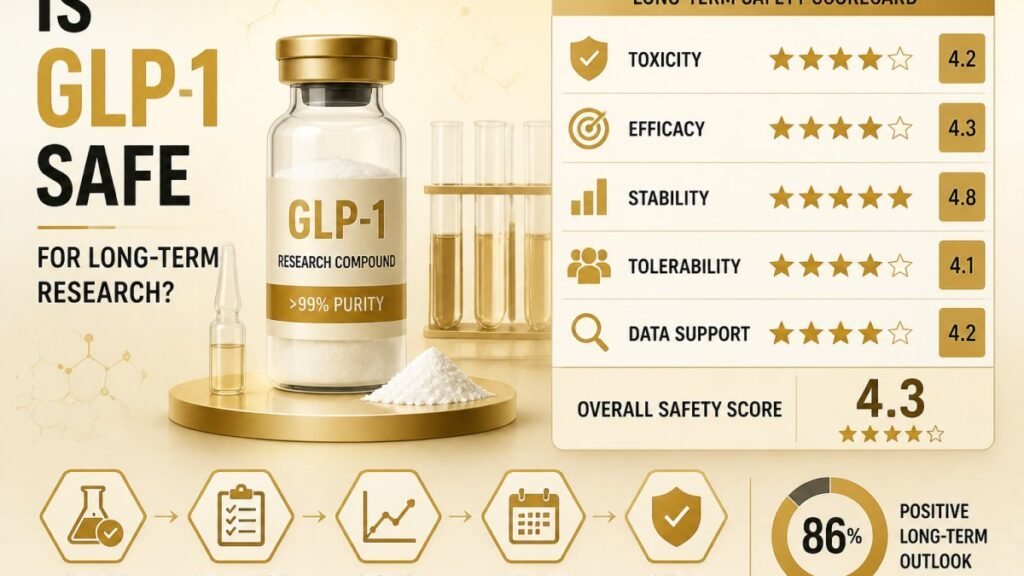
Is GLP-1 safe for long term research remains incompletely answered, particularly beyond the two-year mark that most clinical trials have examined. Current evidence supports safety for 2-3 years with specific drugs at tested doses, but long-term data beyond five years is sparse, requiring careful monitoring protocols in any extended research design.
- Most GLP-1 safety data comes from trials lasting 2-3 years; very few studies extend beyond that window.
- A 2026 study identified associations with decreased dementia and addiction risks alongside increased kidney, pancreas, and gastrointestinal problems.
- Randomized evidence on pancreatic safety is reassuring for specific agents at tested doses, but observational signals warrant deliberate monitoring in long-term protocols.
- Weight regain is rapid and substantial after discontinuation, with most subjects regaining most lost weight within weeks to months.
- Long-term protocols should include baseline and periodic monitoring of renal function, lipase, liver panel, and A1c, with more frequent checks for subjects on insulin or nephrotoxic agents.
Table of Contents
- What the Research Shows About GLP-1 Safety Over Time
- Long-Term Effects of GLP-1 Medications Beyond Weight Loss
- GLP-1 Long-Term Safety Studies: What We Know and Don’t Know
- Gastrointestinal Side Effects and Tolerability
- Pancreatic Safety: Separating Evidence From Concern
- Kidney, Cardiovascular, and Metabolic Outcomes
- Weight Regain After Stopping Semaglutide and Other GLP-1s
- GLP-1 Drug Interactions and Monitoring Considerations
- Planning Your Research Protocol With Current Evidence
- Frequently Asked Questions
What the Research Shows About GLP-1 Safety Over Time
Long-term safety is the critical question researchers face when evaluating GLP-1 receptor agonists for extended use. The evidence on is GLP-1 safe for long term research remains incomplete, particularly beyond the two-year mark that most clinical trials have examined. Rigorous researchers need to know what the data actually supports versus what remains uncertain, and that distinction matters enormously when designing protocols.
According to a 2024 cautionary review, long-term tolerability and efficacy beyond 2 years of GLP-1 agonist treatment were unknown. This limitation applies to most populations, including psychiatric cohorts where long-term data is especially sparse. A 2025 systematic review evaluated long-term efficacy and safety of GLP-1 receptor agonists for obesity, but the evidence base remains concentrated in shorter-duration trials.
The real challenge is this: we know these medications work for weight loss and blood glucose control in the short term. What we don’t know with confidence is how the body responds over five, ten, or twenty years. That gap between marketed use and actual long-term evidence is where careful researchers operate.
Long-Term Effects of GLP-1 Medications Beyond Weight Loss
GLP-1 medications do more than reduce appetite. They affect multiple metabolic pathways, and emerging research suggests benefits and risks that extend well beyond the scale. A 2026 study identified associations with decreased dementia and addiction risks, alongside increased kidney, pancreas, and gastrointestinal problems. These aren’t minor side effects, they’re signals that warrant serious attention in any long-term research design.
The neuroprotective effects are particularly intriguing. Some evidence suggests GLP-1 receptor agonists may reduce dementia risk, though the mechanism isn’t fully understood. This potential benefit has attracted attention from longevity researchers and those studying age-related cognitive decline. However, the same study flagged increased rates of kidney and pancreatic problems, meaning the risk-benefit profile shifts depending on which outcome matters most to your research question.
Weight loss itself produces secondary effects: improved blood pressure, better glycemic control, and reduced cardiovascular strain in many patients. But these benefits may not be universal. Researchers at the University of Virginia cautioned that substantial weight loss doesn’t always translate to improvements in heart and lung function, a finding that challenges assumptions about what weight reduction alone achieves.
For researchers planning long-term protocols, this means you cannot treat GLP-1 effects as a single outcome. You need to measure multiple endpoints: metabolic markers, organ function, cognitive performance, and body composition changes. Your research materials are only as valuable as the questions you ask with them.
GLP-1 Long-Term Safety Studies: What We Know and Don’t Know
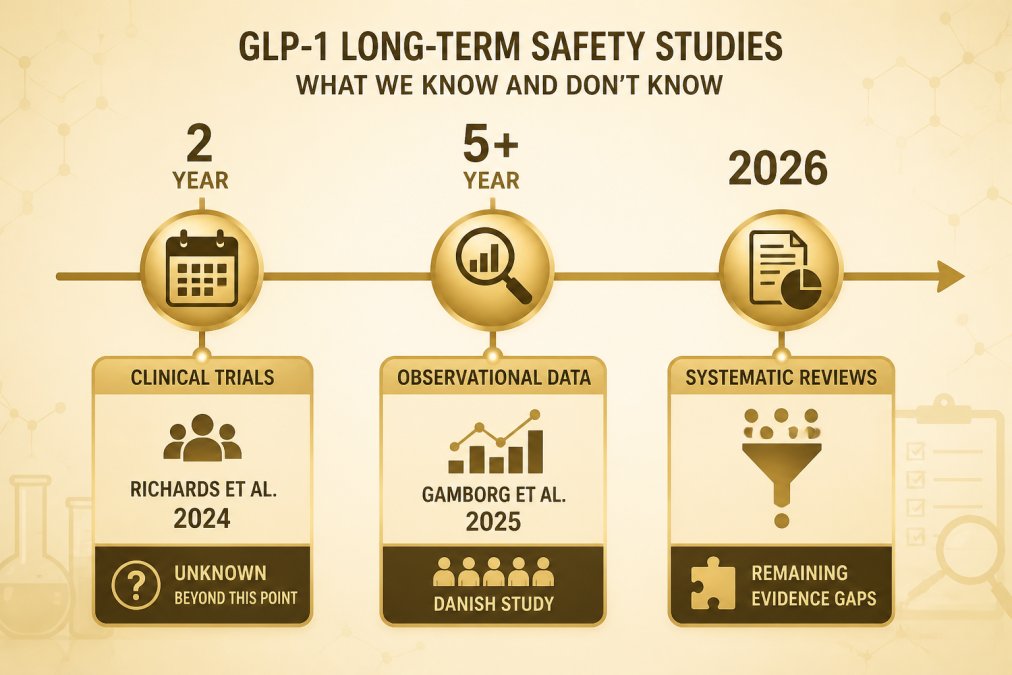
The distinction between “what we know” and “what we think we know” is where research integrity lives. Most GLP-1 safety data comes from trials lasting 2-3 years. Very few studies extend beyond that window, and fewer still track patients for a decade or more. This creates a credibility gap: the drugs are prescribed for long-term use, but the evidence for long-term safety is thin.
Researchers at Harvard noted that doctors do not yet have much long-term data on these medications. A 2026 study examining GLP-1 medication use and interest reported that 2.9% of respondents used these medications, yet the safety of long-term use is currently uncertain. That’s a significant gap: millions of people using compounds where the long-term evidence base is incomplete.
A 2026 review in the Journal of Clinical Investigation stated that concerns about increased acute pancreatitis and pancreatic cancer risk have been dispelled by long-term clinical trials. That’s important reassurance, but it applies only to the timeframes those trials measured. Beyond that, the question remains open. For researchers designing protocols, this means you need to specify your study duration upfront and acknowledge what evidence actually supports that choice.
The most honest assessment: we have solid data on 2-3 year outcomes, emerging data on 5+ year outcomes from observational studies, and almost no data beyond that. When you’re planning research, you’re working within those constraints.
Gastrointestinal Side Effects and Tolerability
Nausea, vomiting, and constipation are the most common complaints, so common that they’re almost expected. What makes them research-relevant is that tolerability often determines whether subjects stay in a study or drop out. High dropout rates undermine your data quality.
Most gastrointestinal effects appear during the dose-escalation phase and improve over time as the body adapts. Subjects on maintenance doses report fewer GI symptoms than those ramping up. But not everyone adapts. Some experience persistent nausea, diarrhea, or loss of appetite that doesn’t resolve even after months of use.
Tufts researchers reported challenges including gastrointestinal side effects, micronutrient deficiencies, and muscle and bone loss. This is the hidden cost of long-term use: the weight loss is real, but so are nutritional consequences. If your research measures body composition, you need to account for whether weight loss includes muscle or fat preferentially, and whether micronutrient status changes over time.
For researchers recruiting subjects, expect that GI tolerability will affect retention. Protocols that allow dose reduction or medication breaks may retain more subjects than rigid dosing schedules. This matters because your data quality depends on who completes the study, not just who enrolls.
Pancreatic Safety: Separating Evidence From Concern
Pancreatic inflammation and cancer were early safety concerns when GLP-1 medications entered widespread use. The concern made sense: the drugs stimulate the pancreas, and stimulation could theoretically increase inflammation or malignancy risk. But the evidence has evolved, and the honest way to read it is drug by drug, dose by dose, and duration by duration, not as a single verdict.
What the randomized evidence actually covers. The strongest pancreatic safety data comes from cardiovascular and weight-management outcome trials of specific agents. For semaglutide, the SUSTAIN and SELECT programs followed patients for roughly 2 to 5 years at doses up to 2.4 mg weekly; for liraglutide, the LEADER trial ran about 3.8 years at 1.8 mg daily; for dulaglutide, REWIND followed patients for a median of about 5.4 years at 1.5 mg weekly; for tirzepatide, the SURPASS and SURMOUNT programs ran 1 to 2 years at doses up to 15 mg weekly.
Where the observational signal lives. A 2025 Danish nationwide cohort study of sustained GLP-1 users reported a small increase in overall cancer risk that the authors noted could be partly explained by survival benefit, people lived long enough to develop cancers they might otherwise not have reached. The same study characterized population-level cancer risk as generally acceptable. The practical lesson is that a small relative increase in a rare event can translate into a very small absolute difference. If a rare pancreatic event occurs in, say, a fraction of a percent of patients over several years, a modest relative increase may still mean only a handful of additional cases per 10,000 patient-years.
Dose and indication matter. Pancreatic risk signals are not uniform across the class. Higher doses and rapid escalation are more often associated with gastrointestinal intolerance, which can complicate the clinical picture when abdominal pain appears. Indication matters too: patients with type 2 diabetes already carry elevated baseline pancreatitis risk from hypertriglyceridemia, gallstones, and alcohol use, so a GLP-1 signal in that population cannot be cleanly separated from background risk without careful adjustment. Obesity-only cohorts have a different baseline. Any long-term protocol should stratify by indication and baseline risk rather than pooling all comers.
What this means for a research protocol. If your study extends beyond 2 years, pancreatic monitoring should be explicit. Baseline lipase and amylase are inexpensive and give you a reference point; periodic monitoring is most defensible in subjects with hypertriglyceridemia, gallstones, heavy alcohol use, or prior pancreatitis. Document abdominal pain as a prespecified adverse event of special interest, with a defined threshold for imaging and for treatment interruption. Distinguish asymptomatic enzyme elevations from clinical pancreatitis, the former are common and usually not actionable, while the latter require discontinuation and workup. Build an adjudication process so that pancreatic events are classified by a blinded reviewer rather than by the treating investigator alone.
The bottom line: the randomized evidence is reassuring for the specific drugs and durations tested, the observational signal is small and partly confounded, and the honest research position is to monitor deliberately rather than to declare the question closed.
Kidney, Cardiovascular, and Metabolic Outcomes
The cardiovascular effects of GLP-1 medications are generally favorable: blood pressure drops, heart rate improves, and cardiovascular events decrease in most populations. These benefits are well-established in 2-3 year trials and contribute to why these drugs are used beyond weight loss alone.
Kidney function is more complex. The 2026 Washington University study identified increased kidney problems among long-term users. This doesn’t mean GLP-1s cause kidney disease in everyone, it means the risk signal is present and warrants monitoring. If your subjects have baseline kidney impairment or diabetes-related nephropathy, renal function becomes a critical outcome measure.
Metabolic outcomes extend beyond glucose and weight. Lipid profiles often improve, insulin sensitivity increases, and inflammatory markers may decline. But these improvements aren’t guaranteed, and individual variation is substantial. Some subjects see dramatic metabolic shifts; others see minimal change despite significant weight loss.
For research design, this means you need baseline and periodic labs: fasting glucose, lipids, renal function (creatinine, eGFR), and potentially inflammatory markers if your hypothesis includes inflammation. The longer your study, the more important these measurements become. The quality of your data depends on the rigor of your measurements.
Weight Regain After Stopping Semaglutide and Other GLP-1s
Here’s the reality that matters for long-term research: GLP-1 medications are intended for long-term use, and discontinuation has consistently been associated with weight regain. This isn’t a minor bounce-back; most subjects regain most of the weight they lost if they stop the medication.
This has two implications for researchers. First, if your protocol involves stopping the medication at any point, you need to plan for what happens next. Weight regain is rapid, often within weeks to months. If you’re measuring body composition, metabolic markers, or functional outcomes post-discontinuation, expect substantial shifts.
Second, this reality shapes how you think about “long-term safety.” If the medication must be taken indefinitely to maintain benefits, then long-term safety isn’t just about acute adverse events, it’s about tolerability and efficacy over years or decades. A medication that’s safe for 5 years but loses efficacy or becomes intolerable at year 7 is a different proposition than one that maintains both safety and benefit.
For your research protocol, consider whether your study includes a discontinuation phase. If it does, you need adequate follow-up to document what happens. If it doesn’t, you’re measuring outcomes while subjects are actively taking the medication, which is valuable but doesn’t answer questions about long-term management after stopping.
GLP-1 Drug Interactions and Monitoring Considerations
Most broad benefit-risk summaries stop at ‘GLP-1s delay gastric emptying and can cause hypoglycemia.’ That is true but not actionable. The gap competitors miss is a practical, evidence-based monitoring plan that names the interacting drug classes, the adjustment thresholds, and the follow-up cadence a long-term protocol should specify.
Delayed gastric emptying and oral absorption. GLP-1 receptor agonists slow gastric emptying, which can shift the time to peak concentration (Tmax) and, for some drugs, reduce total exposure. The effect is most consequential for medications with a narrow therapeutic index or a tight absorption window. Practical examples include levothyroxine (whose absorption is already food- and timing-sensitive), warfarin (where small shifts in absorption and appetite can move INR), and oral contraceptives (where vomiting during dose escalation can reduce effectiveness).
Hypoglycemia risk with insulin and sulfonylureas. This is the interaction most likely to cause harm in a long-term study. When a GLP-1 is added to insulin or a sulfonylurea, the glucose-lowering effects stack. The absolute risk depends heavily on baseline A1c, insulin dose, and renal function. A common clinical pattern is to reduce the sulfonylurea dose by roughly half at initiation, or to reduce basal insulin by about 20% when A1c is near target, then titrate based on self-monitored glucose.
Medications affected by appetite and food intake. GLP-1s suppress appetite, which changes the absorption profile of drugs that require consistent food intake, some antifungals, certain antibiotics, and a number of narrow-window oral agents. They also change alcohol intake in many patients, which matters for warfarin, metronidazole, and any drug with an alcohol-interaction warning. A medication review at baseline and at each dose escalation is the minimum; a structured interaction checklist is better.
Renal clearance and dehydration. Gastrointestinal losses from nausea, vomiting, or diarrhea can cause volume depletion, which raises the risk of acute kidney injury, especially in subjects on ACE inhibitors, ARBs, diuretics, or NSAIDs. The 2026 Washington University analysis flagged increased kidney problems among long-term users, and the practical mitigation is hydration guidance, sick-day rules for holding nephrotoxic agents during GI illness, and periodic creatinine and eGFR checks. For a multi-year protocol, quarterly renal monitoring in subjects with baseline eGFR below 60 mL/min/1.73 m² is a reasonable default.
A concrete monitoring cadence for long-term protocols. A defensible schedule looks like this: baseline medication reconciliation, renal function, lipase, liver panel, and A1c; a check at 4 to 8 weeks after each dose escalation for tolerability and hypoglycemia; quarterly labs in year one for subjects with comorbidities; and at least semiannual labs thereafter, with more frequent checks for anyone on insulin, a sulfonylurea, or a nephrotoxic agent. Prespecify which symptoms trigger urgent assessment, severe persistent abdominal pain, intractable vomiting, signs of dehydration, or severe hypoglycemia, and document how those events are adjudicated.
“It’s also important to note that the long-term side effects of these drugs are not yet well-studied.” — Yuan at University of Chicago Medicine, 2024
That quote captures the core issue: we are still learning, and the way to learn responsibly is to build monitoring into the protocol rather than bolt it on after an adverse event. A medication review process, a defined hypoglycemia protocol, and a scheduled lab cadence are what separate a rigorous long-term study from an observational one that happens to collect data.
For researchers using compounds from PepAlphatides, understanding how to handle, store, and prepare your materials is foundational, but equally important is understanding how they interact with the biological systems you’re studying, and with the other medications your subjects are taking. Understanding how to handle, store, and prepare your materials is foundational, but equally important is understanding how they interact with the biological systems you’re studying, and with the other medications your subjects are taking.
Planning Your Research Protocol With Current Evidence
Design your protocol with the evidence gaps in mind, not despite them. The fact that long-term data is limited doesn’t mean you can’t conduct rigorous research, it means you need to be explicit about what your study can and cannot answer.
Start by defining your study duration. Are you measuring outcomes over 6 months, 2 years, or 5 years? Each timeframe has different evidence support. Two-year studies align with the bulk of existing clinical trial data, making them easier to contextualize. Longer studies contribute to the evidence base but face more challenges with subject retention and cost.
Next, specify your outcome measures. Weight loss is obvious, but what else matters? Metabolic markers, body composition, functional capacity, cognitive outcomes, kidney function, pancreatic markers, cardiovascular parameters? The longer your study, the more important it is to measure multiple endpoints. This is where the distinction between weight loss and health improvement becomes concrete.
Consider your subject population. Are you studying people with obesity, type 2 diabetes, both, or neither? Do they have baseline kidney disease, cardiovascular disease, or psychiatric conditions? These factors change the risk-benefit calculation and may require additional monitoring.
When selecting a GLP-1 research compound, verify that your supplier provides lot-specific Certificates of Analysis, identity confirmation, purity documentation, and clear use boundaries. For researchers at PepAlphatides, we provide GLP-1 S 30mg semaglutide with documented purity exceeding 99%, independent third-party testing, and secure QR-coded reports for every batch. This transparency matters because your data is only as reliable as your materials.
| Research Consideration | What It Means | Why It Matters |
|---|---|---|
| Study duration | How long you measure outcomes | Longer studies require more evidence gaps; 2-year studies align with clinical trial data |
| Outcome measures | Weight, metabolic markers, organ function, cognition | Multiple endpoints reduce bias and capture full risk-benefit picture |
| Subject population | Demographics, comorbidities, medication history | Risk profile changes based on baseline health status |
| Monitoring frequency | How often you assess safety and efficacy | More frequent monitoring catches adverse events earlier |
| Discontinuation plan | What happens when subjects stop the medication | Weight regain is rapid; post-discontinuation follow-up is essential |
| Material sourcing | Purity, testing, documentation standards | Quality compounds ensure data reliability |
Finally, plan your reproducibility safeguards. If you’re conducting a multi-site study or planning for other researchers to replicate your work, detailed protocols, standardized procedures, and transparent reporting are essential. Document everything: how you prepare compounds, how you dose subjects, how you measure outcomes, how you handle adverse events.
The evidence on is GLP-1 safe for long term research will continue to evolve. Your protocol should be designed to contribute to that evidence base while protecting your subjects and maintaining scientific rigor. That means acknowledging what we know, being honest about what we don’t, and building research that advances both.
Frequently Asked Questions
Do GLP-1 medications have bad long-term effects?
GLP-1 receptor agonists show mixed long-term safety profiles. A 2024 review noted that long-term tolerability and efficacy beyond 2 years remain unknown, particularly for psychiatric populations. A 2026 Washington University study linked GLP-1 use to decreased dementia and addiction risk but also increased kidney, pancreatic, and gastrointestinal problems. A 2026 Danish study found a small increased cancer risk in long-term users, though overall cancer risk was characterized as generally safe at the population level. The key concern is incomplete long-term data, most clinical trials span 2-3 years, leaving questions about decade-long use unanswered.
What happens when someone stops taking a GLP-1 medication?
Weight regain after stopping semaglutide and other GLP-1 medications is consistent and well-documented. A 2026 study states that GLP-1 receptor agonists are intended for long-term use, and discontinuation has been associated with weight regain. Harvard Gazette reporting from 2026 confirms that GLP-1 weight and metabolic effects appear to wane after people stop treatment. Clinical experts quoted in Stanford Medicine (June 2026) unanimously stated that GLP-1s generally should be taken for life to maintain benefits. This suggests these medications function as ongoing therapies rather than one-time interventions.
What are the potential drug interactions with semaglutide?
GLP-1 drug interactions require careful monitoring. Semaglutide and other GLP-1 receptor agonists slow gastric emptying, which can affect absorption of oral medications taken concurrently. Researchers should consult current prescribing information and consider whether delayed gastric transit affects the bioavailability of co-administered drugs. Anyone using GLP-1 medications alongside other treatments should work with healthcare providers to time doses appropriately and monitor efficacy of concurrent medications.
How long have GLP-1 medications been studied for long-term safety?
Most clinical trials of GLP-1 receptor agonists span 2-3 years, making long-term safety data limited. A 2024 cautionary review by Richards et al. explicitly states that long-term tolerability and efficacy beyond 2 years of GLP-1 agonist treatment were unknown at the time of publication. A 2025 systematic review evaluated long-term efficacy and safety, but the evidence base remains incomplete for durations exceeding 5 years. Observational studies, such as the 2025 Danish cancer-risk study, provide some longer-term data, but the research community acknowledges that doctors do not yet have substantial long-term data for many outcomes.