Table of Contents
- What Is a Certificate of Analysis and Why It Matters
- The Purpose of a Certificate of Analysis: What It Verifies
- How to Read a Certificate of Analysis: Field-by-Field Breakdown
- Peptide Certificate of Analysis: Purity, Potency, and Composition
- Certificate of Analysis vs. Test Report: Key Differences
- How to Verify a Certificate of Analysis for Authenticity
- Understanding Detection Limits and Measurement Uncertainty
- Comparing Certificates of Analysis Across Products and Labs
- What to Do When a Result Fails or Information Is Missing
- How Third-Party Testing Ensures Research Integrity
- Frequently Asked Questions
Last Updated: October 20, 2026
What Is a Certificate of Analysis and Why It Matters
A certificate of analysis (CoA) is a detailed laboratory document that verifies the composition, purity, potency, and quality of a research compound.
At PepAlphatides, we recognize that every batch of research compounds deserves rigorous verification.
The certificate of analysis serves as the bridge between what a manufacturer promises and what you can independently verify.
Most researchers new to peptide work don’t immediately grasp why certificates of analysis matter.
A certificate of analysis from a reputable testing laboratory is your first line of defense against contaminated, mislabeled, or misrepresented compounds. Always request a CoA before purchasing research materials, and verify that testing was performed by an independent third-party laboratory, not the supplier itself.
The Purpose of a Certificate of Analysis: What It Verifies
The primary purpose of a certificate of analysis is to document what was actually found when a laboratory tested a specific batch of product.
A CoA typically verifies several key aspects of product quality. Second, it documents purity levels, showing the percentage of the active compound versus inert materials or impurities.
The certificate of analysis also establishes traceability.
Different industries and regulatory contexts define CoA requirements differently. In pharmaceutical and supplement manufacturing, CoAs are often mandated by regulatory bodies.
A certificate of analysis is your documented proof of batch quality. It transforms a supplier’s claim into independently verified data, making it an essential document for any serious research work.
How to Read a Certificate of Analysis: Field-by-Field Breakdown
Reading a certificate of analysis requires understanding what each section represents and why it matters. Most CoAs follow a similar structure, though formatting varies by laboratory.
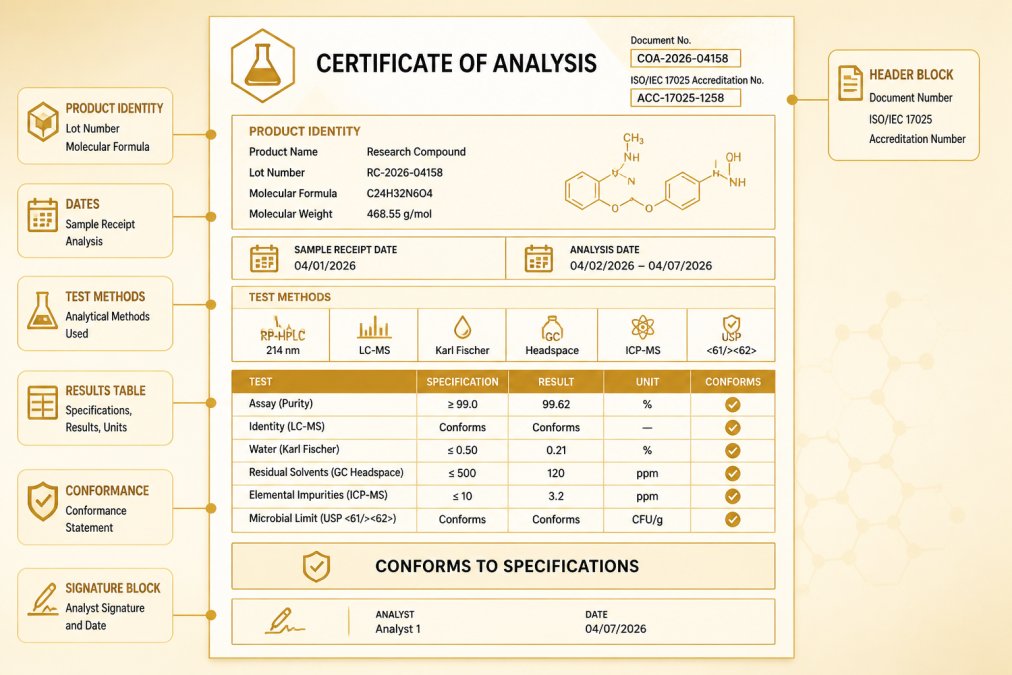
Below is an annotated walkthrough of a representative CoA for a research peptide. The values are illustrative, not a claim about any specific product, but the structure, units, and pass/fail logic mirror what accredited laboratories typically report.
Header Block: Document Identity and Traceability
The top of the certificate establishes what document you are holding and who issued it. Expect to see:
- Document title and number, for example, “Certificate of Analysis, CoA No. 24-10-1187.” The number lets the laboratory retrieve the record if you call to verify it.
- Laboratory name, address, and contact information, a legitimate CoA makes the testing facility easy to reach.
- Accreditation statement and number, for example, “ISO/IEC 17025 accredited, A2LA certificate No. 1234.01.” The accreditation number is what you verify against the accrediting body’s public directory.
If the header lacks a document number, a verifiable accreditation number, or contact details, treat the rest of the document with caution.
Product Identity and Batch Information
The identity block answers “what was tested?” and “which batch?” Typical fields include:
- Product name, for example, “BPC-157, research grade.”
- Lot or batch number, for example, “LOT 20241002-A.” This is the single most important field for you, because it must match the batch number printed on the vial or container you received. A CoA without a lot number cannot be tied to your material.
- CAS number and molecular formula, for a peptide, the CAS registry number and the amino acid sequence or molecular formula confirm you received the specific compound ordered, not a related analog.
Cross-check the manufacturer or supplier named on the CoA against your purchase record. A mismatch is a red flag worth resolving before you use the material.
Test Methods Column
Every result line should name the method used. A representative peptide CoA might list:
- Purity and assay, “RP-HPLC, UV detection at 214 nm, C18 column.” The wavelength and column chemistry matter because different detection wavelengths reveal different impurities.
- Identity confirmation, “ESI-MS” or “LC-MS,” reporting the observed mass-to-charge ratio against the theoretical value.
- Water content, “Karl Fischer titration.”
A result reported without a method is difficult to interpret and difficult to compare against another laboratory’s data.
Specifications, Results, and Units
This is the core table. Each row pairs a test parameter, a specification (the acceptance criterion), the measured result, and a pass/fail call. A representative set of rows might read:
| Parameter | Method | Specification | Result | Status |
|---|---|---|---|---|
| Appearance | Visual | White to off-white powder | Conforms | Pass |
| Identity (mass) | LC-MS | Theoretical MW ± 1.0 Da | 1419.5 Da (theoretical 1419.5) | Pass |
| Purity | RP-HPLC, 214 nm | ≥ 98.0% | 99.2% | Pass |
| Water content | Karl Fischer | ≤ 8.0% | 4.1% | Pass |
| Residual solvents | GC headspace | Below ICH Q3C limits | Below limit of quantification | Pass |
| Heavy metals | ICP-MS | ≤ 10 ppm total | < 5 ppm | Pass |
| Microbial limits | USP <61>/<62> | TAMC ≤ 10³ CFU/g; absence of specified organisms | < 100 CFU/g; none detected | Pass |
Read this table in three passes. First, confirm the specification column reflects criteria you actually care about. Second, compare the result to the specification and note the margin, not just the pass/fail. Third, check the units: a water content of “4.1” means nothing unless the unit is percent, and a heavy metals result of “< 5 ppm” is a non-detect at a stated threshold, not a measurement of exactly 5 ppm.
Conformance Statement and Signatures
The conformance statement is the formal declaration that summarizes the table: for example, “The above results conform to the specifications listed. This batch is approved for release.” It should be signed or electronically approved by an authorized analyst or laboratory director, with a printed name, title, and date. A certificate with no signatory, or with a signature block that is clearly a pasted image, deserves scrutiny.
What the Example Teaches
Notice what the walkthrough does not show: raw chromatograms, calibration curves, or the full method validation package. Those live in the underlying test report, not the certificate. The CoA is a summary document, and its job is to let you confirm identity, batch, methods, results against specification, and conformance in a few minutes.
Before you rely on any CoA, do the three-point match: lot number on the certificate equals lot number on your container; method listed for each result; result compared against a stated specification with units. If any of the three is missing, ask the supplier for a complete certificate.
Peptide Certificate of Analysis: Purity, Potency, and Composition
For peptide research compounds, the certificate of analysis focuses heavily on purity and composition. Peptides are chains of amino acids, and the exact sequence, length, and purity of that chain determine the peptide’s function and suitability for research.
Understanding Purity and Assay Results
Purity is expressed as a percentage and represents the proportion of the desired peptide in the sample.
The assay result is the measured purity determined by the analytical method used. At PepAlphatides, we ensure every batch undergoes independent third-party testing to verify purity levels exceeding 99%, giving researchers confidence in the consistency and quality of their experimental materials.
Potency, in the context of peptides, typically refers to the biological activity or functional strength of the peptide.
Understanding the difference between purity and potency is essential. A peptide can be very pure but have low potency if it’s been partially degraded. Conversely, a sample might contain the correct peptide but be contaminated with inactive byproducts, lowering purity.
Specifications and Acceptance Criteria
Every certificate of analysis includes a specifications section that lists the acceptable ranges for key test results. These specifications define what “passing” means for that batch. Common specifications for peptides include:
- Purity: typically 95% to 99%+ by HPLC
- Water content: usually less than 5-10%
- Residual solvents: below detectable limits or below regulatory thresholds
The certificate of analysis then shows the measured results and whether each result falls within the specification range. If a result is within range, it passes. If it falls outside the range, the batch fails that test. A conformance statement at the bottom of the CoA summarizes whether the overall batch meets all specifications.
If a measured result falls outside the specification range, that batch does not meet quality standards. Do not use a batch that fails any specification without first understanding why the failure occurred and whether it affects your research. A failed heavy metals test, for example, means the compound contains contaminants that could interfere with your results.
Certificate of Analysis vs. Test Report: Key Differences
The terms “certificate of analysis” and “test report” are sometimes used interchangeably, but they have subtle differences worth understanding.
A certificate of analysis is a formal, standardized document that certifies that a product meets specified standards.
A test report is a more general document that presents laboratory findings without necessarily making a conformance declaration.
When evaluating a supplier’s documentation, ask for a certificate of analysis rather than a generic test report.
How to Verify a Certificate of Analysis for Authenticity
Not all certificates of analysis are created equal. Some are legitimate documents from accredited laboratories. Others may be fabricated, altered, or generated by unqualified facilities. Verifying the authenticity of a certificate of analysis is a critical step in protecting your research integrity.
Assessing Laboratory Credibility and Testing Scope
Start by verifying that the laboratory listed on the certificate of analysis is a real, accredited facility. Look for accreditation marks or certifications on the document.
Many accreditation bodies maintain searchable databases of certified laboratories. For example, the A2LA (American Association for Laboratory Accreditation) maintains a public directory of accredited laboratories (Touchstone:Accreditation & Assessment Management System).
Next, assess the scope of testing. Does the certificate of analysis include tests for the contaminants and parameters relevant to your research?
Contact the laboratory directly if you have questions about their testing methodology or accreditation.
Checking for Red Flags and Document Fraud
Several red flags can indicate that a certificate of analysis may be fraudulent or unreliable.
Second, verify that all required fields are completed.
Third, look for a signature or approval from a qualified analyst or laboratory director.
Fourth, check whether the certificate includes the laboratory’s contact information and accreditation details.
Fifth, compare the CoA with other documentation from the same supplier.
Common red flags for fraudulent or unreliable certificates of analysis include: missing batch numbers, incomplete test results, lack of laboratory accreditation information, no analyst signature, inconsistent formatting, or purity claims that seem unrealistically high for the compound type. If you spot multiple red flags, request a new CoA from the supplier or consider switching suppliers.
Understanding Detection Limits and Measurement Uncertainty
Every analytical test has limits. No laboratory can detect infinitesimally small amounts of contaminants, and no measurement is perfectly precise. Understanding detection limits and measurement uncertainty helps you interpret your certificate of analysis realistically, especially when a result is a non-detect or sits close to a specification limit.
The Three Thresholds You Will See
Analytical methods are characterized by three related thresholds:
- Limit of detection (LOD), the smallest amount of a substance the method can reliably distinguish from background noise. Results below the LOD are reported as “not detected” or “< LOD.”
- Limit of quantification (LOQ), the smallest amount that can be measured with acceptable accuracy and precision. Results between the LOD and LOQ are often reported as “detected but not quantified” or “< LOQ.”
- Reporting limit, the threshold the laboratory sets for routine reporting, often at or slightly above the LOQ. A result of “< 10 ppm” usually means the reporting limit is 10 ppm, not that the laboratory looked for 1 ppm and found nothing.
A non-detect is therefore a statement about the method, not a guarantee of absence. “Heavy metals: < 5 ppm” means the method could not find metals at or above 5 ppm; it does not prove the sample contains zero. When the specification is “≤ 10 ppm,” a non-detect at 5 ppm is comfortably conforming. When the specification is “≤ 1 ppm,” the same non-detect tells you nothing useful, because the method was not sensitive enough to demonstrate compliance.
Reading a Non-Detect Correctly
The practical rule: compare the reporting limit to the specification, not the word “none” to the specification. If the reporting limit is at or below the specification limit, a non-detect supports a pass.
This distinction matters most for trace contaminants. A residual solvent screen reported as “below LOQ” against an ICH Q3C limit is a meaningful pass when the LOQ is well under the limit.
Measurement Uncertainty and Borderline Results
Measurement uncertainty is the range around a reported value that likely contains the true value. Laboratories express it in different ways: a plus-or-minus figure (“99.2% ± 0.4%”), a expanded uncertainty at a stated confidence level, or a statement that uncertainty is available on request.
Borderline results are where uncertainty changes the decision. Suppose a purity specification is “≥ 98.0%” and the reported result is 98.1% with an uncertainty of ± 0.4%. The measured value passes, but the uncertainty band extends below the specification.
A few practical habits help:
- Ask for the uncertainty statement if the certificate does not include one. Accredited laboratories can provide it.
- Note the margin, not just the status. A result one unit inside a limit is a different risk profile from a result in the middle of the range.
- Distinguish “conforms” from “comfortably conforms.” Both may be passes, but only one gives you room for method-to-method variation.
Why This Matters for Comparing Certificates
Two certificates can report the same specification and the same pass status while telling you very different things, because their reporting limits and uncertainties differ. A laboratory reporting heavy metals at a 1 ppm reporting limit gives you more information than one reporting at 10 ppm, even if both say “pass.” When you compare suppliers, compare the reporting limits and uncertainty statements alongside the results.
A “not detected” or “below limit” result is only as strong as the reporting limit behind it. If the reporting limit is higher than the specification limit you care about, the result does not demonstrate compliance. Ask the laboratory for the LOD, LOQ, and reporting limit before you treat a non-detect as proof of absence.
Interpret every result in three dimensions: the measured value, the specification it is compared against, and the method’s detection and uncertainty limits. A pass with a thin margin or a non-detect above the specification limit deserves a follow-up question, not a blind acceptance.
Comparing Certificates of Analysis Across Products and Labs
Start by checking whether all certificates use the same test methods.
Next, verify that specifications are comparable. One lab might accept purity between 95% and 99%, while another might specify 98% to 99.5%.
Also compare the testing scope. Does one lab test for heavy metals while another doesn’t?
Look for consistency within a supplier’s batches over time.
At PepAlphatides, we maintain consistent testing standards across all batches.
What to Do When a Result Fails or Information Is Missing
Occasionally, you’ll encounter a certificate of analysis where a result falls outside specifications or where critical information is missing.
First, contact your supplier and ask for an explanation. Sometimes a failed result indicates a real quality issue.
If critical information is missing from the certificate of analysis, such as the batch number, test methods, or conformance statement, request a complete CoA from the laboratory.
If the laboratory cannot provide a complete or satisfactory certificate of analysis, consider this a red flag about the supplier’s quality standards.
A failed specification or missing information on a certificate of analysis is a legitimate reason to request a replacement batch or refund. Your research depends on material quality, and you should never compromise on documentation or test results.
How Third-Party Testing Ensures Research Integrity
When a manufacturer tests its own products, there’s an inherent conflict of interest.
Accredited third-party laboratories follow standardized testing protocols and maintain rigorous quality control.
According to FDA guidance on third-party testing programs, independent laboratory verification of product quality is a best practice that strengthens confidence in product safety and efficacy.
At PepAlphatides, every batch undergoes independent third-party laboratory testing. We don’t test our own products.
The benefits of third-party testing extend beyond initial batch verification.
Choosing research compounds without verifying their quality through a comprehensive certificate of analysis is a risk that undermines your entire research project.
| Certificate Section | What It Shows | Why It Matters |
|---|---|---|
| Product Identity & Batch Number | What compound was tested and which specific batch | Links results to your specific vial; enables traceability |
| Sample & Analysis Dates | When testing was performed | Indicates data freshness; helps assess compound stability |
| Test Methods | Which analytical techniques were used (HPLC, ICP-MS, etc.) | Determines sensitivity and what can be detected |
| Purity/Assay Results | Percentage of active compound vs. impurities | Confirms the compound strength and composition |
| Specifications & Results | Acceptable ranges and whether batch passed | Clear pass/fail determination for quality standards |
| Conformance Statement | Official declaration of pass or fail | Formal verification that batch meets requirements |
| Laboratory Accreditation | Certifications and credentials of testing facility | Confirms laboratory is qualified and independent |
Frequently Asked Questions
What is a certificate of analysis and why do I need it for peptide research?
A certificate of analysis is an official laboratory report that documents the purity, potency, and composition of a specific batch of peptide. It verifies that the product meets stated specifications and confirms batch identity through lot numbers and sample dates. For research purposes, a CoA ensures consistency across experiments, provides traceability for regulatory compliance, and confirms that the compound you received matches what you ordered. Third-party testing adds credibility by removing any bias from the manufacturer.
How do I know if a peptide certificate of analysis is legitimate?
Verify the laboratory’s credentials by checking if they are accredited by recognized standards bodies. Look for specific test methods listed (HPLC, mass spectrometry, etc.) rather than vague descriptions. Legitimate CoAs include the lab’s contact information, analyst signature or ID, and analysis date. Cross-reference the batch number on the CoA with the product you received. Be cautious of CoAs that lack detection limits, show suspiciously round numbers (like exactly 99.9% purity), or omit critical test results. Secure QR codes linking to batch-specific reports add another verification layer.
What is the difference between a certificate of analysis and a test report?
A certificate of analysis is a formal, standardized document that confirms a product meets specifications and includes a conformance statement (pass/fail). A test report is a detailed technical document showing all raw data, methodology, and results without necessarily confirming whether the product meets standards. A CoA is typically shorter and designed for compliance and purchasing decisions, while a test report provides deeper analytical information for research purposes. Many providers issue both: the CoA for verification and the full test report for detailed analysis.
How do I compare certificates of analysis from different suppliers or labs?
Check that all CoAs use the same test methods for the same analytes, as different methods can yield different results. Compare the reported purity percentages, but also verify the detection limits and measurement uncertainty for each lab. Look at the specifications listed: ensure they align with your research requirements. Note the analysis dates and batch numbers to confirm you are comparing the same product generation. Be wary of comparing results from labs with different accreditation levels. Request full test reports if CoAs alone don’t provide enough detail to make a confident decision.
What should I do if a peptide fails its certificate of analysis or key information is missing?
Contact the supplier immediately with the batch number and specific results in question. Request clarification on whether the failure is in a critical parameter for your research or a secondary specification. Ask the lab to confirm the test method used and whether measurement uncertainty could explain borderline results. If key information is missing (detection limits, conformance statement, lab accreditation), request a complete CoA before proceeding. Do not use the batch for research until you have clear answers. Document all communications for your records.
What do purity and potency mean on a peptide certificate of analysis?
Purity refers to the percentage of the target peptide in the sample, with the remainder being impurities or degradation products. Potency measures the biological activity or functional strength of the peptide in your research application. A CoA reports purity as a percentage (e.g., 99.2%) determined by analytical methods like HPLC. Potency is context-dependent: it may be expressed as a percentage of expected activity or as a specific unit of biological effect. Both values must meet your research specifications. High purity does not automatically guarantee high potency; both must be verified independently.
How do I interpret the test methods and acceptance criteria listed on a CoA?
Test methods (such as HPLC, mass spectrometry, or microbial testing) describe the analytical technique used to measure the compound. Each method has specific sensitivity and accuracy ranges. Acceptance criteria are the upper and lower limits the product must fall within to pass. For example, a purity acceptance criterion might be 98-102%, meaning the reported value must fall in that range. The CoA shows the measured result and confirms whether it meets the criteria (pass/fail conformance statement). Understanding these ensures you know exactly what was tested, how it was tested, and whether the results are acceptable for your research goals.
What are detection limits and measurement uncertainty, and why do they matter on a CoA?
Detection limit is the lowest concentration a test can reliably measure; anything below that threshold cannot be quantified. Measurement uncertainty is the range of error around a reported result. For example, if a CoA reports 99.5% purity with ±0.3% uncertainty, the true value likely falls between 99.2% and 99.8%. These values matter because they explain why results from different labs or methods may vary slightly. A result close to the acceptance limit may actually pass or fail depending on measurement uncertainty. Always check these values when comparing CoAs or when results are borderline for your research specifications.