Table of Contents
- Why Shipping Delays Hurt Lab Research and How to Prevent Them
- Identify the Root Causes of Shipping and Carrier Delays
- Plan Ahead: Set Realistic Delivery Windows and Lead Times
- Lab Inventory Management Best Practices to Reduce Reorder Urgency
- Define Your Critical Lab Supplies Reorder Point
- How to Track Laboratory Supply Orders from Placement to Arrival
- Choose a Reliable Carrier or Courier for Temperature-Sensitive Materials
- Use a Supplier Delay Communication Template to Stay Aligned
- Prepare Shipping Documentation and Packaging to Prevent Damage Claims
- Create a Contingency Plan for Missed Deliveries and Service Disruptions
- Frequently Asked Questions
Last Updated: October 18, 2026
Why Shipping Delays Hurt Lab Research and How to Prevent Them
Avoiding shipping delays for lab supplies is critical because delays can derail research timelines, compromise experimental integrity, and waste months of planning. At PepAlphatides, we work with researchers who know avoiding shipping delays for lab supplies isn’t about convenience, it’s about protecting the validity of your work.
A late delivery of temperature-sensitive materials can mean the difference between usable compounds and wasted batches, forcing you to restart timelines already committed to collaborators or regulators.
This guide covers identifying delay causes, planning realistic timelines, managing inventory smarter, and building contingency systems.
Identify the Root Causes of Shipping and Carrier Delays
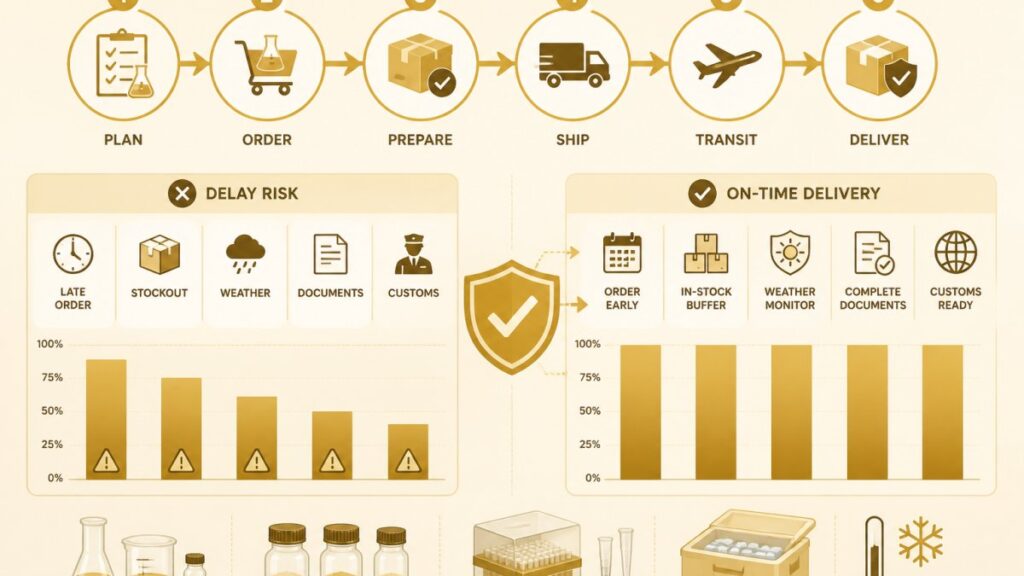
Understanding why delays happen is your first step toward preventing them. Most shipping disruptions fall into a few predictable categories.
Carrier delays are the most common culprit. Weather, mechanical failures, route congestion, and staffing shortages slow couriers, and temperature-controlled shipping adds complexity since any deviation can require rerouting.
Supplier delays happen before your package ships: inventory issues, quality control holds, or documentation problems. If supplies require independent third-party testing before release, that verification adds days.
Address and documentation errors are surprisingly common. A mistyped zip code, unclear building access instructions, or incomplete hazmat paperwork can trap your shipment for days.
Seasonal and geographic factors matter too: winter weather slows transit, rural locations have fewer carrier options, and holidays overwhelm the logistics network.
The fix starts with knowing which of these affects YOUR supply chain. Track where delays happen most often, by carrier, supplier, or time of year, and focus prevention there.
Plan Ahead: Set Realistic Delivery Windows and Lead Times
The most effective way to avoid shipping delays is to build realistic delivery windows into your research timeline from the start.
Never assume best-case delivery times. If a supplier says “5-7 business days,” add buffer for processing (2-3 days), transit (5-7 days), and unexpected holds (1-2 days). A realistic lead time for most lab supplies is 10-14 business days; temperature-controlled shipping often takes longer.
Map your critical path. Identify supplies that, if delayed, stop your entire project. Order these first and earliest; non-critical supplies can follow later.
Set internal deadlines before external ones. If your study site needs materials by a specific date, order 3-4 weeks earlier so you can handle delays without missing your real deadline.
Document your lead times by supplier. After a few orders, you’ll know which suppliers deliver in 10 days and which take 14. Use that historical data, not the stated estimate.
| Supply Type | Typical Lead Time | Buffer to Add | Order By This Date |
|---|---|---|---|
| Standard lab compounds | 10-14 days | 3-5 days | 17-19 days before need |
| Temperature-sensitive materials | 12-18 days | 4-7 days | 21-25 days before need |
| Hazardous materials | 12-16 days | 3-5 days | 19-21 days before need |
| Custom or specialized compounds | 14-21 days | 5-7 days | 26-28 days before need |
Set a calendar reminder 4 weeks before you need critical supplies. This gives you a reorder checkpoint before delays become emergencies. Most research delays are preventable, they just require planning further ahead than feels comfortable.
Lab Inventory Management Best Practices to Reduce Reorder Urgency
Better inventory management removes the pressure that leads to rushed orders and missed deadlines, letting you order strategically and accept realistic lead times.
Track consumption rates accurately. Many labs estimate usage instead of measuring it. Count how much of each supply you use per week or experiment; that real number is your baseline.
Build a reorder calendar. Once you know your consumption rate, calculate when you’ll hit your reorder point and mark that date on a shared calendar. This removes guesswork and last-minute panic.
Maintain a safety stock for critical supplies. For regularly used compounds, keep 2-3 weeks of extra supply on hand so a delayed shipment doesn’t stop your work; you dip into reserves while you wait.
Consolidate orders where possible. Ordering multiple supplies from one vendor in a single shipment reduces exposure to carrier delays and often qualifies for volume discounts.
Use supplier inventory visibility tools. Verify items are in stock before ordering to prevent delays from backorders disguised as “in-stock” items.
The single biggest mistake labs make is treating inventory as something to manage reactively. Switch to a calendar-based system where you know exactly when each supply needs to be reordered.
Define Your Critical Lab Supplies Reorder Point
A critical lab supplies reorder point is the inventory level at which you must place a new order to avoid stockouts. Setting this correctly is the backbone of reliable supply chains.
Calculate your reorder point using this simple formula:
Reorder Point = (Average Daily Usage × Lead Time in Days) + Safety Stock
For example, if you use 5 units per day, your lead time is 14 days, and you want 10 units of safety stock:
Reorder Point = (5 × 14) + 10 = 80 units
Order when inventory hits 80. By the time your new shipment arrives (14 days later), you’ll have used those 80 units and hit your safety stock buffer.
Apply this to your three most critical supplies first, the compounds that halt research immediately if you run out. Once those are dialed in, expand to secondary supplies.
Adjust your reorder point seasonally. If research volume increases in certain quarters, raise your reorder point then; lower it during slower seasons to avoid excess stock.
Review and update quarterly. As your research program evolves, consumption rates change. Recalculate reorder points every three months to stay accurate.
How to Track Laboratory Supply Orders from Placement to Arrival
Shipment tracking isn’t just about knowing when your package arrives, it’s about catching problems before they become delays.
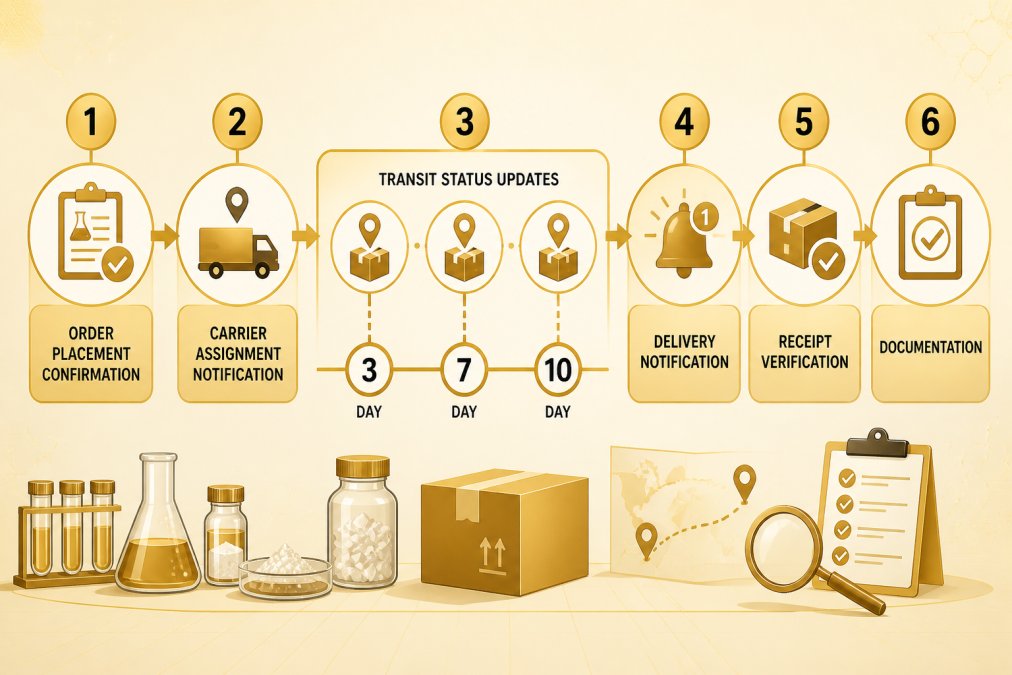
Step 1: Capture tracking information immediately. Save the tracking number with order date, expected delivery date, and supplier name to create an audit trail.
Step 2: Activate carrier notifications. Turn on email or SMS alerts so you get updates when your package ships, is in transit, and is out for delivery.
Step 3: Check status 3 days before expected delivery. Don’t wait until the delivery date. Check tracking 72 hours early and address delays now rather than on the day you needed the shipment.
Step 4: Verify delivery confirmation. When the package arrives, confirm receipt immediately. Check that the seal is intact, temperature indicators (if applicable) look normal, and contents match the order.
Step 5: Log any delays or damage. Note delay duration, carrier, and visible cause to reveal which carriers and routes are most reliable.
A common mistake is assuming a “delivered” status means your package is safe. Temperature-sensitive materials can degrade in a delivery truck. Check the package condition immediately. If the temperature indicator shows exposure, document it and contact the supplier for replacement before using the materials in your research.
Choose a Reliable Carrier or Courier for Temperature-Sensitive Materials
Not all carriers are equal for lab supplies, especially temperature-sensitive materials. The right one reduces delays, damage claims, and the risk of a temperature excursion that silently ruins a shipment.
Qualify carriers on five criteria, not three. Beyond reliability and temperature control, evaluate validation documentation, exception handling, and claims performance.
1. On-time performance, measured not assumed. Ask for on-time delivery rate by service level and by lane. A carrier that is 95% on-time nationally may be 80% on-time on the rural lane your study site sits on. Request lane-level data; if the carrier won’t share it, that is itself a signal.
2. Cold-chain validation and monitoring. For temperature-sensitive compounds, ask three questions: Does the carrier provide continuous temperature monitoring with downloadable data loggers, or only endpoint indicators? What is the documented acceptable temperature range and excursion duration for the service? And what happens operationally when an excursion is detected in transit, is the package rerouted, held, or delivered with a flag? Carriers that specialize in cold-chain logistics use insulated containers, refrigerated vehicles on certain lanes, and validated pack-outs. They cost more, but they prevent total loss of expensive shipments.
3. Coverage and accessorial services. Confirm the carrier services your exact delivery address, including dock access, inside delivery, liftgate needs, and appointment scheduling. Rural and institutional addresses frequently trigger accessorial fees and missed-delivery attempts that look like carrier delays but are really address-capability mismatches.
4. Exception handling and proactive notification. The best carrier is the one that tells you about a problem before you discover it. Ask whether the carrier provides proactive exception alerts (weather hold, mechanical delay, address issue) and how quickly. A carrier that notifies you at the moment of exception gives you hours to activate a contingency; one that only updates tracking status gives you nothing until the delivery window passes.
5. Claims and replacement performance. For high-value or irreplaceable shipments, ask how damage and loss claims are handled, typical resolution time, and whether the carrier offers declared-value coverage above the default. A cheap carrier with a slow claims process can cost more than a premium carrier that resolves a lost shipment in days.
Match the carrier to the supply type. General parcel carriers are fine for ambient-stable consumables and lab plastics. Temperature-sensitive reagents, biological samples, and dry-ice shipments need a carrier with documented cold-chain capability and dry-ice handling rules. Hazardous materials need a carrier authorized for the applicable hazard class and trained in the required documentation. Using a general carrier for a hazmat or cold-chain shipment is one of the most common causes of multi-day holds at sorting facilities.
Ask your supplier which carrier and service level they use, and why. Many default to the cheapest service meeting nominal transit time. For critical compounds, ask whether a faster or validated service is available and what it costs; some suppliers offer dedicated courier or white-glove service at a premium.
Track carrier performance over time. After 5-10 shipments, calculate on-time delivery rate, transit-time variance, damage rate, and temperature-excursion rate per carrier and lane. Stick with carriers that perform on your lanes; consistency beats chasing the lowest price.
Before you commit a critical shipment to a new carrier, run a test shipment of a non-critical item on the same lane and service level. You will learn more from one real transit than from any sales call, including how the carrier handles exceptions and how accurate its tracking updates are.
Carrier cold-chain and hazardous materials service requirements
Use a Supplier Delay Communication Template to Stay Aligned
When delays happen, communication prevents panic and keeps your team aligned. Use this template to document and communicate with your supplier and your team.
Subject: Shipment Delay Report – Order [Order Number] – [Supplier Name]
To: [Supplier Contact] | [Your Team Lead] | [Study Site Coordinator]
Shipment Details:
- Order Number: [#]
- Original Expected Delivery: [Date]
- Current Expected Delivery: [Date]
- Delay Duration: [X days]
Reason for Delay (per supplier):
[Carrier issue / Inventory hold / Quality control / Documentation / Other]
Impact on Research Timeline:
[Describe how this affects your study. Example: “Delays our patient enrollment by 5 days” or “Requires us to reschedule experiment for next week”]
Action Plan:
- Supplier has confirmed new delivery date
- Alternative supplier contacted (if applicable)
- Study site notified of new timeline
- Budget impact assessed (if any)
Escalation Point:
If delivery does not occur by [New Date + 2 days], escalate to [Supplier Manager Name] or contact [Alternative Supplier].
Follow-Up:
Check in with supplier 48 hours before new delivery date to confirm status.
Send this template to your supplier as soon as you learn of a delay. It shows you’re organized, it prevents miscommunication, and it creates accountability. Most suppliers respond faster when they know you’re tracking the issue formally.
Prepare Shipping Documentation and Packaging to Prevent Damage Claims
Poor documentation and packaging cause delays that feel like carrier failures but are preventable on your end. For lab supplies, the paperwork and packaging must match the material’s hazard class and temperature requirements. Get these right from the start.
Shipping documentation must be complete, accurate, and matched to the supply type. At minimum, include:
- Correct recipient address with building access details (gate code, suite number, dock entrance, receiving hours)
- Accurate hazardous materials classification and the corresponding shipping papers (for example, a Shipper’s Declaration for Dangerous Goods where required)
- Dry-ice notation: the net weight of dry ice and the proper shipping name and UN number on the air waybill and package marking
- Contents description matching the invoice and packing list
- Special handling instructions (fragile, temperature-sensitive, do not stack, this side up)
- A 24/7 contact phone number and email for the receiving lab
Incomplete or incorrect documentation traps shipments in carrier facilities while staff verify details, adding 2-5 days. Hazardous and dry-ice shipments are especially prone to holds because the carrier is legally required to verify the paperwork before moving the package.
Packaging must protect both the material and the temperature profile. Use:
- Sturdy outer boxes (double-walled corrugated cardboard) sized so the inner contents cannot shift
- Cushioning material (bubble wrap, foam inserts) on all six sides, not just the top and bottom
- A validated temperature-controlled pack-out for sensitive materials: insulated cooler, conditioned refrigerant (gel packs, phase-change materials, or dry ice depending on the required range), and a data logger or endpoint indicator inside the box
- Absorbent material inside to contain any leaks, plus secondary containment for liquids
- Waterproof tape sealing all seams, with the label placed on the top face and a copy of the packing list inside
Poor packaging leads to damaged shipments and replacement orders, adding a full cycle delay. For temperature-sensitive materials, it can also cause an excursion that is not visible on arrival and may not be caught until the material fails in use.
Match packaging and paperwork to the supply type. The requirements differ by category, and treating them the same is a common source of holds and claims:
- Ambient-stable consumables and lab plastics: standard parcel packaging and a commercial invoice are usually sufficient.
- Reagents and temperature-sensitive materials: validated insulated pack-out, refrigerant sized to the expected transit time plus a buffer, and a temperature indicator or logger. Confirm the refrigerant will not freeze materials that must stay above freezing.
- Dry ice shipments: proper marking and labeling, net weight declared, vented packaging so gas can escape, and carrier acceptance confirmed in advance, since not every carrier or service level accepts dry ice.
- Hazardous chemicals: correct hazard class, packing group, UN number, and shipping papers; carrier authorization for the hazard class; and trained personnel preparing the shipment.
- Biological samples: category-specific packaging (for example, triple packaging for infectious substances) and the applicable documentation, prepared by someone trained in the requirements.
Verify all documentation before the carrier picks up. Do not assume your supplier got it right. Check the label yourself. Confirm the address is correct. Verify the hazard classification and dry-ice weight match the materials. Confirm the temperature indicator is armed and the refrigerant is conditioned, not still warm from the freezer. One small error can redirect your shipment or delay it at a sorting facility.
Build receiving verification into the process, not just the shipment. When the package arrives, check the outer condition, confirm the temperature indicator or logger data is within range, verify quantities against the packing list, and record the receipt with date, time, and condition. For chain-of-custody materials, log who received the package and where it was stored. This record is what supports a damage or excursion claim and what protects your research records if a material’s integrity is later questioned.
A package that arrives on time can still be a failed shipment. If the temperature indicator shows an excursion, do not use the material in your research until the supplier confirms whether it is still within specification. Document the indicator reading and the arrival condition before you open the inner packaging, and contact the supplier for replacement or disposition instructions.
Create a Contingency Plan for Missed Deliveries and Service Disruptions
Even with perfect planning, disruptions happen. A contingency plan means you’re not scrambling when they do.
Define your contingency triggers. These are the events that activate your backup plan:
- Shipment is 3+ days late
- Tracking shows the package is damaged or lost
- Carrier experiences a major service disruption (weather, strike, system failure)
- Supplier goes out of stock on a critical item
Identify backup suppliers before you need them. Document who else can supply your critical compounds, with contact information and lead times, rather than searching during a crisis.
Establish an escalation chain. Define who decides to activate the contingency plan and in what order they’re contacted. Example:
- Lab Manager makes the call (Day 1 of delay)
- Contacts primary supplier to request expedited replacement
- If no resolution within 24 hours, contacts backup supplier
- Notifies Study Site Coordinator of revised timeline
- Updates research timeline and budget if needed
Budget for emergency shipping. Expedited courier services cost 2-3x standard rates but are worth it for critical shipments. Include a contingency budget line item.
Document every contingency activation. Record what triggered it, what you did, the cost, and what you’d do differently next time to improve future planning.
Shipping delays disrupt research timelines and compromise your ability to deliver results. Realistic planning, smart inventory management, careful carrier selection, and solid contingency planning eliminate most delays before they happen, and catch the rest early.
At PepAlphatides, we understand that reliable lab supplies depend on reliable shipping. That’s why our compounds come with transparent documentation, secure QR-coded analytical reports, and free shipping on orders over $250. We also offer a 10% discount for research members. When you order from us, you’re working with a supplier committed to getting your materials to you ready for your research. Start building a more reliable supply chain today with PepAlphatides.
Frequently Asked Questions
What are the main causes of shipping delays for lab supplies?
Shipping delays stem from carrier capacity constraints, weather disruptions, address errors, incomplete shipping documentation, customs delays for hazardous materials, and supplier inventory shortages. Temperature-sensitive materials like peptides and biologics face additional delays due to cold chain logistics. Seasonal demand spikes and transit route congestion also extend delivery timelines. Understanding these causes helps labs build realistic lead times into their procurement schedules.
How can I set a critical lab supplies reorder point to avoid stockouts?
Calculate your reorder point by multiplying your average daily usage rate by the supplier’s lead time (in days), then add a safety buffer of 20-30% for unexpected delays. For example, if you use 10 units daily and the supplier’s typical transit time is 14 days, reorder when stock reaches 140-182 units. Track consumption patterns monthly and adjust your reorder point seasonally. This approach prevents emergency orders and reduces pressure on shipping timelines.
How should I track laboratory supply orders to catch delays early?
Request shipment tracking numbers from your supplier at order placement and monitor tracking status daily using the carrier’s online portal. Set calendar reminders for expected delivery dates and contact the supplier 2-3 days before arrival to confirm on-time status. Document all tracking updates and delivery confirmations. This early visibility lets you escalate issues before they disrupt your research timeline and helps you file claims quickly if shipments arrive damaged.
What should I include in a supplier delay communication template?
Your template should capture the original order number, expected delivery date, current status, reason for delay (if known), revised delivery estimate, impact on your research timeline, and required next steps. Include fields for the supplier’s contact person, escalation contact, and your team’s primary point of contact. Share this template with your supplier immediately upon discovering a delay. Clear communication prevents miscommunication, documents the issue for your records, and often expedites resolution.