Table of Contents
- The Price of Precision: Why High Purity Peptides Command Premium Costs
- Understanding Peptide Synthesis and Its Cost Drivers
- The Role of Third-Party Testing for Research Peptides
- Cost of HPLC Purification and Quality Control
- How to Verify Peptide Purity Before Purchase
- Why Purity Standards Matter for Research Integrity
- Batch Consistency and Supply Chain Transparency
- Regulatory Compliance Costs and Research-Grade Standards
- Good Manufacturing Practice (GMP) Standards and Facility Requirements
- Documentation and Record-Keeping Systems
- Staff Training and Qualification
- Quality Assurance and Regulatory Affairs Personnel
- Regulatory Inspections and Audits
- The Compliance Cost Multiplier
- Research-Grade Standards and When They Apply
- The Real Cost-Benefit of High Purity Peptides
- Conclusion
- Frequently Asked Questions
Last Updated: September 27, 2026
The Price of Precision: Why High Purity Peptides Command Premium Costs
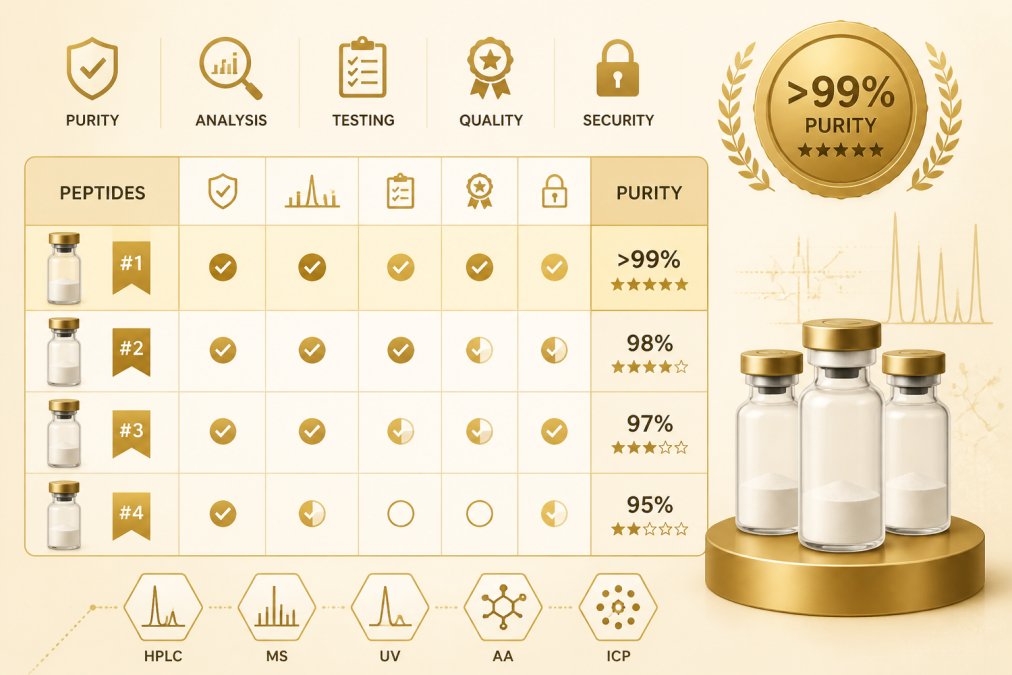
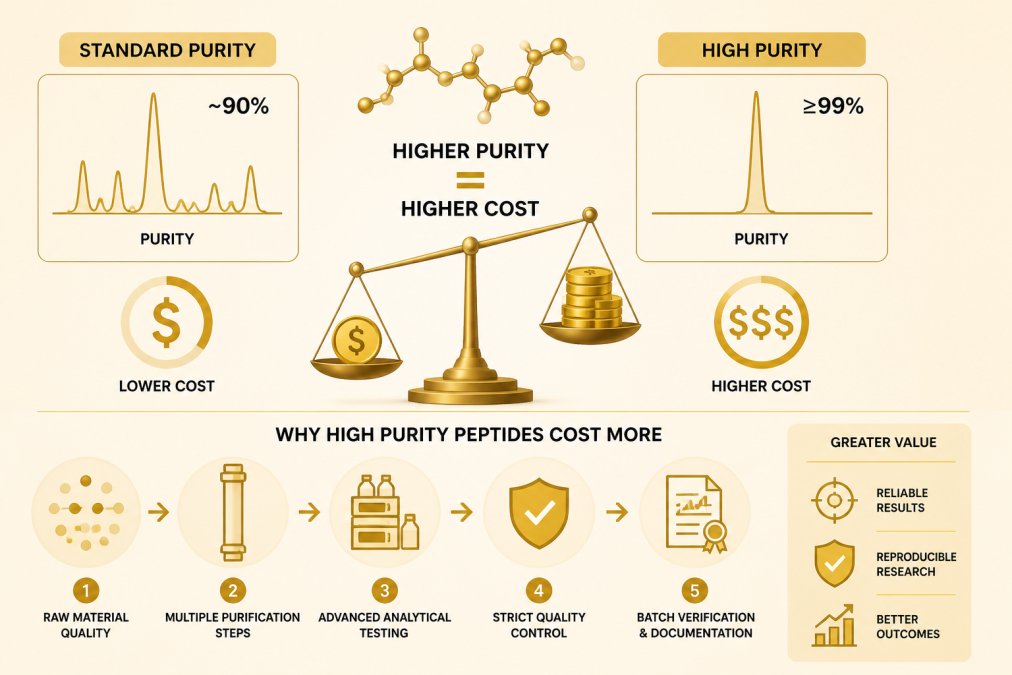
When you’re sourcing research peptides, the price difference between standard-grade and high-purity compounds can feel jarring. A 99% pure peptide costs significantly more than a 95% pure alternative, sometimes 40-60% more per unit. That gap isn’t arbitrary markup. It reflects the real cost of precision.
At PepAlphatides, we prioritize scientific integrity by ensuring every batch undergoes independent third-party testing to verify purity levels exceeding 99%. Researchers can rely on our transparent documentation and secure QR-coded analytical reports to maintain consistency in their experimental work.
This guide breaks down exactly where those costs come from, not as marketing justification, but as technical reality. Understanding peptide pricing means understanding the science behind quality assurance.
Understanding Peptide Synthesis and Its Cost Drivers
Peptide synthesis is deceptively complex. The process chains amino acids together in a specific sequence, but controlling that sequence at scale introduces multiple cost layers.
Amino Acid Sequencing and Synthesis Yield
The amino acid sequence determines everything about a peptide’s behavior in research. Even a single substitution changes its properties entirely. Manufacturing peptides with precise amino acid sequences requires high-quality reagents and careful process control.
Synthesis yield, the percentage of the target peptide successfully created versus the total material processed, directly impacts cost. A synthesis yield of 70% means you’re processing 30% waste. Lower yields require more starting material, more reagents, more labor, and more time. Improving yield from 60% to 80% doesn’t sound dramatic until you calculate it: at 60% yield, producing 100 grams of pure peptide requires processing roughly 167 grams of material. At 80% yield, that drops to 125 grams. The difference compounds across batches.
Achieving higher synthesis yield requires optimized protocols, better reagent quality, and more rigorous process monitoring. These are not free improvements, they’re investments in equipment, training, and quality control systems.
Synthesis yield directly affects your cost per unit.
Manufacturing Overhead and Operational Costs
Manufacturing overhead includes facility costs, equipment maintenance, staff training, and the infrastructure required to maintain batch consistency. A facility producing research-grade peptides must maintain environmental controls: temperature stability, humidity management, and contamination prevention protocols.
Equipment represents a significant overhead component. HPLC systems, mass spectrometry instruments, and synthesis equipment require regular maintenance and calibration. A single HPLC system can cost tens of thousands of dollars; maintaining it adds thousands more annually. These costs spread across every batch produced.
Labor costs also factor in. Trained chemists and technicians command market-rate salaries. Quality assurance personnel, data analysts, and documentation specialists add to payroll. A small batch of high-purity peptides involves dozens of person-hours across synthesis, testing, and verification.
Regulatory compliance adds another layer. Documentation, record-keeping, and adherence to good manufacturing practices (GMP) standards require systems and oversight.
The Role of Third-Party Testing for Research Peptides
This is where high purity peptides cost more becomes most apparent. Third-party laboratory testing adds direct cost, but it’s the cost that separates research-grade materials from everything else.
Independent testing verifies what a manufacturer claims. When PepAlphatides states that a peptide batch exceeds 99% purity, that claim is backed by a third-party laboratory certificate. The vendor doesn’t test its own product, an external lab does. This eliminates bias and provides researchers with unbiased verification.
Third-party testing costs money. A single batch analysis can cost hundreds to thousands of dollars depending on the testing methods required. That cost flows directly into the final price.
The alternative is in-house testing only.
Third-party testing is the most reliable way to verify purity claims. It costs more, but it’s the only way to know you’re actually getting what you paid for.
Cost of HPLC Purification and Quality Control
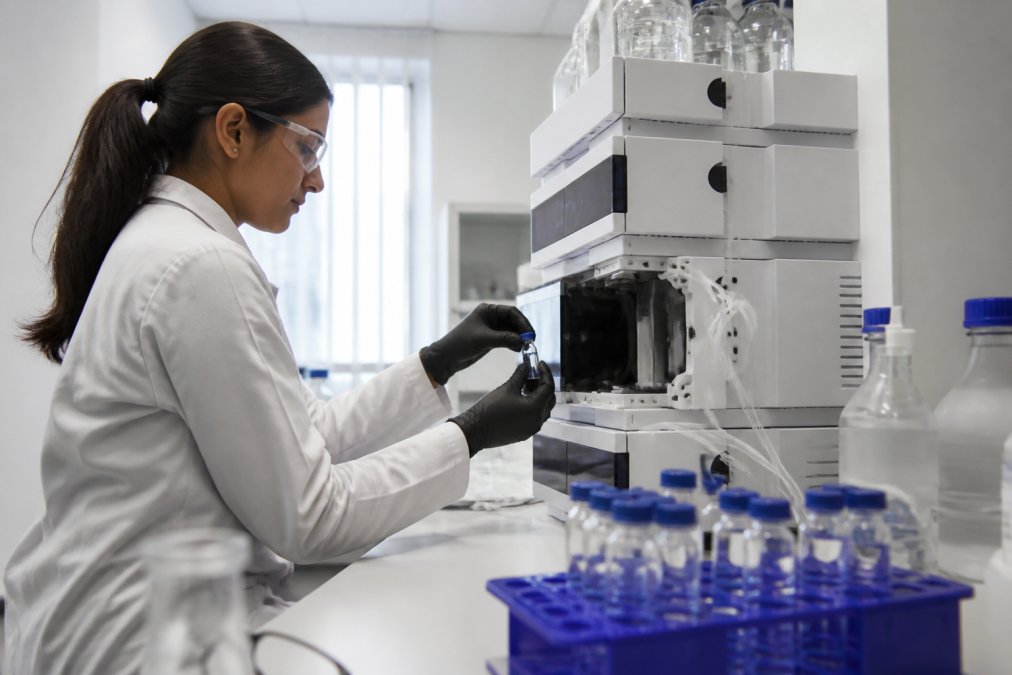
High-Performance Liquid Chromatography (HPLC) is the gold standard for peptide purification and purity verification. It’s also expensive, and the cost scales dramatically based on what impurities are present and how difficult they are to separate from the target peptide.
What HPLC Testing Reveals and Why Impurity Composition Matters
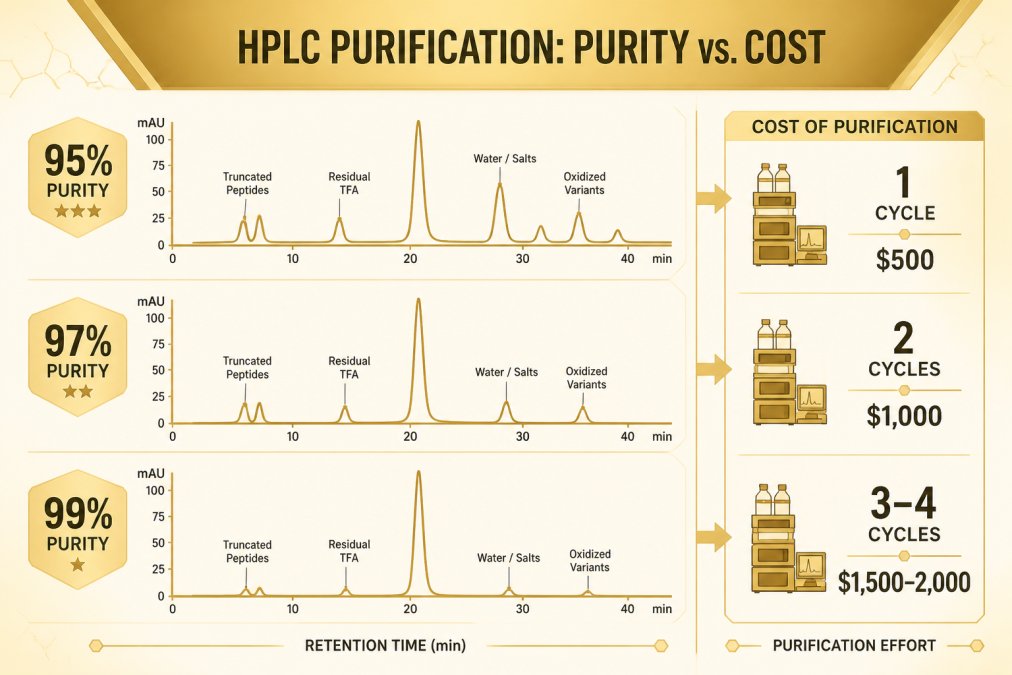
HPLC separates peptide components based on their chemical properties. As the peptide mixture flows through the column, different compounds exit at different times. This separation reveals what’s actually in the sample: the target peptide, truncated peptides (incomplete chains), contaminants, and residual solvents.
HPLC generates a chromatogram, a graph showing peaks representing different compounds in the sample. The area under each peak corresponds to the concentration of that compound. By comparing the target peptide peak to all other peaks, technicians calculate purity percentage.
But here’s where the real cost driver lies: not all impurities are equally expensive to remove. A 99% pure peptide shows a dominant peak representing the target compound, with minimal peaks from impurities. A 95% pure peptide shows more secondary peaks. The difference in purity directly correlates to the clarity of the chromatogram and the cleanliness of the sample.
The remaining 1-5% of impurities in a peptide batch typically consists of:
Truncated peptides, These are incomplete amino acid chains, often missing one or more amino acids from the C-terminus or N-terminus. They’re chemically similar to the target peptide, making them extremely difficult to separate via HPLC. Removing truncated peptides from 95% to 99% purity often requires multiple purification cycles, each adding hours of technician time and solvent costs.
Residual solvents, Peptide synthesis uses organic solvents like acetonitrile and trifluoroacetic acid (TFA). These must be removed during purification. TFA is particularly stubborn; it binds to peptide molecules and requires extended drying or specialized solvent exchanges to eliminate. Residual TFA above 0.1% can interfere with cell assays and protein binding studies, making its removal critical for research-grade material.
Water and inorganic salts, Peptides are hygroscopic and readily absorb moisture. Salts from buffer systems used during synthesis also remain. These are relatively easy to remove via lyophilization (freeze-drying), but incomplete removal can affect peptide solubility and stability. This is a lower-cost impurity to address.
Oxidized variants, Amino acids like methionine and cysteine are susceptible to oxidation, especially during storage or synthesis. Oxidized peptides have different chemical properties and can affect research outcomes.
Unreacted starting materials, If synthesis doesn’t go to completion, unreacted amino acids or protected peptide intermediates remain. These are generally easy to remove but indicate lower synthesis efficiency, which itself drives up costs.
The Purification Cost Multiplier
The composition of impurities directly determines purification cost. A batch with primarily water and salts (easy to remove) might reach 99% purity with a single purification cycle. A batch with high truncated peptide content (difficult to remove) might require three or four cycles to reach the same purity level.
Each additional purification cycle incurs costs for technician labor, HPLC column time and solvents, and quality verification (additional HPLC analysis).
A vendor pushing a batch from 95% to 99% purity might invest significantly in additional purification. A vendor selling 95% purity may skip these cycles entirely, cutting costs but leaving impurities in the final product.
Reading an HPLC Result Requires Expertise
Interpreting HPLC data demands trained personnel. Technicians must identify peaks, understand what each represents, determine whether impurities pose problems for research use, and decide whether additional purification is warranted. This analysis is labor-intensive and requires experienced chemists.
A detailed HPLC report should list:
- Retention time for each peak (identifies the compound)
- Peak area or height (quantifies concentration)
- Purity percentage calculated from peak areas
- Identification of major impurities (truncated variants, residual solvents, oxidized forms)
- Recommendation on suitability for research use
Many vendors provide only the purity percentage. Detailed reports that identify specific impurities cost more to generate because they require expert interpretation and documentation.
HPLC Equipment and Operational Costs
HPLC equipment itself is expensive. Research-grade HPLC systems are expensive. Running samples incurs costs for solvents, column maintenance, instrument time, and technician labor. Each analysis takes significant instrument time and technician interpretation.
A single batch might require multiple HPLC runs:
- Initial purity assessment: 1 run
- Post-purification verification: 1-2 runs
- Stability testing (if batch is held): additional runs
- Method validation (ensuring the HPLC method is accurate): additional runs
A high-purity batch might accumulate multiple HPLC analyses before release, incurring significant direct HPLC costs.
Mass Spectrometry and Molecular Weight Verification
Mass spectrometry (MS) is the second major analytical tool for peptide verification. Where HPLC measures purity, MS confirms molecular weight and structure.
Mass spectrometry ionizes peptide molecules and measures their mass-to-charge ratio. For a peptide with a known amino acid sequence, the molecular weight is predictable. If the MS data matches the expected molecular weight, you’ve confirmed the correct peptide was synthesized.
MS also detects truncated peptides, incomplete chains missing one or more amino acids. These truncated variants have lower molecular weights than the target. The MS data reveals their presence and concentration, providing independent verification of what HPLC found.
Running mass spectrometry requires specialized equipment and expertise. MS instruments are expensive, and operation demands trained specialists. Each sample analysis takes significant time and generates complex data requiring interpretation.
High-purity peptide providers run MS on every batch or representative samples. This adds direct costs but provides definitive structural confirmation and independent verification of HPLC results.
A Certificate of Analysis listing only “purity %” without breaking down impurity profiles or including MS data is incomplete. The composition of impurities matters as much as the percentage. Ask vendors to provide detailed impurity identification and MS confirmation before purchasing.
How to Verify Peptide Purity Before Purchase
Verification starts before you buy. Reputable vendors provide documentation that lets you assess quality claims independently.
Reading and Interpreting Certificates of Analysis
A Certificate of Analysis (CoA) is the document that proves what you’re buying. It lists the peptide sequence, expected molecular weight, purity percentage (usually determined by HPLC), and the testing date.
A legitimate CoA includes:
- Peptide sequence and molecular weight
- Purity percentage with the analytical method used (HPLC, for example)
- Impurity profile (what contaminants were detected)
- Batch number for traceability
- Testing date and expiration date for the result
- Third-party laboratory name and signature
The most important line is purity percentage. This number tells you what percentage of the sample is the target peptide versus everything else. A 99% pure peptide means 1% of the sample is contaminants or impurities.
Reputable providers like PepAlphatides make CoAs available before you order, often with secure QR codes linking to batch-specific reports. This transparency lets you verify quality claims in advance.
Identifying Chemical Impurity Profiles
Beyond the purity percentage, the impurity profile matters. What exactly comprises that 1% or 5% of impurities?
Common peptide impurities include:
- Truncated peptides (incomplete amino acid chains)
- Residual solvents (acetonitrile, trifluoroacetic acid)
- Water and salts
- Oxidized variants (peptides damaged by oxidation)
- Unreacted starting materials
A CoA should detail these impurities. Truncated peptides are particularly important, they’re chemically similar to the target but functionally different. A high-purity peptide should show minimal truncation.
Residual solvents matter for research applications. Some solvents interfere with assays or cell culture. A CoA listing residual solvents lets you assess whether the peptide is suitable for your specific research.
A CoA listing only “purity %” without breaking down impurity profiles is incomplete. Ask vendors for detailed impurity data before purchasing. Some impurities are worse than others for research use.
Why Purity Standards Matter for Research Integrity
Research peptides aren’t food or cosmetics, they’re tools for scientific investigation. Impurities directly affect results.
A 95% pure peptide contains 5% unknown material. In a cell culture experiment, that 5% might include compounds affecting cell behavior, confounding your results. You won’t know whether your observed effect comes from the target peptide or the contaminants.
A 99% pure peptide minimizes this risk. With only 1% impurities, you’re far more confident that observed effects come from the target peptide, not background noise.
Research reproducibility depends on consistency. If Batch A is 95% pure and Batch B is 97% pure, the different impurity levels might produce different results. Researchers can’t trust their findings across batches. High-purity peptides with consistent purity levels enable reproducible research.
According to NIH guidance on research materials, maintaining material consistency is essential for reliable science. Purity standards directly support this principle.
Batch Consistency and Supply Chain Transparency
High-purity peptide manufacturers invest in systems to ensure every batch meets the same standards. This consistency costs money but enables reproducible research.
Batch consistency requires process controls at every step: reagent quality verification, synthesis parameter monitoring, purification protocols, and testing procedures. Each batch goes through the same steps with the same rigor. Deviations trigger investigation and correction.
Supply chain transparency means tracking materials from source to finished product. Where did the amino acids come from? Were they tested for purity? What reagents were used in synthesis? What solvents were employed? Documented supply chains add cost but prevent contamination and ensure quality.
PepAlphatides provides batch-specific documentation with secure QR codes. Each vial traces back to its specific batch, allowing researchers to access the exact CoA for the material they’re using. This level of transparency requires systems and processes that cheaper vendors don’t maintain.
Regulatory Compliance Costs and Research-Grade Standards
Research-grade peptides often fall under regulatory oversight depending on their intended use. Compliance with these standards adds measurable cost at every operational level, from facility infrastructure to ongoing certification maintenance.
Good Manufacturing Practice (GMP) Standards and Facility Requirements
GMP compliance requires specific facility infrastructure:
Cleanroom environments, GMP-compliant peptide synthesis must occur in controlled environments. A Class B cleanroom (the minimum for pharmaceutical manufacturing) maintains particle counts below 3,520 particles per cubic meter and requires HEPA filtration systems, annual maintenance and filter replacement, environmental monitoring (particle counters, viable air samplers), and dedicated HVAC systems with redundancy.
Maintaining ISO 13485 certification incurs significant annual costs.
Documentation and Record-Keeping Systems
GMP compliance requires comprehensive documentation:
Batch records, Every batch must have a complete record including:
- Raw material certificates and testing results
- Synthesis parameters (temperatures, times, reagent quantities)
- In-process testing results
- Final product testing (HPLC, MS, water content, endotoxin if applicable)
- Deviation reports if anything goes wrong
- Stability data if the batch is held
Generating and maintaining these records requires specialized software systems (Laboratory Information Management Systems, or LIMS) and staff time to enter data, review records, and archive documentation.
Traceability systems, GMP requires tracking materials from source to finished product. This includes:
- Supplier qualification (verifying that raw material vendors meet standards)
- Certificate of Analysis review for every incoming material
- Lot tracking through synthesis and purification
- Storage condition monitoring
- Distribution records
Staff Training and Qualification
GMP requires documented training for all personnel involved in manufacturing and testing:
Initial training, New employees receive:
- GMP principles training: 16-40 hours
- Standard operating procedure (SOP) training: 20-60 hours
- Equipment-specific training: 10-30 hours
- Quality system training: 8-16 hours
Quality Assurance and Regulatory Affairs Personnel
GMP operations require dedicated quality personnel:
Quality Assurance Manager, Oversees compliance, reviews batch records, manages deviations, and ensures SOPs are followed.
Quality Control Analyst, Conducts testing and interprets results.
Regulatory Inspections and Audits
Vendors serving regulated markets may face inspections by regulatory agencies (FDA if producing for U.S. markets, EMA for European markets). Preparing for and responding to inspections costs:
- Pre-inspection audit by third-party consultants, internal audit preparation, actual inspection response, and remediation if findings are identified.
The Compliance Cost Multiplier
Adding these up, a GMP-compliant vendor with ISO certifications and dedicated quality staff incurs:
- Cleanroom and environmental controls, ISO 13485 and ISO 17025 maintenance, LIMS and traceability systems, staff training, quality assurance personnel, and regulatory audits and inspections all contribute to significant annual compliance overhead.
Research-Grade Standards and When They Apply
Basic research (cell culture, in vitro assays), Vendors typically maintain good laboratory practices (GLP) and provide third-party testing, but full GMP may not be necessary. Cost impact: moderate (third-party testing adds costs per batch).
Compliance costs are real, measurable, and substantial. Ask vendors about their certifications, quality personnel, and compliance systems before purchasing.
The Real Cost-Benefit of High Purity Peptides
The premium for high purity peptides isn’t arbitrary. It reflects real investments in quality, testing, and verification.
Research teams with strict reproducibility requirements, studies requiring regulatory compliance, and projects where material consistency directly impacts outcomes.
| Cost Factor | Standard-Grade Peptides | High-Purity Peptides | Impact |
|---|---|---|---|
| Synthesis yield optimization | Basic | Advanced | Reduces waste, lowers per-unit cost |
| Third-party testing | Rare or absent | Standard | Adds $300-800 per batch |
| HPLC purification | Limited | Comprehensive | Multiple runs per batch |
| Mass spectrometry verification | Minimal | Standard | Confirms structure and purity |
| Supply chain documentation | Basic | Detailed | Enables full traceability |
| Batch consistency protocols | Loose | Strict | Ensures reproducibility |
| QR-coded CoA access | No | Yes | Provides pre-purchase verification |
Conclusion
High purity peptides cost more because quality at scale requires investment. Synthesis optimization, third-party testing, HPLC purification, mass spectrometry verification, and regulatory compliance all add real expenses that cheaper alternatives skip.
Frequently Asked Questions
How do I know high purity peptide claims are legitimate?
Legitimate high purity peptides come with a Certificate of Analysis (CoA) from an independent third-party laboratory. This document shows HPLC and mass spectrometry results verifying the peptide’s purity percentage, molecular weight, and impurity profile. Request the CoA before purchase and verify it includes specific assay data, not just a purity number. Transparent vendors provide batch-specific documentation with secure access, allowing you to confirm quality before committing to an order.
What makes third-party testing for research peptides so expensive?
Third-party testing involves HPLC analysis, mass spectrometry, and residual solvent testing, each requiring specialized equipment, trained technicians, and time. When vendors test every batch independently rather than relying on in-house data, these costs accumulate across hundreds of batches monthly. This expense is passed to customers because it guarantees unbiased purity verification and protects the vendor’s credibility.
Is 95% or 98% purity sufficient for research work, or do I need 99%+?
Purity requirements depend on your research application. For general exploratory work, 95% may suffice, but impurities at that level can skew results. At 98%, truncated peptides and contaminants are minimal enough for most analytical studies. For rigorous research where batch consistency and precise dosing matter, 99%+ purity eliminates most variables and ensures reproducibility. Higher purity also improves stability and storage shelf-life, reducing degradation over time.
What factors most influence the cost of peptide synthesis?
Synthesis yield, peptide chain length, and purification method are the primary cost drivers. Longer peptide chains require more amino acids and longer synthesis times, increasing reagent costs. Synthesis yield, the percentage of successfully formed peptides, affects how much raw material you must process to obtain the final product. HPLC purification and lyophilization add significant overhead. Manufacturing overhead, supply chain transparency, and regulatory compliance also contribute. Bulk orders typically reduce per-unit costs because fixed overhead is distributed across more units.