Quick Summary
High quality research peptides are identified by three verifiable things: confirmed identity, measured purity and stated quantity, each backed by lot-specific records. Check that a Certificate of Analysis matches your vial’s lot number, names the analytical method and testing lab, and that testing is done by an independent third party.
- Confirm the lot number on the Certificate of Analysis matches your vial.
- A purity percentage means little without confirmed identity beside it.
- Independent third-party testing reduces the conflict of interest in supplier results.
- Score each supplier on the same checklist, and treat totals below 6 out of 10 as a warning.
- Request storage temperature and shipping class in writing before ordering.
Table of Contents
- What Makes a Research Peptide High Quality
- How to Read a Peptide Certificate of Analysis
- What Purity Results Do and Do Not Establish
- Third-Party Testing and Manufacturing Standards
- How to Evaluate a Research Peptide Supplier
- Red Flags and Misleading Quality Claims
- Storage, Handling, and Stability After Delivery
- Matching Your Next Order to Your Research Requirements
- Frequently Asked Questions
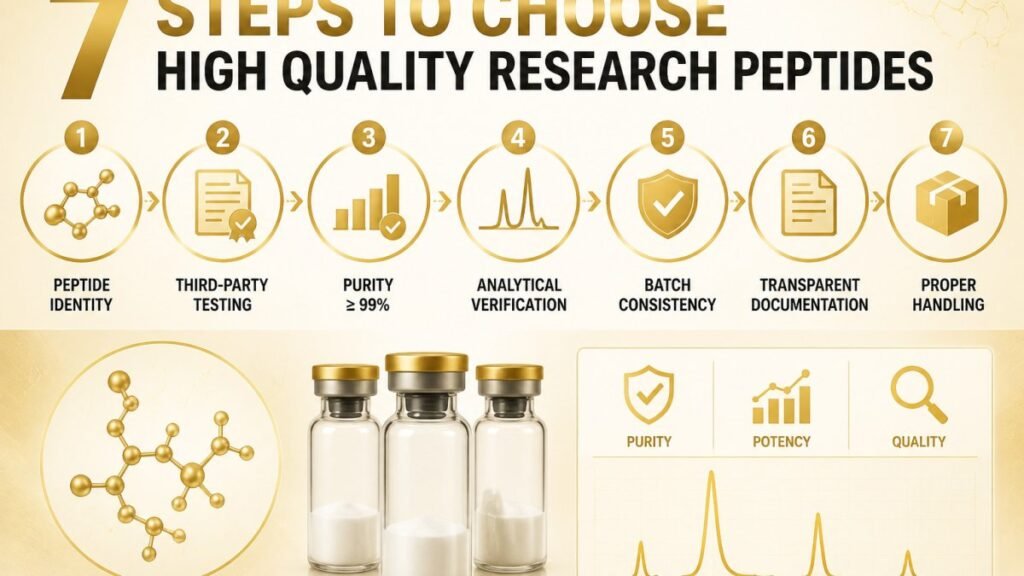
7 Steps to Choose High Quality Research Peptides
Last Updated: November 4, 2026
What Makes a Research Peptide High Quality
Choosing high quality research peptides starts with knowing what “quality” actually means. A peptide is a short chain of amino acids, usually between 500 and 5,000 Da in molecular weight, and its value in a study depends on whether the sequence, purity and quantity match what the protocol requires. Peptides are a class of pharmaceutical agents, and reviews of the field describe them as ordered amino-acid sequences that researchers study across many applications (Therapeutic peptides: current applications and future directions).
At PepAlphatides, we judge quality by three things: verified identity, measured purity and documented quantity. Each one can be checked, and each one can fail independently. A vial can be pure but the wrong sequence, or the right sequence at the wrong amount.
Four markers separate a dependable research peptide from a risky one:
- Documented identity: Mass spectrometry or a comparable method confirms the molecular weight matches the sequence.
- Measured purity: High-performance liquid chromatography (HPLC) shows the share of the target peptide versus impurities.
- Stated quantity: The net amount in each vial is listed and tested, not estimated.
- Lot-level traceability: Each batch has its own records, so results can be tied to a specific production run.
A supplier that cannot provide all four should raise questions before any order is placed.
How to Read a Peptide Certificate of Analysis
A Certificate of Analysis (CoA) is the main document that records a batch’s test results. It is only as useful as the data printed on it, so read it line by line instead of skimming for a headline number.
Start by confirming the document matches your product. Check the product name, sequence, lot number and manufacture date against the vial label. A CoA from a different batch tells you nothing about the peptide in your hands.
Identity, Purity, and Quantity: What Each Number Shows
Each of the three core values answers a different question:
- Identity answers “Is this the right molecule?” Look for a mass value that matches the expected molecular weight.
- Purity answers “How much of the sample is the target peptide?” A purity percentage reported by HPLC shows the main peak relative to all detected peaks.
- Quantity answers “How much peptide is actually in the vial?” Net content and any peptide-content correction should be stated clearly.
Many businesses find that a high purity number means little without the identity result beside it. A 99% purity figure on a CoA that does not confirm identity leaves the most important question unanswered.
How to Independently Verify a CoA
A CoA is a supplier document, so treat it as a claim to test rather than a guarantee. Use these checks:
- Confirm the lot number on the CoA matches the lot number on your vial.
- Check that the analytical method (such as HPLC or mass spectrometry) is named, not just the result.
- Look for the testing laboratory’s name and the date the analysis was performed.
- Compare the stated molecular weight against the sequence’s calculated weight.
- Ask for the raw chromatogram or spectrum if the summary seems incomplete.
Watch out: A CoA with no lot number, no method and no lab name is a weak document, even if the purity figure looks impressive.
What Purity Results Do and Do Not Establish
A purity percentage describes one measurement, taken by one method, on one sample from one batch. It does not describe the whole production run, and it does not guarantee how the peptide will behave once it is dissolved, stored or shipped.
Purity also says nothing about sterility, endotoxin levels or whether the peptide will remain stable over time. Those properties need their own tests. Researchers who plan sensitive work should ask suppliers which of these were measured, not assume they were.
Regulatory guidance on peptide analysis and stability testing exists for drug development, and it shows how much work goes into proving a peptide’s quality (Regulatory Guidelines for the Analysis of Therapeutic Peptides). That level of testing is well beyond a typical CoA, which is one more reason to read the document critically.
Third-Party Testing and Manufacturing Standards
Independent testing means a laboratory with no stake in the sale checks the product. This matters because a supplier testing its own batches has an obvious incentive to report favorable numbers.
Look for these points when you review a supplier’s testing program:
- Testing is performed by an outside laboratory, and that lab is named.
- Results are issued per batch, not as a single general statement.
- The supplier explains how batches are sampled and tested.
- Manufacturing follows documented quality controls, with records you can request.
At PepAlphatides, every batch goes through independent third-party testing, and each product has its own Certificate of Analysis. A research team can use this to match a vial to its test results.
How to Evaluate a Research Peptide Supplier
Supplier quality is a judgment you make from evidence, not from marketing copy. Gather the same information from each supplier so the comparison is fair.
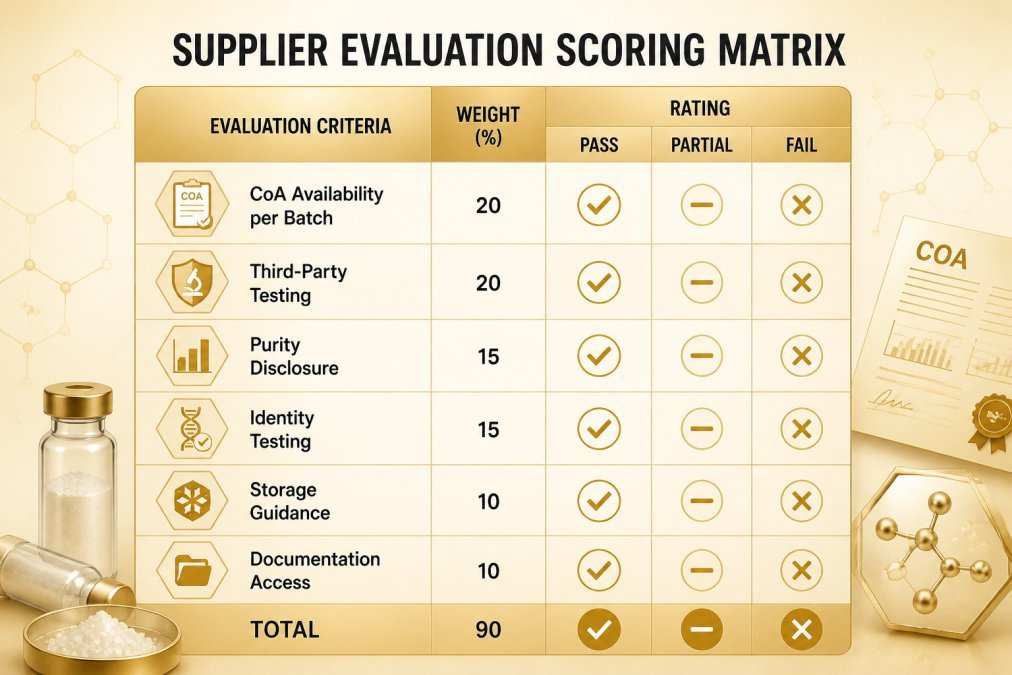
Start with documentation, then move to transparency and responsiveness. A supplier that answers technical questions clearly is usually easier to work with than one that deflects them.
A Reproducible Supplier-Scoring Checklist
Score each supplier on the same criteria, then compare totals:
- Lot-specific CoA available before purchase (2 points)
- Identity confirmed by a named analytical method (2 points)
- Purity reported with the method and lab named (2 points)
- Third-party testing performed by an outside lab (2 points)
- Storage and handling guidance provided in writing (1 point)
- Technical questions answered directly and in writing (1 point)
Suppliers scoring below 6 out of 10 need a closer look before you order. Keep the scores in a spreadsheet so you can repeat the process for every new supplier.
| Criterion | Weight | Pass | Partial | Fail |
|---|---|---|---|---|
| Lot-specific CoA | 2 | Per-lot document | Generic document | None |
| Identity confirmed | 2 | Named method | Method unnamed | None |
| Third-party testing | 2 | Outside lab named | Lab unnamed | In-house only |
| Storage guidance | 1 | Written guidance | Verbal only | None |
Red Flags and Misleading Quality Claims
Some quality claims sound precise but mean very little. Watch for these patterns:
- A purity figure with no method, no lot number and no lab name.
- “Pharmaceutical grade” or “clinical grade” used without supporting documents.
- A CoA that is identical across many different products and batches.
- Refusal to share a CoA until after payment.
- Testing claims that never say who performed the test.
- Prices far below the market average, paired with vague quality statements.
Pricing depends on quantity, delivery timing and the testing performed, so an unusually low price should prompt questions about what is included. For current prices, check PepAlphatides’s website or request a quote directly.
Storage, Handling, and Stability After Delivery
Even a high quality peptide can degrade between the supplier’s freezer and your bench. Stability is not a single property; it depends on the peptide’s sequence, its form (lyophilized powder versus reconstituted solution), the temperature it is held at, its moisture exposure, and how many freeze-thaw cycles it undergoes. Evaluating a supplier on storage and shipping means asking what they control, what they document, and what they hand off to you.
What the Supplier Should Document Before Shipping
Ask for the following in writing before an order ships:
- Recommended storage temperature for the lyophilized product, stated as a range (for example, -20 °C or -80 °C) rather than a vague “keep cold.”
- Shipping temperature class, ambient, refrigerated, or frozen, and how the shipment is packed to hold that range for the expected transit time.
- Stability data or a stability statement covering the lyophilized form, and separately the reconstituted form if the supplier provides one.
- Recommended reconstitution solvent and concentration, since solvent choice and concentration affect both solubility and degradation rate.
- Handling precautions such as avoiding repeated warming of the stock vial and limiting moisture ingress.
A supplier that cannot state a storage temperature range or a shipping class is not giving you enough information to protect the material after it arrives.
How to Evaluate Shipping Conditions
Temperature excursions in transit are one of the most common causes of unexplained assay variability. Evaluate shipping on these points:
- Packaging matches the temperature class. Frozen shipments should arrive with sufficient dry ice for the stated transit time, and the supplier should state how long the package holds temperature. Refrigerated shipments should use validated cold packs, not loose ice.
- There is a temperature indicator or data logger on temperature-sensitive shipments, so you can confirm the package stayed in range. A logger record is evidence; a sticker that says “keep frozen” is not.
- Transit time is stated and realistic. Overnight or two-day service is typical for temperature-sensitive material. A supplier that ships frozen peptide by ground service is trading your stability for their freight cost.
- Packaging protects the vial. Lyophilized powder is hygroscopic; a vial that arrives with a compromised seal or without desiccant in a humid climate has already begun absorbing moisture.
- Receiving instructions are provided. The supplier should tell you what to check on arrival, vial integrity, temperature indicator status, and lot number match, and what to do if the shipment arrives out of range.
Watch out: A package that arrives cold but with a melted or absent temperature indicator gives you no evidence the material stayed in range for the whole transit, only that it was cold at the end.
Storage Practices That Preserve Lyophilized Peptide
Lyophilized peptide is generally more stable than reconstituted solution, but it is not inert:
- Store at the supplier’s stated temperature. For most lyophilized research peptides this is -20 °C, with -80 °C used for longer-term storage or for peptides the supplier flags as less stable.
- Keep the vial sealed and dry. Moisture is the primary degradation route for lyophilized powder. Let the vial equilibrate to room temperature before opening, so condensation does not form inside.
- Limit opening cycles. Each time the vial is opened, moisture and oxygen enter. Plan to weigh or aliquot what you need in as few sessions as possible.
- Protect from light if the peptide contains aromatic or photosensitive residues; amber vials or foil wrapping are common mitigations.
- Record storage conditions alongside the lot number so that any later stability question can be traced to how the material was actually held.
Reconstitution and Freeze-Thaw Discipline
Once reconstituted, stability drops and the handling rules tighten:
- Use the recommended solvent. Bacteriostatic water, sterile water, or a buffer may each be appropriate depending on the peptide; the wrong solvent can cause aggregation or precipitation.
- Reconstitute at the recommended concentration. Some peptides aggregate at high concentration; follow the supplier’s guidance rather than improvising.
- Aliquot before freezing. Divide the reconstituted solution into single-use portions so each aliquot is thawed once. Repeated freeze-thaw cycles are a common and avoidable cause of degradation.
- Store reconstituted solution at the temperature the supplier specifies, typically 2-8 °C for short-term use and frozen for longer storage, with the understanding that freezing a solution introduces its own risks.
- Label each aliquot with the lot number, reconstitution date, and concentration. Without this, a later result cannot be tied back to a specific preparation.
Stability Documentation to Ask For
Stability claims should be supported by data, not adjectives. Ask whether the supplier can provide:
- A stability study summary for the lyophilized form, including the time points and conditions tested.
- Any available data on the reconstituted form, including how long it remains within specification at a stated temperature.
- A statement of the analytical method used to assess stability (for example, HPLC purity at each time point).
If no stability data exists, that is not automatically disqualifying for a research material, but it does mean the burden of controlling storage and handling falls entirely on you, and you should plan accordingly.
A Practical Receiving Checklist
When a shipment arrives:
- Confirm the temperature indicator or logger shows the package stayed in range.
- Check that vials are intact, seals are unbroken, and desiccant is present where expected.
- Match the lot number on each vial to the CoA and packing slip.
- Move the material to the supplier’s stated storage temperature promptly.
- Record the receipt date, lot number, and storage location in your order log.
Handling storage and shipping as documented, checkable steps rather than afterthoughts is what separates a peptide that performs as tested from one that quietly degrades before the first experiment.
Matching Your Next Order to Your Research Requirements
The best peptide is the one that fits your protocol. Before you order, write down the sequence, the quantity you need, the purity level your method requires and the documents your lab will want on file.
Then match the supplier’s offer to that list. A high purity claim is only useful if the identity, quantity and lot records also match your needs.
We recommend keeping a simple order log that stores each vial’s lot number, CoA and receipt date. This makes it easy to trace results back to a batch if a study needs review later. Browse the PepAlphatides catalog and review each product’s Certificate of Analysis before you add an item to your cart.
ADD TO CART when the documentation, the purity data and the quantity all match what your research needs.
Frequently Asked Questions
How can you verify the purity of a research peptide?
Start with the batch-specific Certificate of Analysis and check whether it reports an HPLC purity percentage and mass spectrometry identity confirmation for the same lot number on your vial. Purity percentages describe the proportion of the target peptide relative to detectable impurities under the test method used, so compare the method and lot number, not just the headline figure. Independent third-party lab results add a further check, since a supplier’s internal data alone cannot be verified by the buyer. Ask for the raw chromatogram if the summary is unclear.
What should a certificate of analysis include for a research peptide?
A useful Certificate of Analysis lists the peptide name and sequence, the lot or batch number, the testing laboratory, the test date, identity confirmation by mass spectrometry, purity by HPLC, and the quantity or net content. It should match the lot number printed on the vial. Look for the analytical method and conditions, not just a number. Documentation that is generic, undated, or not tied to a specific batch offers limited assurance for research use.
What does research-grade mean for peptides?
Research-grade is a marketing term rather than a formal regulatory standard, so it does not by itself guarantee purity, identity, or manufacturing controls. The label is meaningful only when the supplier backs it with batch-specific analytical data, documented testing methods, and clear research-use-only labeling. Treat the term as a starting point for due diligence and verify the underlying documentation for each lot before relying on it.
How should research peptides be stored and handled?
Stability depends on the specific sequence, whether the peptide is lyophilized or in solution, and the storage conditions. Lyophilized peptides are generally more stable than reconstituted solutions. Follow the supplier’s storage instructions, keep vials sealed and protected from light and moisture, and avoid repeated freeze-thaw cycles. Record the date of receipt and reconstitution so you can track how long a preparation has been stored.