Last Updated: November 2, 2026
Quick Summary
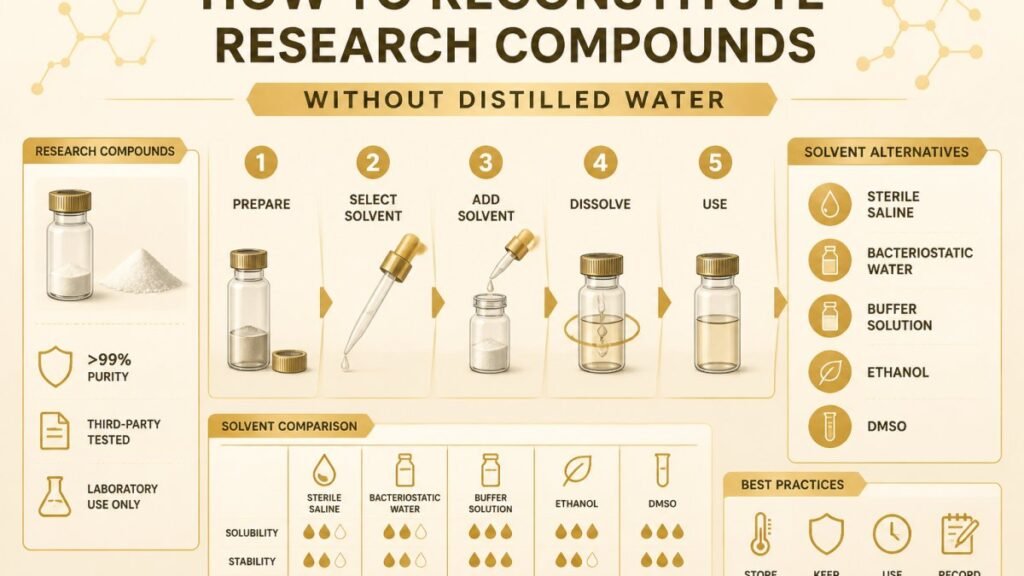
No, you cannot use distilled water to reconstitute research compounds. Distilled water is purified but not sterile, and sterility is the deciding factor for anything entering a vial. Use sterile water for single-use reconstitution or bacteriostatic water for multi-dose workflows when the compound is compatible.
- Distillation removes minerals and salts but does not reliably remove bacteria, spores, or endotoxins.
- Sterile water is purified then sterilized by filtration or autoclaving and suits single-use reconstitution.
- Bacteriostatic water contains benzyl alcohol at 0.9% and slows microbial growth across repeated draws.
- Aim diluent down the vial wall and swirl gently, never shake, to avoid foaming and compound damage.
- Never substitute tap, bottled, or distilled water for a sterile diluent; wait for the correct one instead.
Table of Contents
- Can You Use Distilled Water to Reconstitute Research Compounds?
- What Distilled Water Actually Is
- Why Sterility, Not Purity Alone, Decides Suitability
- Distilled Water vs Sterile Water for Peptides: The Four Water Types Compared
- Why Sterile Water for Peptide Reconstitution Is the Minimum Standard
- Bacteriostatic Water for Research Peptides: When the Preservative Matters
- Equipment and Clean Workspace Setup Before You Begin
- Step-by-Step: How to Reconstitute Research Compounds Safely
- How to Store Reconstituted Peptides to Protect Stability
- When Your Specified Diluent Is Unavailable: A Decision Path
- Choosing Research Compounds With Documented Diluent Guidance
- Frequently Asked Questions
Can You Use Distilled Water to Reconstitute Research Compounds?
No. Distilled water is not suitable for reconstituting research compounds. It is purified, but it is not sterile. Sterility is the deciding factor, not purity alone.
If you are asking whether you can use distilled water to reconstitute research compounds, the short answer is that the practice falls outside documented protocol. Distilled water removes minerals and dissolved solids. It does not remove bacteria, spores, or endotoxins. For laboratory use with a lyophilized powder, that gap matters.
The quality of your diluent is the other half of that equation.
Below, we break down the four water types, the step-by-step protocol, and what to do when your specified diluent is unavailable.
What Distilled Water Actually Is
Distilled water is water that has been boiled into vapor and condensed back into liquid. The process strips minerals, salts, and most dissolved contaminants.
What it does not do is sterilize. The condensation step can reintroduce organisms if the equipment and container are not sterile. Distillation removes chemistry, not biology. That distinction is the whole argument.
Many people assume “purified” means “safe for sensitive work.” It does not. A clean-looking liquid can still carry particulates and microbial load.
Why Sterility, Not Purity Alone, Decides Suitability
Sterility means the absence of viable microorganisms. Purity means the absence of unwanted chemical content. Those are different tests.
A reconstituted solution contacts a rubber stopper, a needle, and the interior of a vial. Each contact is a contamination risk. Starting with a non-sterile diluent stacks the odds against you before the first draw.
The U.S. Pharmacopeia general chapter on water for pharmaceutical use separates water grades by use, and sterility is a stated requirement for preparations that enter a vial. That is why sterile water for peptide reconstitution is treated as the floor, not the ceiling.
Watch out: skipping sterility to save a step can introduce contamination you cannot see, and a cloudy or particulate-laden solution often traces back to the diluent, not the powder.
Distilled Water vs Sterile Water for Peptides: The Four Water Types Compared
Four water types get confused constantly, and the confusion is usually about which attribute actually matters. Here is the clean split, with the production method and the practical consequence for each.
- Purified water: filtered, deionized, or otherwise treated to remove chemical impurities. Not sterile. Suitable for rinsing glassware and general lab work, not for entering a vial.
- Distilled water: boiled into vapor and condensed back into liquid. Removes minerals, salts, and most dissolved solids. Not sterile, and the condensation and container steps can reintroduce organisms. Suitable for equipment and some reagent preparation, not for reconstituting a lyophilized powder.
- Sterile water: purified and then sterilized, typically by filtration or autoclaving, and packaged in a sterile container. No preservative. Suitable for single-use reconstitution when the protocol specifies it.
- Bacteriostatic water: sterile water plus benzyl alcohol, usually at 0.9%, as a preservative. Slows microbial growth across repeated draws. Suitable for multi-dose workflows when the compound is compatible with the preservative.
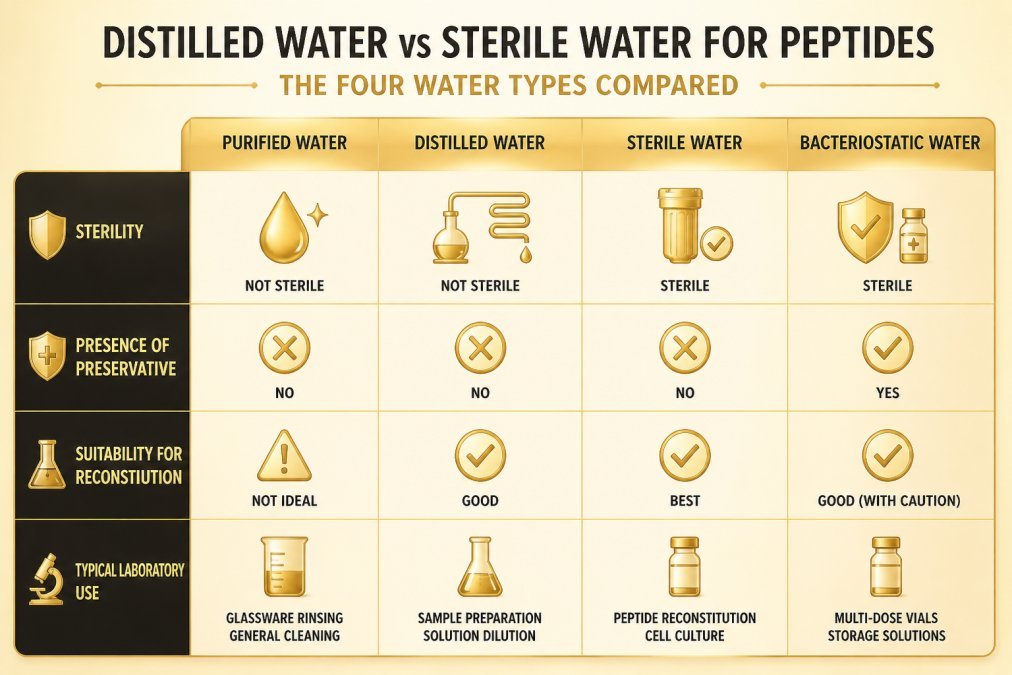
Purified, Distilled, Sterile, and Bacteriostatic Side by Side
| Water Type | How It Is Made | Sterile? | Preservative? | Suitable for Reconstitution? | Typical Use |
|---|---|---|---|---|---|
| Purified | Filtration, deionization, or reverse osmosis | No | No | No | General lab rinsing, reagent prep |
| Distilled | Boiled to vapor, then condensed | No | No | No | Equipment, not vials |
| Sterile | Purified, then filtered or autoclaved into a sterile container | Yes | No | Yes, single-use | One-time reconstitution |
| Bacteriostatic | Sterile water plus benzyl alcohol | Yes | Benzyl alcohol | Yes, multi-dose | Repeated draws |
The distilled water vs sterile water for peptides question collapses once you see the table. One column decides it: sterility. Purity is a separate test, and distilled water passes the purity test while failing the sterility test.
What Each Water Grade Does and Does Not Remove
The distinction is easier to hold onto when you separate chemistry from biology.
- Distillation removes dissolved minerals, salts, and most volatile and non-volatile chemical contaminants. It does not reliably remove bacteria, bacterial spores, or endotoxins, and the condensation and packaging steps can reintroduce them if the equipment and container are not sterile.
- Sterilization by filtration or autoclaving targets viable microorganisms. It does not remove chemical contaminants, which is why sterile water starts from purified water rather than tap water.
- Benzyl alcohol in bacteriostatic water does not sterilize a non-sterile liquid. It slows microbial growth in an already-sterile product across repeated needle entries.
That is why “purified” and “sterile” are not interchangeable and why a clean-looking liquid can still carry particulates and microbial load.
How the Choice Interacts With Compound Stability and Handling Window
The diluent is not a neutral carrier. It affects how long the reconstituted solution stays usable and whether the compound remains compatible.
- Sterile water, no preservative: the handling window is short and single-use. Once the vial is entered, there is no preservative to slow microbial growth, so the solution should be used within the window the protocol states and then discarded.
- Bacteriostatic water, with benzyl alcohol: the preservative extends the practical multi-draw window, but only for compounds that are stable in the presence of benzyl alcohol. Some compounds are not, and the protocol should say so.
- Distilled water: no sterility and no preservative, so it offers neither the single-use assurance of sterile water nor the multi-draw protection of bacteriostatic water. It is the wrong tool on both counts.
A common pattern is to assume bacteriostatic water is always the safer choice because it has a preservative. That is not correct. The preservative is a compatibility question first and a convenience question second. If the compound documentation does not confirm benzyl alcohol compatibility, plain sterile water for a single draw is the more defensible choice.
Matching the Water Type to the Protocol, Not to Convenience
The right diluent is the one the compound documentation specifies, and that specification usually reflects the compound’s stability profile and the intended handling window. When the documentation is silent, the safe default is sterile water for a single use, not distilled water and not an improvised substitute. The next section covers what to do when the specified diluent is not on the shelf.
Why Sterile Water for Peptide Reconstitution Is the Minimum Standard
Sterile water is the minimum because it removes the microbial variable you cannot control. It is purified and sterilized, so the only contamination risk left is your technique.
Single-use sterile vials suit one reconstitution. Draw what you need, use it, discard it. No preservative means no repeated entry.
The FDA guidance on sterile drug products treats sterility assurance as a core requirement for anything entering a vial. Match that standard in your own bench work.
Bacteriostatic Water for Research Peptides: When the Preservative Matters
Bacteriostatic water for research peptides matters when you plan multiple draws from one vial. Benzyl alcohol slows microbial growth, so repeated needle entry carries less risk.
It is not a free pass. The preservative buys time, not immunity. Aseptic technique still governs every draw.
Use bacteriostatic water when:
- Your protocol calls for several withdrawals from one vial
- The compound is stable in the presence of benzyl alcohol
- You are working within a defined handling window
Skip it when your documented protocol specifies plain sterile water, or when compound compatibility with the preservative is unverified.
A common mistake is assuming bacteriostatic water suits every compound. It does not. Check compatibility first.
Equipment and Clean Workspace Setup Before You Begin
Set up before you open anything. A clean workspace is not decoration; it is the first control.
Gather these supplies:
- Sterile syringe and needle, sized to your diluent volume
- Alcohol swabs for the stopper and vial top
- The specified diluent vial
- The lyophilized powder vial
- A clean, non-porous surface
- Gloves and a sharps container
Wipe the surface. Swab the rubber stopper. Let the alcohol dry fully before you puncture anything. See Choosing Laboratory Glassware For Precise Work for guidance on selecting glassware.
Step-by-Step: How to Reconstitute Research Compounds Safely
Here is the protocol. Follow it in order. For more detail, read Proper Peptide Reconstitution and Storage Techniques.
- Read the manufacturer instructions. Confirm the specified diluent and volume.
- Wash your hands and put on gloves. Work on a clean surface.
- Swab the stopper of both the diluent and powder vials. Let it dry.
- Draw the diluent with a sterile syringe. Expel air bubbles.
- Insert the needle at an angle into the powder vial, aiming the stream at the glass wall.
- Release the diluent slowly. Do not blast it onto the powder.
- Withdraw the needle and swab the stopper again.
- Swirl gently until dissolved. Never shake.
- Inspect the solution for clarity and particulates.
- Label the vial with date, concentration, and compound.
Adding Diluent Without Foaming or Damaging the Compound
Foaming is the enemy. A fast stream shears the compound and creates bubbles that make concentration reads unreliable.
Aim the diluent down the inside wall of the vial. Let it run. Then swirl, do not shake. Gentle motion dissolves the lyophilized powder without mechanical stress.
If foam forms, set the vial down and wait. Do not stir it away. Patience beats force here.
Calculating Concentration and Diluent Volume
Concentration equals mass divided by diluent volume. Get the units straight before you draw.
- If you add 2 mL to a 5 mg vial, your concentration is 2.5 mg/mL
- If you add 1 mL to the same vial, it is 5 mg/mL
- Always match the diluent volume to your documented protocol
Write the concentration on the label immediately. Memory fails; labels do not.
How to Store Reconstituted Peptides to Protect Stability
Refrigeration is the default for most reconstituted solutions. Keep the vial cold, upright, and away from light.
Storage basics:
- Refrigerate at the temperature your protocol states
- Avoid repeated temperature swings
- Keep the stopper clean between draws
- Note the date on the label
- Discard when the handling window closes
Our guide to peptide storage best practices goes deeper on temperature, light, and shelf life. A CDC overview of vaccine storage and handling offers useful cold-chain principles that apply to any temperature-sensitive vial.
When Your Specified Diluent Is Unavailable: A Decision Path
Supplies run out, and the temptation is to substitute whatever liquid is on the shelf. That is exactly where a reconstitution goes wrong. The decision path below is built to keep you from substituting an unverified liquid, and it is the part most guides skip.
Work through it in order. Stop at the first step that applies.
- Re-read the compound documentation. The Certificate of Analysis and the manufacturer’s reconstitution instructions are the authority. If they name a diluent and a volume, that is the answer, and the rest of this section is only for the case where that diluent is genuinely unavailable.
- If the protocol names sterile water and you have none: do not substitute distilled water. Distilled water is not sterile, and sterility is the attribute the protocol is relying on. Wait for sterile water, or use bacteriostatic water only if the compound documentation confirms benzyl alcohol compatibility and you understand you are changing the handling window.
- If the protocol names bacteriostatic water and you have none: plain sterile water works for a single draw, but you lose the preservative benefit and the multi-draw window shrinks to single-use. Document the substitution and shorten the handling window accordingly.
- If no diluent is specified: stop and ask. A documented protocol from the supplier or a qualified professional beats an improvised one, and the absence of a specification is not permission to guess.
- If you must proceed with the closest sterile option: use only a sterile, preservative-free or preservative-containing product that matches the compound’s known compatibility, document the deviation in your records, and label the vial with the substitution and date.
Never substitute tap water, bottled water, or distilled water for a sterile diluent. The gap between distilled and sterile is the whole point of this article, and a non-sterile diluent stacks contamination risk before the first draw. If the only liquid available is non-sterile, the correct decision is to wait.
Compound-Specific Caveats That Change the Decision
The decision path is not universal, because diluent choice depends on the compound, the intended use, and the validated protocol. Three caveats matter most.
- Stability in benzyl alcohol: some compounds degrade or behave differently in the presence of benzyl alcohol. If the documentation does not confirm compatibility, do not treat bacteriostatic water as a drop-in for sterile water.
- Concentration and volume constraints: substituting a different diluent volume changes the concentration. If you must change the volume, recalculate and relabel, and confirm the new concentration is within the protocol’s stated range.
- Handling window: a substitution that removes the preservative shortens the usable window. A substitution that adds a preservative may extend it, but only for a compatible compound. Either way, the label should reflect the new window.
Documenting the Deviation
A substitution that is not documented is a substitution you cannot trace later. Record the compound, the specified diluent, the substitute used, the date, the new concentration, and the revised handling window. If the deviation affects the validity of a run, note that too. The goal is not to make substitutions routine; it is to make any unavoidable one visible and reviewable.
The safest answer when the specified diluent is unavailable is usually to wait for the correct diluent. When waiting is not possible, the next safest step is the closest sterile option with confirmed compound compatibility, documented and labeled. Distilled water is never that option.
Choosing Research Compounds With Documented Diluent Guidance
Good compounds come with good documentation. Diluent guidance should be part of what you receive, not something you reverse-engineer.
Look for:
- A batch-specific Certificate of Analysis
- Stated purity and testing method
- Clear reconstitution and storage instructions
- Traceable batch codes
PepAlphatides batches undergo independent third-party testing, and vials carry QR codes linked to analytical reports. Current pricing, discounts, and shipping terms are available on the PepAlphatides website.
Frequently Asked Questions
Can you use distilled water to reconstitute research compounds?
Distilled water is not a suitable diluent for reconstituting research compounds. Distillation removes minerals and dissolved solids, but it does not guarantee sterility, and the finished water is not packaged or validated as a sterile solution. Because reconstitution breaches the vial’s rubber stopper, any non-sterile diluent introduces contamination risk to the lyophilized powder. Use sterile water for single-use work or bacteriostatic water when a multiple-dose vial and preservative are appropriate, and follow the manufacturer’s documented protocol for the specific compound.
Which is better for peptides, sterile water or bacteriostatic water?
The choice depends on how the vial will be used. Sterile water contains no preservative, so it suits single-use reconstitution where the entire solution is consumed in one session. Bacteriostatic water contains benzyl alcohol, which slows microbial growth and makes it the common choice for multiple-dose vials drawn from repeatedly. Neither is universally better: match the diluent to the documented protocol, the number of draws planned, and any compound-specific compatibility notes. When the protocol is silent, sterile water is the more conservative starting point for a single session.
What is the difference between distilled water and sterile water for reconstitution?
Distilled water has been boiled into vapor and condensed, which strips minerals and contaminants but says nothing about microbial content or packaging. Sterile water has been processed and validated to be free of viable microorganisms and is supplied in a sealed container intended for laboratory or clinical preparation. For reconstitution, sterility is the deciding attribute, not mineral removal. That is why distilled water vs sterile water for peptides is not a close comparison: only the sterile product carries the assurance the procedure requires.
How should reconstituted research compounds be stored?
Store reconstituted compounds refrigerated, typically at 2 to 8 degrees Celsius, protected from light and kept upright to reduce contact between solution and stopper. Avoid repeated temperature swings; let the vial equilibrate rather than warming it actively. Follow the manufacturer’s stated shelf life for the reconstituted form, label the vial with the reconstitution date and diluent used, and discard it once that window closes. Bacteriostatic solutions are not indefinite: the preservative slows microbial growth but does not stop degradation of the compound itself.
Reconstituting research compounds correctly starts with the right diluent and ends with documented handling. If you want compounds backed by batch-specific testing and clear guidance, PepAlphatides gives you the purity data, QR-coded COAs, and research-focused sourcing to run your work with confidence. Get started with PepAlphatides and reconstitute with a documented protocol behind every vial.