Last Updated: October 23, 2026
Quick Summary
Analytical grade peptide purity refers to the measured percentage of your target peptide in a sample, determined through rigorous laboratory testing. It’s not a single number but a combination of different measurements that tell you what you actually have, including chromatographic purity and net peptide content.
- A peptide labeled 95% pure means 95% of the sample’s weight is the target peptide, with the remaining 5% being water, salts, or synthesis byproducts.
- Two peptides can both be 95% pure and perform completely differently because purity percentage alone doesn’t indicate stability, degradation, or oxidation status.
- Net peptide content differs from chromatographic purity and must be used for accurate dosing calculations.
- HPLC is the industry standard method for measuring peptide purity through chemical separation and peak area analysis.
- Identity testing via mass spectrometry confirms you have the correct peptide, separate from purity testing.
Table of Contents
- What Analytical Grade Peptide Purity Actually Means
- Why Peptide Purity Matters for Research
- How to Read a Peptide Certificate of Analysis
- HPLC Peptide Purity Testing: The Standard Method
- Peptide Identity Testing: Confirming What You Have
- Analytical Grade vs Research Grade Peptides
- The Difference Between High Purity and High Potency
- How to Verify Your Peptide’s Purity Claims
- Frequently Asked Questions
What Analytical Grade Peptide Purity Actually Means
Analytical grade peptide purity refers to the measured percentage of your target peptide in a sample, determined through rigorous laboratory testing. It’s not a single number, it’s a combination of different measurements that tell you what you actually have.
When we talk about purity, we’re answering a specific question: How much of what I ordered is actually the peptide I need? A peptide labeled “95% pure” means 95% of the sample’s weight is the target peptide. The remaining 5% could be water, salts, or byproducts from synthesis.
But here’s what most guides miss: purity percentage alone doesn’t tell the whole story. Two peptides can both be 95% pure and perform completely differently in your research. One might be stable and potent. The other might be degraded or oxidized despite the high purity number.
At PepAlphatides, we go beyond a single purity percentage. Every batch undergoes independent third-party testing to verify purity levels exceeding 99%. We provide detailed analytical reports so you can see exactly what you’re working with, not just a headline number, but the full breakdown of what’s in your vial.
Why Peptide Purity Matters for Research
High purity directly affects your research results. Contaminated or impure peptides introduce variables you can’t control. Your experiments become unreliable. Results don’t replicate. You waste time chasing false leads.
Consider what happens when you use a lower-purity peptide:
- Your dosing calculations become inaccurate
- Contaminants may trigger unexpected biological responses
- Batch-to-batch variability makes it impossible to build consistent protocols
- Your research timeline extends as you troubleshoot inconsistent results
Researchers working with high-purity peptides report more consistent outcomes. They can confidently attribute results to the peptide itself, not to impurities or degradation products. This is especially critical for studies involving potency, bioavailability, or cellular response.
Physical and chemical characterization is important for establishing identity and purity according to regulatory guidelines for therapeutic peptide analysis. When you’re building a research foundation, starting with verified high-purity compounds saves time and strengthens your conclusions.
Always request the full Certificate of Analysis before purchasing, not after. This lets you verify purity claims before committing your research budget. A transparent supplier will provide this without hesitation.
How to Read a Peptide Certificate of Analysis
A Certificate of Analysis (COA) is your proof of purity. It’s the document that backs up the “99% pure” claim. But many researchers don’t know how to interpret what they’re reading.
A typical COA includes several key sections:
Batch and Product Information
This identifies the exact peptide, batch number, and manufacturing date. Always match this to your order. Different batches can have slightly different purity levels.
Purity Results
This section shows how purity was measured. You’ll see a chromatographic purity percentage. This is the percentage of your target peptide’s peak area compared to all peaks detected. A result of 98.5% chromatographic purity means the target peptide accounts for 98.5% of all compounds detected by the analytical method.
Net Peptide Content
This is different from chromatographic purity. Net peptide content accounts for water and salt content. A peptide might be 99% pure chromatographically but only 75% net peptide content if it retains significant water weight. Both numbers matter for accurate dosing.
Identity Confirmation
The COA should confirm the peptide’s identity through mass spectrometry or similar methods. This proves you have the right compound, not a similar-looking impurity.
Storage Recommendations
This section tells you how to maintain purity after receipt. Temperature, light exposure, and humidity all affect stability. Follow these guidelines carefully.
If a COA shows only a purity percentage without chromatographic data or net peptide content breakdown, you’re missing critical information. Request the full report. A supplier hiding details is a red flag.
HPLC Peptide Purity Testing: The Standard Method
High-Performance Liquid Chromatography (HPLC) is the industry standard for measuring peptide purity. It’s the method behind almost every analytical grade peptide report you’ll see.
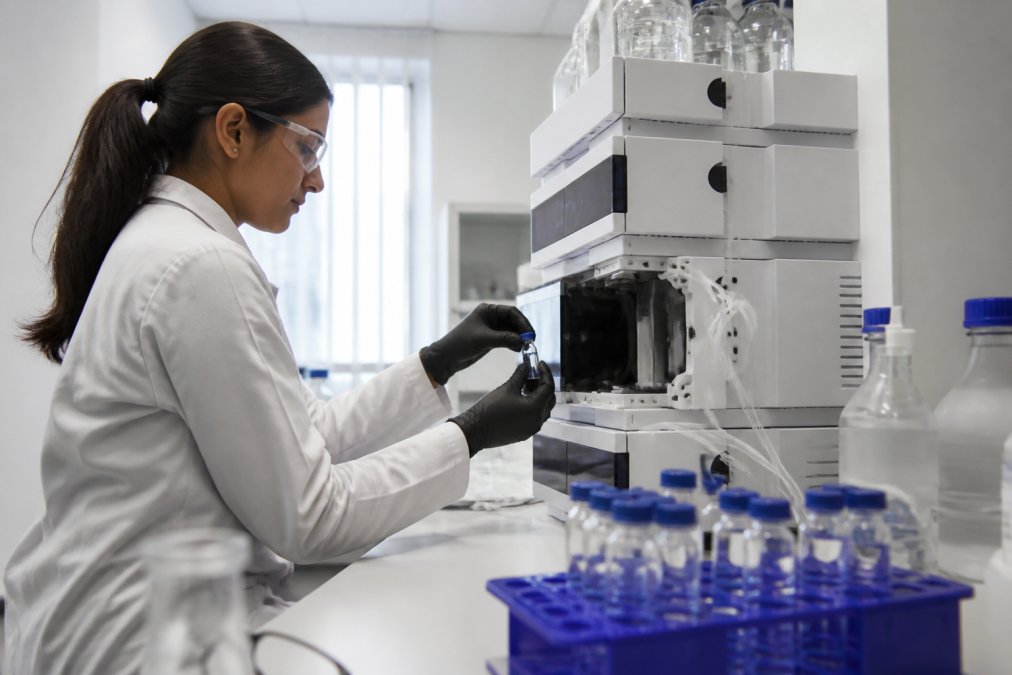
HPLC works by separating compounds based on their chemical properties. Your peptide sample enters a column filled with specialized material. Different compounds move through at different speeds. A detector measures each compound as it exits. The result is a chromatogram, a graph showing peaks for each compound present.
The process follows these steps:
- Sample Preparation, Your peptide sample is dissolved in a solvent compatible with HPLC
- Injection, A precise amount enters the column
- Separation, Compounds travel through the column at different rates
- Detection, A UV detector measures each compound as it emerges
- Analysis, Software calculates the area under each peak
- Purity Calculation, Your target peptide’s peak area is divided by the total of all peaks
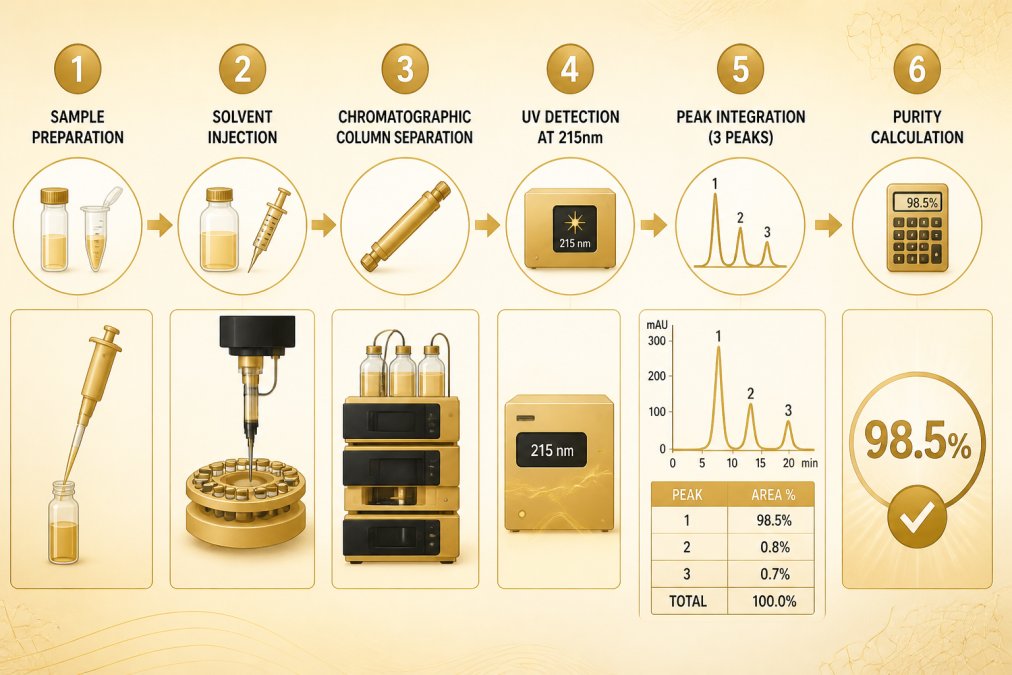
What HPLC Results Tell You
An HPLC chromatogram shows you everything present in your sample. The largest peak is typically your target peptide. Smaller peaks are impurities or byproducts.
The purity percentage comes from comparing peak areas. If your target peptide peak covers 98.5% of the total peak area, your chromatographic purity is 98.5%. This is a direct measure of chemical purity, how much of your sample is the compound you want.
HPLC results are reproducible and quantitative. Different labs running the same peptide produce comparable results. This is why it’s the standard method across the industry.
However, HPLC has limits. It measures what’s present, but not necessarily potency. A peptide can be 99% pure and still be inactive if it’s been degraded or mishandled. Purity and potency are related but separate measurements.
Why Chromatographic Purity Differs from Net Peptide Content
This distinction confuses many researchers. Chromatographic purity measures chemical composition. Net peptide content measures the actual amount of active peptide by weight.
Chromatographic purity answers: “What percentage of the compounds in my sample is my target peptide?” HPLC measures this. A result of 98% means 98% of detected compounds are your peptide.
Net peptide content answers: “How much of the actual weight is usable peptide?” This accounts for water, salts, and other non-peptide material. A peptide might be 99% pure chromatographically but only 70% net peptide content if it contains significant water weight.
Why does this matter? Dosing accuracy depends on net peptide content. If you’re working with a peptide that’s 99% pure but only 75% net peptide content, you need to adjust your calculations. Using chromatographic purity alone would lead to incorrect dosing.
Always use net peptide content for dosing calculations, not chromatographic purity. Chromatographic purity tells you chemical composition. Net peptide content tells you how much actual peptide you have by weight.
Peptide Identity Testing: Confirming What You Have
Purity measures how much of your target peptide is present. Identity testing confirms you have the right peptide at all.
The most common identity confirmation method is mass spectrometry. This technique measures the molecular weight of your peptide. Every peptide has a specific molecular weight. If the mass spectrometry result matches the expected weight, you have the right compound.
A COA should include mass spectrometry data showing the observed molecular weight and the theoretical molecular weight. They should match closely. Any significant difference indicates you don’t have the peptide you ordered.
Some suppliers use additional identity tests like amino acid analysis or NMR spectroscopy. These provide additional confirmation, especially for complex peptides. More confirmation methods mean higher confidence in identity.
Identity testing is separate from purity testing. You could have a very pure sample of the wrong compound. Both tests together give you complete information about what you’ve received.
Analytical Grade vs Research Grade Peptides
The terms “analytical grade” and “research grade” are used differently across suppliers. Understanding the distinction helps you choose appropriately.
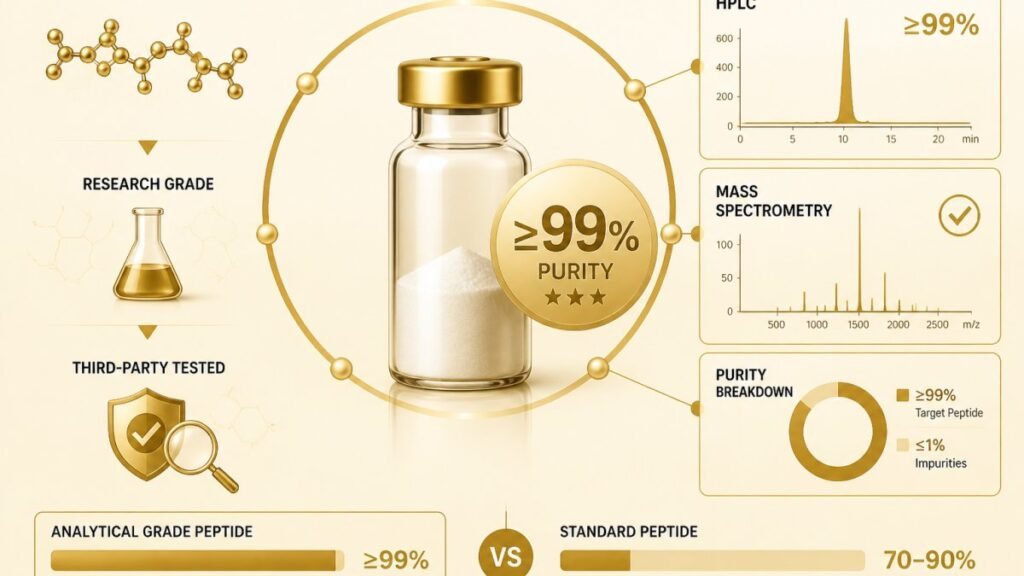
Analytical grade typically means the peptide has been tested to higher standards. It includes detailed analytical data: HPLC purity, mass spectrometry confirmation, and often additional characterization. These peptides come with comprehensive COAs.
Research grade is a broader category. It generally means the peptide is suitable for laboratory research but may have less rigorous testing. Some research-grade peptides come with basic purity data. Others provide minimal documentation.
The key difference is documentation and verification. Analytical grade peptides give you detailed proof of what you’re receiving. Research grade may offer less certainty about exact composition.
For most serious research, analytical grade is the better choice. You’re paying for verified quality and detailed documentation. This investment pays off through more reliable experiments and consistent results.
The Difference Between High Purity and High Potency
This is where many researchers get confused. High purity doesn’t automatically mean high potency.
Purity is a chemical measure. It tells you the percentage of your target peptide present in the sample. A 99% pure peptide contains 99% of the target compound by measurement.
Potency is a biological measure. It tells you how effectively the peptide works in your research application. A peptide can be 99% pure yet have low potency if it’s been damaged.
Common causes of low potency despite high purity:
- Oxidation, Exposure to air oxidizes sensitive amino acids, reducing activity
- Mishandling, Temperature fluctuations or improper storage damage peptide structure
- Age, Even properly stored peptides degrade over time
- Freeze-thaw cycles, Repeated freezing and thawing damages peptide integrity
A peptide can be 99% pure yet have low potency if damaged by mishandling, oxidation, or improper storage as noted in industry guidance on peptide quality. The purity number tells you what’s there. It doesn’t tell you if that peptide is active.
This is why handling and storage matter so much. You can receive a perfectly pure peptide and render it useless through poor storage. Conversely, a slightly lower-purity peptide stored properly may perform better than a higher-purity peptide that’s been damaged.
How to Verify Your Peptide’s Purity Claims
Don’t take purity claims at face value. Verify them before relying on the peptide for critical research.
Request the full COA before purchasing. A reputable supplier provides this without delay. If you have to ask multiple times or wait until after purchase, that’s a warning sign. We provide secure QR-coded analytical reports with every batch so you can verify exactly what you’re receiving.
Check for third-party testing. Independent laboratory testing is more credible than in-house testing. A supplier using an external lab has less incentive to inflate purity numbers. Look for COAs from recognized analytical laboratories.
Verify the testing method. HPLC is the standard, but confirm it’s the method used. Check that the report includes both chromatographic purity and net peptide content. A complete report shows methodology details.
Compare across batches. If you’ve purchased from a supplier before, compare COAs across different batches. Consistent high purity across batches suggests reliable quality control. Wide variation suggests inconsistent processes.
Test yourself if possible. For critical research, consider running your own identity or purity confirmation. This is especially important for high-stakes experiments. It adds cost but eliminates uncertainty.
Look for transparency. A supplier confident in quality provides detailed documentation. Vague reports or missing data suggest they’re hiding something.
PepAlphatides prioritizes scientific integrity through independent third-party testing and transparent documentation. Every batch receives individual analytical verification. You can access detailed COAs through secure QR codes on each vial, giving you complete confidence in what you’re using.
Frequently Asked Questions
What does analytical grade peptide purity actually measure?
Analytical grade peptide purity is the percentage of your target peptide present in the sample by weight or integrated peak area. A 99% purity rating means 99% of the measured material is the peptide you ordered; the remaining 1% consists of byproducts, salts, or residual solvents. This measurement comes from chromatographic analysis (typically HPLC) and represents the purity of the target peptide, not necessarily its potency or biological activity.
How do I know if a high purity percentage on a COA is actually legitimate?
Verify three things: (1) The COA includes the testing method used (HPLC is standard for peptides), (2) it identifies the testing laboratory and includes their credentials or accreditation, and (3) the document provides a unique batch identifier or QR code you can cross-reference with your vial. Independent third-party testing, not in-house testing by the supplier, adds credibility. Request the full COA before purchase if the supplier doesn’t provide it automatically.
Can a peptide be 99% pure but still have low potency?
Yes. Purity measures chemical composition; potency measures biological activity. A peptide can be 99% chemically pure yet have degraded or damaged molecules if it was exposed to heat, oxidation, or improper storage. This is why storage conditions, handling history, and stability data matter as much as the purity number itself. Always check the COA for storage recommendations and expiration guidelines.
What’s the difference between analytical grade and research grade peptides?
Analytical grade peptides undergo rigorous testing with documented purity typically exceeding 95-99%, include a detailed COA with identity confirmation, and meet stricter manufacturing standards. Research grade peptides may have lower purity thresholds (often 80-95%), less comprehensive testing, and minimal documentation. Analytical grade is preferred for reproducible research, dose-response studies, and work where consistency is critical.
Understanding analytical grade peptide purity puts you in control of your research quality. High purity alone doesn’t guarantee success, but it’s the foundation. When you start with verified, well-characterized peptides, your experiments become more reliable and your results more trustworthy. Work with suppliers who provide transparent documentation and independent verification. Your research depends on it.