Last Updated: October 25, 2026
Quick Summary
Research compounds quality depends on purity percentage verified by analytical methods like HPLC or mass spectrometry, a batch-specific Certificate of Analysis with matching lot numbers, and transparent supplier documentation. Identifying high quality research compounds requires checking that test dates precede shipment, impurity profiles are detailed, and testing laboratories hold third-party accreditation.
- Purity should be reported as a percentage with the analytical method named, such as HPLC or mass spectrometry
- A Certificate of Analysis must match the lot number on your vial and precede the shipment date
- HPLC assesses purity while mass spectrometry confirms molecular weight and identity
- Red flags include vague purity claims without numbers, COAs available only after purchase, and supplier self-testing without third-party accreditation
- Improper storage, especially heat and freeze-thaw cycles, can degrade a 99% pure compound within weeks
Table of Contents
- Why Research Compound Quality Matters
- Understanding Purity Percentage and What It Means
- Certificate of Analysis for Research Compounds
- Research Peptide Testing Methods Explained
- Batch-Specific Certificate of Analysis Requirements
- Verifying Supplier Reliability and Transparency
- Research Compound Quality Checklist
- Storage, Handling, and Stability as Quality Factors
- Interpreting Conflicting or Incomplete Test Results
- Getting Started With Verified Research Compounds
- Frequently Asked Questions
Why Research Compound Quality Matters
When you’re working with research compounds, research compounds quality isn’t negotiable. The difference between research compounds can come down to how thoroughly they’re tested and documented.
At PepAlphatides, we understand that identifying high quality research compounds starts with knowing exactly what to look for. Every batch of research peptides should come with proof of purity, clear documentation of testing methods, and transparent supplier information.
That’s why we’ve built our business around independent third-party testing and batch transparency. Below, we’ll show you how to evaluate research compounds before they enter your workflow.
Understanding Purity Percentage and What It Means
Purity percentage is one measure used when evaluating a research compound.
Purity is one quality indicator among several, not the only measure of quality.
When evaluating research compound quality, look for:
- Purity percentage reported by analytical method (HPLC or mass spectrometry)
- Specific impurity profiles that identify what the 1% actually contains
- Consistency across multiple batches from the same supplier
- Purity thresholds that match your research requirements
The specification sheet should clearly state the purity percentage and the testing method used. If a supplier just says “high purity” without numbers, that’s a red flag.
Certificate of Analysis for Research Compounds
A Certificate of Analysis (COA) is documentation that reports analytical results for a research compound. A COA can show test results, lot numbers, and the date the testing was performed.
A COA documents which analytical methods were used, what the results showed, and who performed the testing.
A Step-by-Step COA Verification Workflow
Most guidance stops at listing what a COA should contain. The harder question is how to actually check one. Use this sequence when reviewing a COA:
- Match the lot number first. Confirm the lot number printed on the vial, the outer packaging, and the COA are identical. A mismatch means the document does not apply to your material, regardless of how good the results look.
- Check the test date against the ship date. The test date should precede shipment.
- Confirm the analytical method is named. Look for explicit method names such as HPLC and mass spectrometry, not generic phrases like “lab tested.” The method determines what the result can and cannot establish.
- Read the units. Purity should be reported as a percentage with the method attached. Molecular weight should be reported in units.
- Verify identity and purity are both addressed. Purity without identity confirmation is incomplete. Identity without a purity figure is also incomplete. A complete COA answers both questions.
- Check the impurity profile. A COA may include an impurity profile.
- Confirm the testing laboratory and its credentials. The lab may be named, and its accreditation or certification may be verifiable.
- Compare the specification sheet to the COA. The stated specification (for example, a minimum purity threshold) can be compared with the reported result.
Keep a copy of each COA alongside your lab records.
A COA may include numbers, testing methods, and laboratory information.
Research Peptide Testing Methods Explained
Analytical methods can be used to evaluate research compounds.
HPLC and mass spectrometry are analytical methods that can answer different questions about a compound.
High-Performance Liquid Chromatography (HPLC)
HPLC separates components of a sample (Liquid Chromatography: Introduction and Instrumentation | NIST).
HPLC works by passing a sample through a column. The result is a chromatogram.
What HPLC can be used to assess:
- Purity
HPLC results alone do not establish identity.
Mass Spectrometry (MS) and Identity Confirmation
Mass spectrometry can measure molecular weight (Mass Spectrometer).
MS measures the mass-to-charge ratio of ions in a sample.
What MS can be used to assess:
- Molecular-weight information
MS results alone do not establish purity.
HPLC and MS are analytical methods that can provide different information about a research compound.
Batch-Specific Certificate of Analysis Requirements
A batch-specific COA is associated with a particular batch. Batch documentation can include a lot number, test date, and results.
A COA can be reviewed for batch information. Check that:
- The lot number on the vial matches the lot number on the COA
- The test date is listed
- The results are associated with the batch
A COA can be reviewed to determine which batch its results describe.
Verifying Supplier Reliability and Transparency
A supplier’s documentation can be reviewed when evaluating its quality information.
Red flags in supplier behavior:
- COAs are only available after purchase
- Generic COAs that don’t match your specific lot number
- Reluctance to answer questions about testing methods
- No third-party laboratory accreditation listed
- Vague claims about purity without supporting data
A COA may identify the testing laboratory and its credentials.
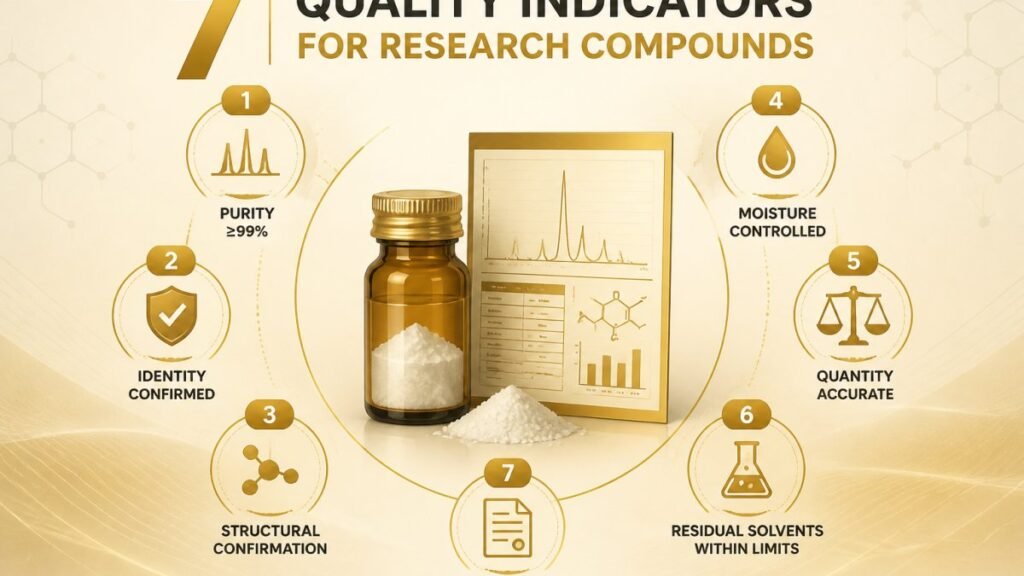
Research Compound Quality Checklist
Use this checklist every time you evaluate a new research compound or supplier:
| Quality Indicator | What to Check | Red Flag |
|---|---|---|
| Purity Percentage | Exact number with analytical method listed | “High purity” without numbers |
| Lot Number | Matches your vial and the COA | Missing or mismatched |
| Test Date | Recent (within weeks, not months) | Undated or very old |
| Testing Method | HPLC and/or MS specified | Method not listed |
| Lab Accreditation | Third-party lab with recognized credentials | Supplier tested it themselves |
| Identity Confirmation | MS or equivalent confirms molecular weight | No identity verification |
| Impurity Profile | Specific breakdown of what the 1% contains | “Impurities present” with no details |
| Supplier Transparency | Easy access to COAs before purchase | Documentation hidden or delayed |
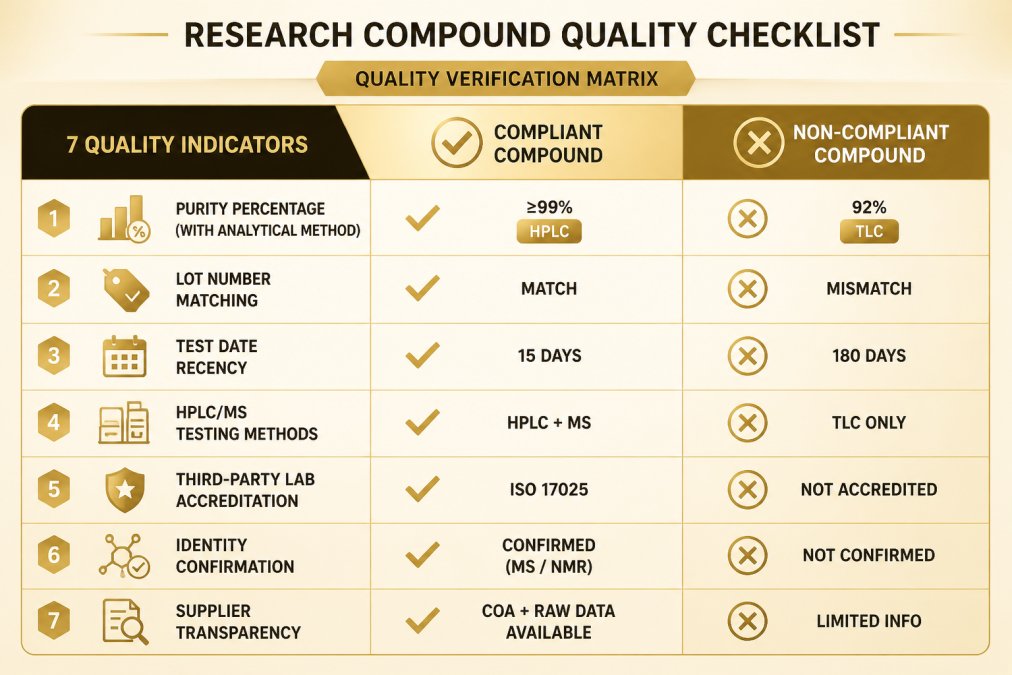
Review the available information for each research compound.
Storage, Handling, and Stability as Quality Factors
Quality evaluation can include reviewing available information about a research compound.
Temperature control is the biggest factor. Most research peptides should be stored at specific temperatures, often frozen or refrigerated depending on the compound. Heat accelerates degradation (ncbi.nlm.nih.gov). Freeze-thaw cycles damage molecular structure. Improper storage can turn a 99% pure compound into something unreliable within weeks.
Interpreting Conflicting or Incomplete Test Results
COAs may contain incomplete or differing information. Reviewing the documentation can help identify questions to raise.
When the COA Lacks a Method
If a purity result appears without a named analytical method, the method used is not specified. You can ask the supplier which method was used.
When Units Are Ambiguous
Molecular weight reported without clear units, or purity reported as a range without a specific value, may prompt a request for clarification.
When the COA Does Not Match the Label
A mismatch between the product label and the COA can be noted. Check the compound name, lot number, and stated specification on both documents.
When HPLC and MS Disagree
HPLC and MS are analytical methods that can provide different information. If results differ, you can ask the supplier for clarification.
When Results Are Simply Missing
Incomplete documentation may prompt questions about the information provided.
A COA can be reviewed to determine which product or batch its results describe.
When test results conflict, you can ask the supplier for clarification.
Getting Started With Verified Research Compounds
Identifying high quality research compounds can include asking questions before you buy.
At PepAlphatides, every batch undergoes independent third-party testing to verify purity levels exceeding 99%. PepAlphatides provides secure QR-coded analytical reports for batch transparency.
The compounds you work with are part of your research materials.
Frequently Asked Questions
How can you tell if a research compound is high quality?
PepAlphatides states that its research compounds have purity levels exceeding 99%, undergo independent third-party testing, and have secure QR-coded analytical reports. A Certificate of Analysis (COA) can provide information about a compound and its testing. Review the documentation available for the product and batch.
What should a certificate of analysis include?
A Certificate of Analysis (COA) can include information about a compound and its analytical testing. Review the documentation available for the product and batch.
Why is independent third-party testing important for research compounds?
PepAlphatides states that every batch undergoes independent third-party testing to verify purity levels exceeding 99%. A COA or analytical report can provide information about testing results. Review the documentation available for the product and batch.
What is the difference between purity and identity testing?
Purity and identity are different aspects of analytical evaluation. PepAlphatides states that independent third-party testing verifies purity levels exceeding 99%. Review the available analytical documentation for information about the tests performed.
Quality compounds from a transparent supplier aren’t just better science, they’re the only way to ensure your research stands up to scrutiny. PepAlphatides delivers research compounds backed by independent testing, batch-specific COAs, and complete transparency. Get started with PepAlphatides verified research compounds and add verified materials to your workflow today.