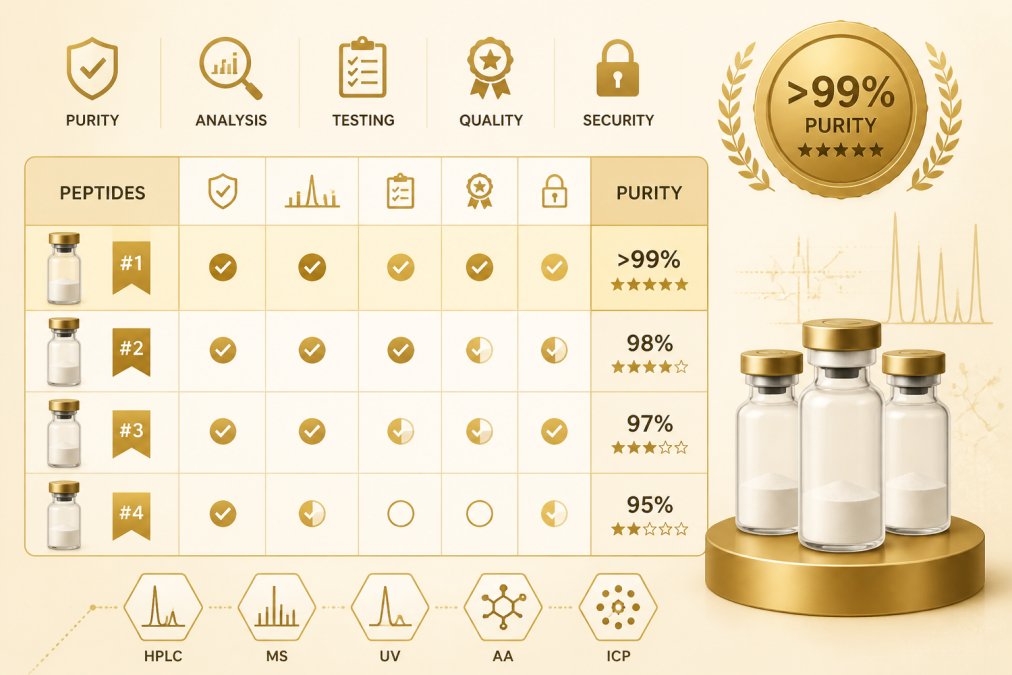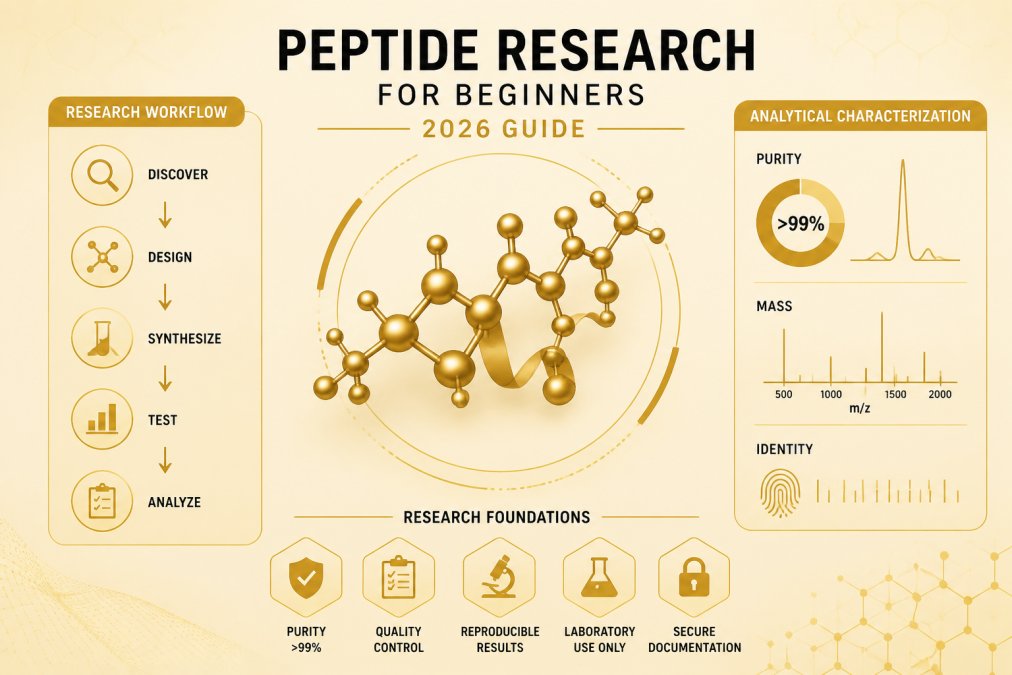
Quick Summary
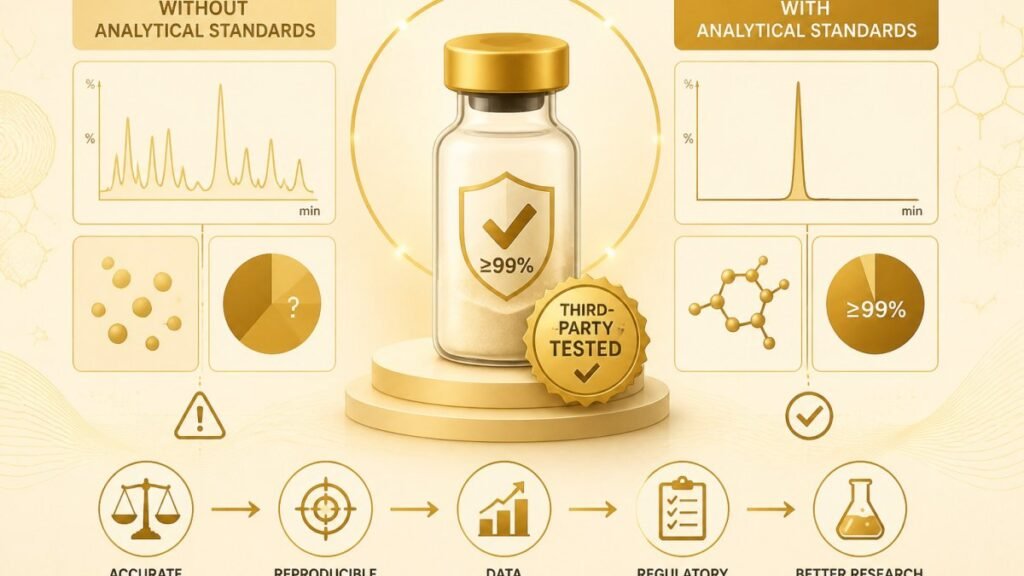
Analytical standards are worth it when they let you trust your numbers, because they are reference materials with characterized identity, purity and content. Without one, an instrument reading shows only a pattern, and handling losses can go unreported. Match the standard to the method you run.
- Research has shown peptide quantification can be inaccurate even with a validated assay, due to sample handling.
- Identity, purity, quantitative and system suitability standards each serve a different job.
- Purity percentage and net peptide content are different numbers and should not be confused.
- Check a certificate of analysis for the method used, the lot number and the assigned value with uncertainty.
- Match the standard to the method, since a purity reference should not calibrate a quantitative assay.
Table of Contents
- What Analytical Standards Do in Peptide Research
- Types of Peptide Reference Standards and Their Purposes
- Research-Use Materials Versus Regulated Reference Standards
- Peptide Identity Testing: Confirming What the Vial Contains
- Peptide Purity Testing and Impurity Assessment
- Capillary Electrophoresis as a Complementary Technique
- Reading a Peptide Certificate of Analysis Line by Line
- Certificate of Analysis and Traceability Checks
- Calibration, System Suitability, and Method Validation
- Standard Handling, Reconstitution, and Stability
- Mapping Each Analytical Method to the Right Standard
- Choosing a Peptide Standard and Requesting Your Next Batch Documentation
- Frequently Asked Questions
Are Analytical Standards Worth It for Peptide Research?
Last Updated: October 28, 2026
What Analytical Standards Do in Peptide Research
Analytical standards are reference materials with a characterized identity, purity and content value, used to calibrate instruments and verify that a measurement is correct.
Peptide quantification is harder than it looks. A case study on peptide adsorption during ultrafiltration using a beta-endorphin assay.
The question worth asking is not whether a standard exists, but whether it is traceable, characterized and suited to the method you are running.
Types of Peptide Reference Standards and Their Purposes
Peptide reference standards are not all used for the same job. Some confirm identity, some quantify content, and some serve as system suitability markers that show an instrument is performing before any sample is run.
Common categories include:
- Identity standards: Confirm that a peptide has the expected molecular weight and sequence.
- Purity standards: Support chromatographic purity measurements and impurity profiling.
- Quantitative standards: Establish a calibration curve so unknown samples can be measured against a known amount.
- System suitability standards: Verify column performance and separation before a run.
A 2023 review on synthetic peptide reference standards describes how these standards are produced through vialing, lyophilization, analytical testing and stability studies.
Match the standard to the question. A system suitability peptide will not tell you the absolute content of your sample, and an identity standard will not tell you how much impurity is present.
Research-Use Materials Versus Regulated Reference Standards
This distinction matters more than most buyers expect. A research-use peptide and a regulated reference standard can look identical in a vial but carry very different documentation, characterization depth and intended use.
Regulated reference standards are produced and documented to pharmacopeial or regulatory expectations. The United States Pharmacopeia’s peptide standards resourcelists documentary standards, validated test methods and acceptance criteria as core elements of a well-characterized peptide.
Neither category is automatically wrong for your work. The point is to know which one you bought and to document how you plan to use it.
Peptide Identity Testing: Confirming What the Vial Contains
Identity testing answers the most basic question: is this the peptide I think it is? A dedicated guide to verifying peptide identity walks through the confirmation steps. Two complementary approaches dominate, and they answer different parts of that question.
Mass Spectrometry for Molecular Weight and Sequence
Mass spectrometry measures the mass-to-charge ratio of a peptide and its fragments. A match between the observed molecular weight and the expected value is a strong identity signal. Fragmentation patterns can add sequence information, which helps distinguish closely related peptides with similar masses.
Use the molecular weight on your certificate of analysis as the starting comparison, not the final word. A mass match does not rule out co-eluting impurities with similar masses, which is why identity testing and purity testing are usually run together.
Amino Acid Analysis for Composition
Amino acid analysis hydrolyzes a peptide and quantifies its constituent residues. The result confirms composition, meaning the relative amounts of each amino acid, rather than the exact order. It is most useful when you need an independent check on how much peptide material is actually present, since it provides a content measurement that a purity percentage alone does not.
Peptide Purity Testing and Impurity Assessment
Purity and content are different numbers, and confusing them is one of the most common errors in peptide work. A deeper look at the impurities that show up in research peptides is available in common impurities in research peptides.
Peptide purity testing commonly combines HPLC, mass spectrometry and, where needed, amino acid analysis. For a practical walkthrough of verifying purity levels, see how to verify peptide purity levels. Each method reveals a different class of impurity, so no single result should be trusted in isolation.
HPLC and Chromatographic Purity Measurements
High-performance liquid chromatography separates the peptide from related impurities based on how each interacts with the column and mobile phase. The purity value reported is typically the main peak area divided by total peak area. Gradient accuracy, mobile phase preparation and column condition all shape the result, so the method details on a certificate matter as much as the headline number.
Why Purity Results Differ Between Methods
Two labs can report different purity figures for the same peptide and both be correct for their method. Differences in column chemistry, gradient, detection wavelength and integration rules all shift the number. Adsorption to containers and filters can also reduce the measured amount in ways the separation itself does not show. When results disagree, compare the methods before concluding either is wrong.
Capillary Electrophoresis as a Complementary Technique
Capillary electrophoresis separates molecules by charge-to-size ratio rather than by column interaction, which makes it a useful orthogonal check. A peptide impurity that co-elutes in HPLC may separate cleanly in capillary electrophoresis. Using a second separation mechanism reduces the risk that a hidden impurity inflates your purity figure.
Capillary electrophoresis is rarely the only method used, but it strengthens a purity claim that already rests on HPLC and mass spectrometry.
Reading a Peptide Certificate of Analysis Line by Line
A certificate of analysis is only as useful as your ability to read it. Work through it line by line rather than jumping to the purity percentage.
- Identity: Look for the stated method (usually mass spectrometry) and whether the observed mass matches the expected mass.
- Purity: Note the method, the wavelength and whether the value is a peak-area percentage.
- Content: Check whether a net peptide content or amino acid analysis value is reported separately from purity.
- Lot or batch number: Confirm it matches the vial you received.
- Date and storage: Check the test date and the recommended storage conditions.
For a deeper walkthrough, see our guide on how to read a peptide certificate of analysis. If a line is missing or unclear, that gap is itself information worth recording.
Certificate of Analysis and Traceability Checks
A certificate of analysis (CoA) is the primary evidence that a peptide standard is what it claims to be. Most CoAs list identity, purity, and sometimes content, but the details behind those numbers determine whether the standard can support defensible results. Traceability asks whether a reported value can be linked back to a recognized reference through an unbroken chain of comparisons, each with stated uncertainty. A certificate that names its methods and reference materials is far more useful than one that states only a final number.
What a Defensible CoA Should Include
Work through the certificate line by line rather than jumping to the purity percentage. The following elements are worth confirming:
- Identity: the method used (typically mass spectrometry) and whether the observed mass matches the expected mass within a stated tolerance.
- Purity: the method, detection wavelength, and whether the value is a peak-area percentage. A purity value without a method is not reproducible.
- Content or net peptide content: reported separately from purity, often by amino acid analysis or nitrogen determination. This is the number that matters for quantitative work.
- Assigned value and uncertainty: for quantitative standards, the certificate should state the assigned value and its expanded uncertainty (often at a 95% confidence level). Without uncertainty, you cannot judge whether a difference between your result and the assigned value is meaningful.
- Lot or batch number: confirm it matches the vial you received. A CoA for a different lot does not apply to your material.
- Test date and retest date: check that the testing is recent enough for your study and that the material is within its supported stability window.
- Storage conditions: the recommended temperature, protection from light and moisture, and any special handling instructions.
- Traceability statement: a description of how the assigned value was established, including the reference materials or methods used.
If a line is missing or unclear, that gap is itself information worth recording. A certificate that cannot tell you how purity was measured limits your ability to reproduce or challenge the result.
Assessing Assigned Values and Uncertainty
For quantitative standards, the assigned value is the anchor for your calibration. Two details matter: how the value was assigned and how uncertain it is. Assignment may be based on amino acid analysis, quantitative NMR, or comparison to an existing reference standard.
Uncertainty is often reported as an expanded uncertainty with a coverage factor (k = 2 is common, corresponding to roughly 95% confidence). If the certificate reports a purity of 98.0% with an expanded uncertainty of ±1.0%, your result should be interpreted with that range in mind.
Traceability in Practice
Traceability is not a single document; it is a chain. A practical check is to ask whether the certificate identifies the reference materials or methods used to assign its values, and whether those references are themselves traceable to a recognized standard. For research-use materials, full metrological traceability may not be claimed, and the certificate should be read with that limitation in mind. For regulated work, pharmacopoeial or certified reference materials are typically expected because their traceability is documented to a recognized authority.
Research-use standards and certified reference materials are not automatically interchangeable. A research-use peptide may be well characterized for exploratory work but lack the documented traceability and uncertainty required for regulated testing. Confirm the intended use before relying on a standard for a compliance decision.
Storage, Stability, and Lot-Specific Documentation
The certificate should state storage conditions and any retest or expiry date.
Keep the CoA for the specific lot you received. When you compare results across studies, confirm that the standards used were from the same lot or that any lot-to-lot variation is documented.
For a deeper walkthrough of the individual lines on a certificate, see our guide on how to read a peptide certificate of analysis. For a broader overview of documentation practices, see our guide to understanding certificates of analysis.
Calibration, System Suitability, and Method Validation
Calibration, system suitability, and method validation are three distinct layers of confidence, and conflating them is a common source of unreliable peptide data. Calibration converts instrument response into concentration. System suitability proves the instrument and method are performing within defined limits on the day of analysis. Validation demonstrates that the method is fit for its intended purpose across its full operating range. Each layer needs its own acceptance criteria, defined before data is generated.
Calibration: Building a Defensible Curve
A calibration curve is only as good as the standard used to build it. For peptide work, prepare at least five calibration levels spanning the expected sample concentration range, with the lowest standard at or below the lower limit of quantification and the highest at or above the expected upper bound.
Common acceptance criteria for a peptide calibration curve include:
- Correlation coefficient (r): typically ≥ 0.995 for linear regression, or ≥ 0.990 when a weighted 1/x² fit is used for wide ranges.
- Back-calculated accuracy: each calibration standard should fall within ±15% of its nominal value, except at the lower limit of quantification, where ±20% is often accepted.
- Residuals: no systematic pattern that suggests a nonlinear response or an inappropriate weighting factor.
A common pattern is to prepare calibration standards fresh from a stock solution on the day of analysis, because peptide adsorption to container walls and freeze-thaw losses can shift nominal concentrations over time. If you must store calibration standards, aliquot and document the storage conditions.
System Suitability: The Pre-Run Gate
System suitability is a set of checks run before samples to confirm the entire analytical system, instrument, column, mobile phase, and detector, is performing well enough to trust the results. For peptide HPLC, typical suitability parameters include:
- Retention time consistency: the main peptide peak should elute within a narrow window (often ±2% of the established retention time) across replicate injections.
- Peak shape: tailing factor typically ≤ 2.0 and theoretical plates above a method-defined minimum.
- Resolution: the resolution between the main peptide and the nearest impurity should meet or exceed the method-defined limit, often ≥ 1.5.
- Replicate precision: the relative standard deviation of peak area across replicate injections is commonly ≤ 2.0% for a well-behaved method.
Run suitability checks before samples, not after. A failing system that is discovered after a batch of samples has been analyzed forces rework and raises questions about data integrity. Document the suitability results alongside the sample data so the run can be defended later.
Method Validation: Connecting Standards to Acceptance Criteria
Method validation establishes that a method is fit for its purpose. The framework most regulated laboratories follow is the ICH Q2(R2) guideline on analytical procedure validation, which defines the validation characteristics that should be addressed: accuracy, precision, specificity, linearity, range, detection limit, quantitation limit, and robustness.
- Accuracy: assessed by spiking a known amount of the peptide standard into a matrix and measuring recovery. Acceptance is often 95-105% recovery at each level, though wider ranges may be justified for complex matrices.
- Precision: repeatability (same day, same analyst) and intermediate precision (different days or analysts) are expressed as relative standard deviation. A common target is ≤ 2% for repeatability and ≤ 5% for intermediate precision in peptide assays, though method-specific limits should be justified.
- Linearity and range: demonstrated with a calibration curve built from the standard, with the range covering the intended sample concentrations.
- Specificity: confirmed by showing that the peptide peak is resolved from impurities and degradation products, often using orthogonal methods such as mass spectrometry or capillary electrophoresis.
Define acceptance criteria in the validation protocol before the experiments begin. Adjusting criteria after seeing the data undermines the validation and is difficult to defend during a review.
Calibration, system suitability, and validation each answer a different question. Calibration asks “what does this response mean?” System suitability asks “is the system working today?” Validation asks “is the method fit for purpose?” A standard supports all three, but only if its assigned value and traceability are documented well enough to defend the numbers.
Standard Handling, Reconstitution, and Stability
Reconstitute standards with the solvent specified on the certificate, record the concentration and date, and aliquot to avoid repeated freezing. Track stability against the time window the manufacturer supports, and do not assume a reconstituted standard keeps its value indefinitely. Our team at PepAlphatides recommends logging every preparation step, because those notes are often the first thing that explains an unexpected result.
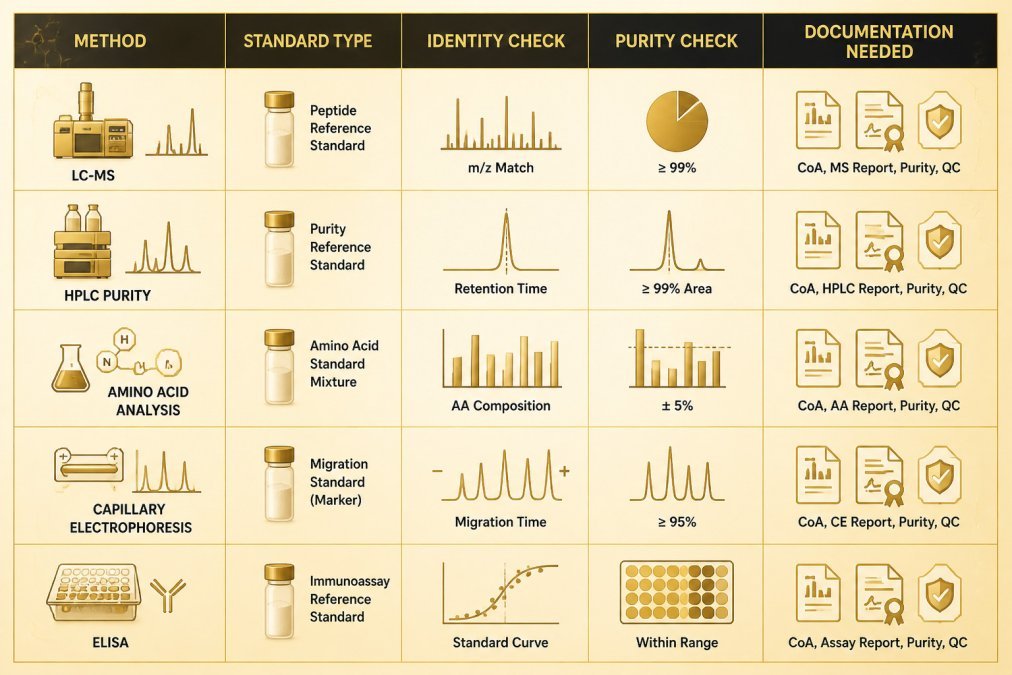
Mapping Each Analytical Method to the Right Standard
The most practical question is which standard supports which method. A method-to-standard map prevents the common error of using a purity reference to calibrate a quantitative assay.
| Method | Standard type | Identity check | Purity check | Documentation needed |
|---|---|---|---|---|
| LC-MS | Identity and quantitative standard | Observed vs. expected mass | Co-elution review | Mass spec method, lot number |
| HPLC purity | Purity standard | Retention time match | Peak-area percentage | Gradient, wavelength, column |
| Amino acid analysis | Composition standard | Residue ratios | Content measurement | Hydrolysis conditions, calibration |
| Capillary electrophoresis | Orthogonal purity check | Migration time match | Impurity separation | Buffer, voltage, capillary |
| ELISA | Quantitative standard | Antibody reactivity | Relative response | Curve fit, diluent, lot |
Use this map as a starting checklist, then confirm the requirements against your own protocol and the certificate supplied with each standard.
Choosing a Peptide Standard and Requesting Your Next Batch Documentation
Start by defining the question your work needs answered. Identity, content and purity each call for different evidence, so the right standard depends on the method you run and the decision the data will support.
When you order, check whether the certificate includes identity, purity, content and traceability information, and confirm the documentation matches the lot you receive.
Standards are worth it when they let you trust your numbers. They are not worth it when they are used for a measurement they were never characterized to support.
Frequently Asked Questions
What analytical standards are used to verify research peptides?
Researchers typically verify research peptides with a combination of mass spectrometry for molecular weight, HPLC for chromatographic purity, and amino acid analysis for composition. Peptide reference standards serve as calibrators so results can be compared across runs and laboratories. The specific standards you need depend on the method you run and the claims you plan to make about the material. Confirm that each technique is backed by a documented procedure and that the standard itself has a current certificate of analysis.
How do researchers confirm a peptide’s identity and purity?
Identity is usually confirmed by mass spectrometry, which checks whether the measured molecular weight matches the expected sequence, and sometimes by amino acid analysis. Purity is typically estimated by reversed-phase HPLC, which separates the target peptide from truncated sequences, deletions and other impurities. Because identity and purity answer different questions, a result for one does not establish the other. Look for both on the certificate of analysis before relying on a batch.
What should a peptide certificate of analysis include?
A useful peptide certificate of analysis lists the lot number, the peptide sequence, the molecular weight, the methods used, and the measured purity with the chromatogram or spectrum behind it. It should also state identity results and the testing laboratory. PepAlphatides provides an individual Certificate of Analysis for every product and secure QR-coded analytical reports for batch transparency.
What is the difference between a peptide reference standard and a research peptide?
A peptide reference standard is characterized with the goal of being used as a calibrator or benchmark. A research peptide is a material supplied for experimental use. Both can be useful. Always read the documentation to see which category a product falls into.
Why do peptide purity results vary between analytical methods?
Purity results differ because each method detects different things. HPLC measures chromatographic separation at a chosen wavelength, so co-eluting impurities or impurities without UV absorbance can be missed. Mass spectrometry detects impurities by mass, which can reveal some co-eluting species that HPLC misses. Sample handling also matters: peptide adsorption during ultrafiltration has been shown to cause quantification inaccuracies. Comparing purity numbers only makes sense when the methods, conditions and standards are the same.
How should peptide reference standards be stored and handled?
Follow the storage temperature and conditions stated on the certificate of analysis, and keep lyophilized material desiccated and protected from light. Reconstitute only the amount you need, use the solvent specified by the supplier, and avoid repeated freeze-thaw cycles, which can degrade the peptide and change its concentration. Record the date of reconstitution and the stability window. Peptides that adsorb to plastic or glass may need low-binding labware, which is a common source of quantification error.
How can researchers assess whether a peptide testing report is reliable?
Check that the report names the analytical methods, shows the raw chromatograms or spectra, and states the acceptance criteria used. Confirm the lot number matches the vial, that identity and purity are both reported, and that the testing laboratory is identified. Traceability to a recognized reference, and evidence that the method was validated, strengthen a report considerably. Reports that give only a single purity percentage with no supporting data deserve more scrutiny before you rely on them.
Do I need an analytical standard if I only want to check a peptide’s purity?
For a qualitative check, a well-documented research peptide with a full certificate of analysis may be enough. If you need a number you can compare across runs or report in a study, a reference standard for system suitability and calibration becomes important, because it lets you confirm that your instrument and method are performing correctly on the day you run samples.