Last Updated: October 30, 2026
Quick Summary
To spot fake peptide suppliers, verify the business’s registration and contact details, check the domain’s age and the site’s legitimacy, and authenticate the certificate of analysis against the exact batch you will receive. Legitimate peptide suppliers provide specific, traceable documentation and answer questions directly.
- Confirm the company name, street address and phone number, and find the business in your state’s registry.
- A domain registered only weeks ago contradicts claims of years of experience; check WHOIS records.
- Match the lot number across the vial label, the COA and the supplier’s lookup tool.
- Contact the testing lab directly through its own channels to confirm it issued the report.
- Avoid wire transfers, gift cards and cryptocurrency; use payment methods that offer buyer protection.
Table of Contents
- How to Verify a Peptide Supplier’s Business Registration and Contact Details
- Checking Domain History and Website Legitimacy
- How to Read a Peptide COA Step by Step
- Fake Peptide COA Red Flags to Watch For
- Confirming Third-Party Peptide Testing
- Peptide Batch Number Verification Steps
- Shipping, Storage and Payment Precautions
- Building a Repeatable Supplier Scoring Checklist
- Your Next Step: Requesting Documentation Before Ordering
- Frequently Asked Questions
Peptide research is growing fast, and so is the number of sellers who want your money without delivering real product. Before you order, you need a way to separate legitimate peptide suppliers from fake ones. A careful buyer can catch most warning signs with a few checks, and this guide walks through them in order.
A fake peptide supplier usually fails in predictable ways. The site looks polished, the prices seem low, and the documentation looks official, yet nothing can be verified. Some sellers ship the wrong compound, an underdosed vial, or nothing at all. A 2024 study of semaglutide sold online without a prescription found that buyers often cannot tell legitimate products from counterfeits, which is exactly why verification matters (Journal of Medical Internet Research study on online semaglutide sales).
Most of these problems show up in the paperwork, the website, and the business details. Each check below is simple on its own. Together, they give you a clear picture of whether a supplier deserves your trust.
How to Verify a Peptide Supplier’s Business Registration and Contact Details
Start with the basics. A real business can be found, named, and contacted. Look for a company name, a physical street address, a working phone number, and a support email that matches the domain. If any of these are missing or vague, stop there.
Next, check the registration itself. Search the company name in your state’s business registry, which is usually run by the Secretary of State. A legitimate company will appear with a formation date, a registered agent, and an active status. Compare that information to what the website says.
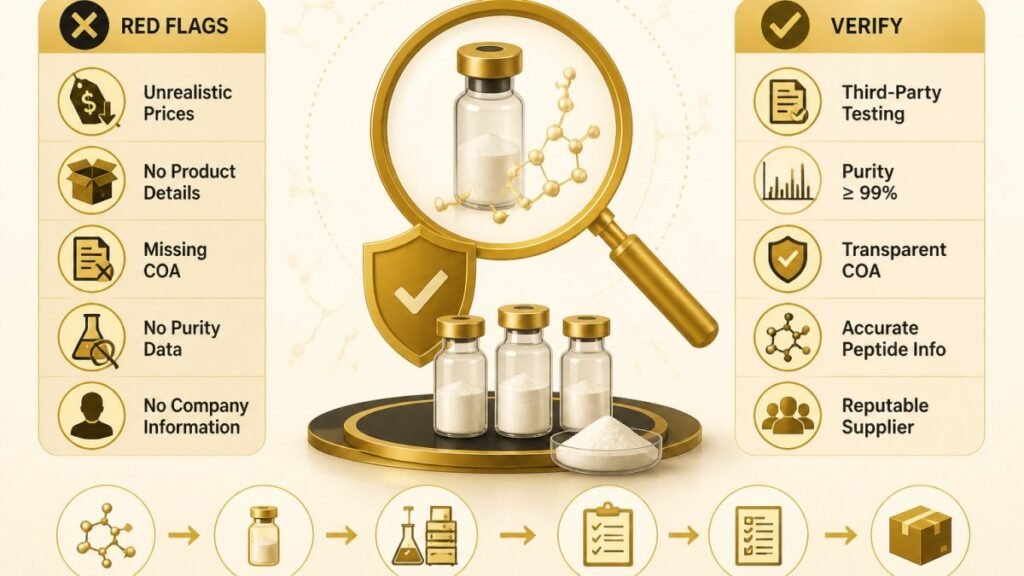
Watch for these common red flags:
- A P.O. box instead of a street address
- A contact form with no direct phone line or email
- A company name that doesn’t appear in any state registry
- A registration date that is only a few weeks old
- Addresses that match a shared mailbox or virtual office with dozens of other businesses
Finally, call the phone number. A legitimate supplier answers questions about product, testing, and shipping, while a fake one dodges, pressures you, or rushes you to pay. Vetting peptide suppliers this way takes only a few minutes and can save you from a costly mistake.
Checking Domain History and Website Legitimacy
A website can look professional in an afternoon. The domain’s history is harder to fake. Use a free WHOIS lookup to see when the domain was registered and who registered it. Many scam sellers use domains that are only weeks or months old, even when they claim years of experience.
Check the registration date against the company’s stated history. If the site claims “trusted since 2015” but the domain was created last month, treat that claim as false. Also look for privacy-protected registration combined with a new domain, since that combination is common in short-lived storefronts.
Review the site itself too:
- Are there broken links, placeholder text, or copied product descriptions?
- Does the checkout use HTTPS and a recognized payment processor?
- Are there reviews, and do they read like real customer experiences?
One caution: a missing or blank review section does not prove a seller is fake. New suppliers often have few reviews. Look for consistency across the business details, domain age, and documentation before you decide.
How to Read a Peptide COA Step by Step
A certificate of analysis, or COA, is the document a lab issues to show what is actually in a vial. It should state the identity, purity, and quantity of the compound. Reading one is useful, but authenticating one is the skill that separates careful buyers from everyone else. For a dedicated walkthrough, see how to read a peptide COA before you buy. This section shows you how to check that the document is real and specific to the vial in your hand.
Work through the COA in this order:
- Confirm the product name and batch. The name should match the product you ordered, and the batch or lot number should appear clearly. Write the lot number down; you will use it again.
- Check the testing lab. Note the lab’s name, address, and contact information. Then confirm that the lab exists as an independent business.
- Review identity testing. Identity results, often from mass spectrometry, should match the expected molecular weight of the compound.
- Review purity results. Purity is usually reported as a percentage from HPLC testing. Look for the method name, the column or detector details if listed, and the percentage.
- Check quantity. Confirm the stated amount in the vial matches what the label claims.
- Look at the date and signature. The report should be dated, and it should identify who approved it.
A good COA is specific. It names the method, gives numbers, and ties itself to one batch. Vague summaries that say “passed” without data are a warning sign.
Authenticating the COA, Not Just Reading It
Reading a COA tells you what the document claims. Authentication tells you whether the document is genuine and whether it belongs to your vial. Use this four-step method:
Step 1: Match the lot number in three places. The lot or batch number on the vial label, on the COA, and on the supplier’s product page or lookup tool should be identical, character for character. Watch for near-matches, a transposed digit, an extra letter, or a date formatted differently, because altered documents often change one character to make a generic report look batch-specific.
Step 2: Contact the named laboratory independently. Do not use the phone number or email printed on the COA alone; find the lab through its own website or a business registry and contact it through that channel. Ask three questions: Did you issue this report? What lot number does it cover? What product and method does it reference? A lab that confirms all three is far more reassuring than a PDF you cannot check. If the lab has no record of the report, treat the COA as unverified regardless of how official it looks.
Step 3: Check that the report is product- and lot-specific. A generic COA, one that lists no lot number, no client, no sample receipt date, or the same results across every product, is a template, not a test record. Real reports reference the sample as received, the date it was logged, and the specific assay run. If the same purity figure appears on multiple lots or multiple products, that is a strong signal the document was copied rather than generated.
Step 4: Look for signs of alteration. Compare fonts, alignment, and margins across the document. Altered COAs often show mismatched typefaces, a pasted-in lot number, a logo that does not match the lab’s current branding, or a report date that falls on a weekend or holiday when the lab would be closed. Cross-check the report date against the supplier’s stated production or receiving timeline; a result dated after you received the vial cannot describe your vial.
Save a copy of every COA you receive, along with the date and the lot number. If a supplier later changes or removes a report, your saved copy is the evidence you will need.
What a COA Cannot Tell You
A COA is evidence about one sample at one point in time. It does not prove that every vial in a lot was tested, that the product is sterile, that it is approved for human use, or that it is safe. Independent testing shows what a lab measured on a given sample; it does not guarantee how a compound will perform in every setting. Use a verified COA as one strong piece of evidence, not as a blanket promise, and pair it with the business, domain, and shipping checks covered elsewhere in this guide.
Use this table to check each step of reading a COA and what to look for in it.
| Step | What to check | Key detail |
|---|---|---|
| Confirm product name and batch | Name and lot number | Lot number matches the vial |
| Check testing lab | Lab name and contact | Lab is independent |
| Review identity testing | Mass spectrometry result | Matches expected molecular weight |
| Review purity results | HPLC purity percentage | Method name is stated |
| Check quantity | Stated amount | Matches the label claim |
| Look at date and signature | Report date and approver | Report is dated and signed |
Fake Peptide COA Red Flags to Watch For
Fake documentation is one of the most common scam tactics. For a companion guide, see signs of low-quality research peptides. Some of the warning signs are easy to spot once you know them:
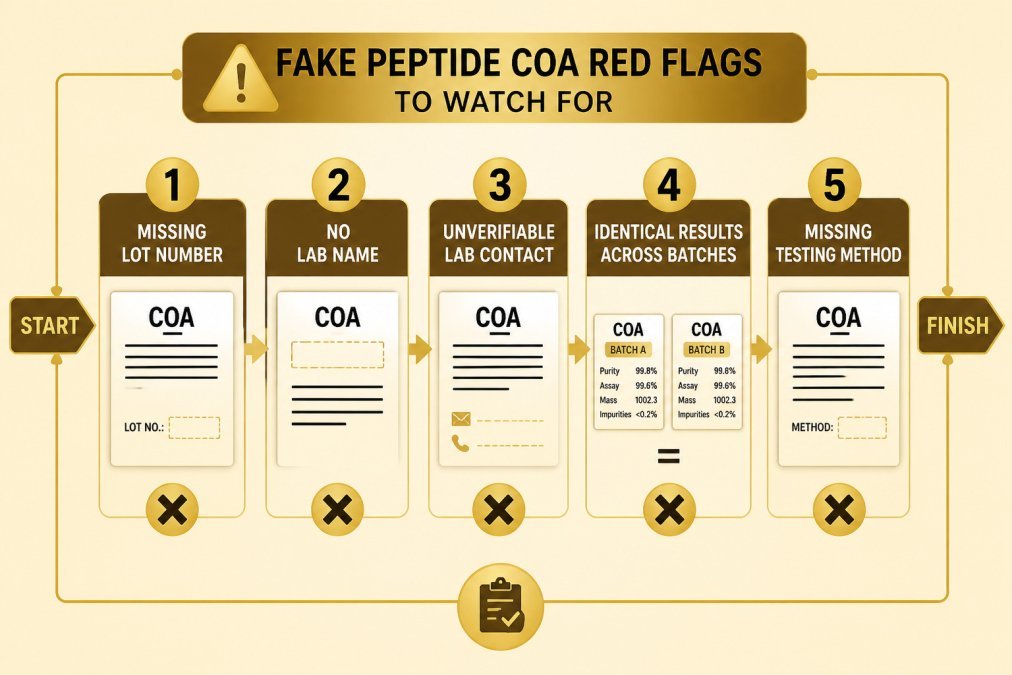
- No lot or batch number. Without it, the report can’t be tied to the vial you receive.
- No lab name or an unverifiable lab. Search the lab’s name and address. If nothing turns up, the report may be invented.
- Identical results across different batches. Real batches vary slightly. Identical purity numbers on multiple lots are suspicious.
- Missing testing method. A report that gives a purity number without naming the method gives you nothing to check.
- Formatting errors or copied templates. Inconsistent fonts, wrong dates, or results that don’t add up are warning signs.
One missing detail doesn’t prove a COA is fake, but several missing details together should make you cautious. Treat a suspicious document as a reason to ask the supplier for clarification, not as a final verdict.
Confirming Third-Party Peptide Testing
Third-party testing means an independent lab tested the product, not the seller. This matters because a supplier can easily write any purity number it wants on its own paperwork.
To confirm third-party testing, ask the supplier for the name of the independent lab. Then contact that lab directly to verify that it issued the report. Ask whether the lab tested the specific batch you are buying. A lab that confirms a report from a supplier is far more reassuring than a PDF you cannot check.
Keep your expectations realistic. Independent testing shows what a lab measured on a given sample. It does not guarantee how a compound will perform in every setting. Use it as one strong piece of evidence, not as a blanket promise.
Peptide Batch Number Verification Steps
A batch number ties a vial to a specific test result. To confirm batch consistency online, follow this step-by-step guide to verifying batch numbers. Without it, documentation proves very little. Here is a simple process to verify it:
- Find the batch number on the vial label and on the COA. The two should match exactly.
- Ask the supplier to confirm the batch number in writing.
- Check that the batch number follows a consistent format across the supplier’s other products.
- Compare the batch’s testing date with the production or receiving date. A result dated after you received the vial is a red flag.
- If the supplier offers a lookup code or QR-coded report, scan it and confirm it opens the matching batch report.
A supplier that can’t tell you which batch you bought, or that gives the same number to every vial, is not providing batch transparency.
Shipping, Storage and Payment Precautions
Even a legitimate product can degrade if it is handled poorly, and even a careful buyer can lose money at checkout. Shipping, storage, and payment are where documentation checks stop and real-world risk begins. This section gives you concrete questions to ask and specific things to inspect.
Cold-Chain and Shipping Verification
Peptides are sensitive to heat, light, and time in transit. Ask the supplier these questions before you order, and treat vague answers as a warning sign:
- What temperature range is the product held at during transit? Look for a stated range and a description of the packaging that maintains it, insulated liners, gel packs, or phase-change materials.
- How long is the product in transit? Ask for the shipping method, the typical transit time, and whether expedited options are available. A product that spends a week in a hot truck is a different risk than one that arrives in two days.
- How is the shipment packaged? Ask whether the vial is protected from light, whether the outer box is discreet, and whether a temperature indicator or data logger is included.
- What happens if a shipment arrives warm or damaged? A legitimate supplier has a written policy for reshipment or refund and will tell you what evidence it needs, photos of the packaging, the vial, and any temperature indicator.
When a shipment arrives, inspect it before you store it. Check that the vial is intact, that the label matches your order and lot number, and that any cold pack is still cool. If the packaging is warm on arrival, photograph everything and contact the supplier before opening the vial. Store the product as directed on the label, and keep it out of heat and direct light.
A supplier that cannot describe its packaging or transit time in specific terms is not thinking about product stability. That is a reason to slow down, not a detail to overlook.
Payment and Data-Security Precautions
Payment is where fraud becomes irreversible. Follow these rules:
- Avoid irreversible payment methods. Wire transfers, gift cards, money orders, and cryptocurrency sent directly to a seller offer little or no dispute path. A supplier that insists on these methods only, or that pressures you to pay outside the normal checkout, is a red flag.
- Use a method with buyer protection. A credit card or a recognized payment processor gives you a dispute process if the product never arrives or is not as described. Check that the checkout page uses HTTPS and that the processor is one you recognize.
- Limit the data you share. A supplier does not need your Social Security number, a copy of your ID, or unrelated financial details to sell you a research product. Be cautious about entering personal data on sites you have not verified, and read the privacy policy to see how data is stored and shared.
- Watch for hidden costs. A low sticker price can be offset by high shipping fees or surprise charges at checkout. Compare the final total, not the advertised price. Free shipping thresholds and member discounts should appear clearly before you pay.
If You Suspect Fraud
Act quickly and keep records. Save the order confirmation, the COA, all emails and messages, and screenshots of the product page and checkout. Contact your payment provider or card issuer to ask about a dispute or chargeback, and report the seller to the relevant consumer protection agency and your state attorney general. If you shared financial information, monitor your accounts and consider a fraud alert. Documentation you saved during the COA and business checks becomes the evidence that supports your report.
Building a Repeatable Supplier Scoring Checklist
Once you know the checks, put them into a scoring system you can reuse. Use this research peptide supplier review checklist to assess purity, COAs, documentation, packaging, support, and research-only compliance before any lab order. Scoring keeps you from relying on a gut feeling, and it makes it easier to compare suppliers side by side.
Use this simple checklist and give each item a score of 0 (fails), 1 (partial), or 2 (passes):
- Physical address and phone number are real and reachable
- Business appears in a state registry with matching details
- Domain age is consistent with the company’s history
- COA includes batch number, lab name, and testing method
- Lab can be independently verified
- Identity and purity results are specific and dated
- Batch number matches the vial and the report
- Shipping and storage conditions are clearly described
- Payment method offers buyer protection
- Final total cost is transparent before checkout
A total of 16 or higher suggests a supplier worth a closer look. A score below 10 is a strong signal to walk away. Use the same checklist for every supplier so your comparisons stay fair.
Your Next Step: Requesting Documentation Before Ordering
Before you place an order, ask the supplier for the documentation in writing. For guidance on qualifying a supplier first, see peptide supplier qualification. Request the COA for the specific batch you plan to buy, the name of the testing lab, and the batch number. Ask how the product will be packaged and shipped. A legitimate supplier will answer these questions quickly and clearly.
If the answers are vague, slow, or evasive, that tells you something. Walk away and keep looking. Careful verification protects your research and your budget.
For current pricing and any available discounts or shipping terms, visit our website or request a quote. Ask us about batch documentation before you buy, and we’re happy to answer your questions.
Frequently Asked Questions
How can you tell if a peptide supplier is legitimate?
Start with the basics: confirm the company has a verifiable U.S. business registration, a physical address and working phone or email contact, and a domain history that does not look newly created or hidden. Then check whether each product has its own certificate of analysis tied to a specific batch, and whether that document names an independent laboratory you can contact directly. A legitimate supplier will answer questions about testing and documentation without hesitation. Vague answers or pressure to order quickly are warning signs worth taking seriously.
What should a legitimate peptide COA include?
A useful certificate of analysis should list the product name, batch or lot number, the testing laboratory’s name and contact details, the test date, and the methods used for identity, purity and potency. Purity results should be reported as a specific percentage from a recognized method such as HPLC, with the chromatogram available on request. If a COA omits the lot number or the lab cannot be located, it is weaker evidence that the vial you receive matches the tested batch.
Can a supplier’s purity claim be trusted without independent testing?
No. A purity claim such as a figure above 99% is only meaningful when an independent laboratory has tested the specific batch and the results can be checked. Supplier-generated data alone does not confirm what is in the vial. Look for third-party testing tied to the lot number, and confirm the laboratory exists and performed the analysis. Treat unsupported purity numbers as unverified until independent documentation is provided.