Table of Contents
- Why Verifying Peptide Batch Consistency Matters
- Step 1: Locate Your Batch Number and Vial Label
- Step 2: How to Verify a Peptide COA Online
- Step 3: Match the Vial Label to the Test Report
- Step 4: Confirm Third-Party Peptide Testing
- Step 5: Assess Peptide Purity Testing Results
- Comparing Results Across Multiple Batches
- What a Certificate of Analysis Cannot Establish
- Troubleshooting Discrepancies and Red Flags
- Frequently Asked Questions
Last Updated: October 13, 2026
Why Verifying Peptide Batch Consistency Matters
To verify peptide batch consistency determines whether your experiments produce reliable, reproducible results. A batch that varies from vial to vial introduces noise, making it impossible to tell whether changes in your results come from your experimental design or the compound itself.
This is where verifying peptide batch consistency online becomes essential. At PepAlphatides, every batch undergoes independent third-party testing, and every vial carries a secure QR code linking to its individual Certificate of Analysis.
Poor batch consistency wastes time, money, and research effort, and can invalidate months of work. Verifying consistency is straightforward once you know what to look for.
Step 1: Locate Your Batch Number and Vial Label
Every peptide vial carries a batch or lot number on the label, your key to the correct test report.
Look for the batch number in these places:
- The main label on the vial itself
- The product box or shipping container
- Your order receipt or packing slip
The format varies by supplier, “BATCH-2026-0847”, “LOT-032026-15”, or a numerical code like “20260312”. Write it down exactly; a single digit off leads to the wrong report.
Some vials display a QR code on the label. Scanning it with your phone’s camera often takes you straight to the Certificate of Analysis for that batch, the fastest path to verification.
If there’s no QR code visible, move to Step 2 to request the report directly from your supplier.
Step 2: How to Verify a Peptide COA Online
A Certificate of Analysis (CoA) is a formal laboratory document reporting test results for a specific batch: what the peptide is, how pure it is, and whether it passed quality checks.
Accessing the Certificate Through QR Code
The fastest way to access your CoA is the QR code on the vial label.
Here’s how:
- Open your phone’s camera app and point it at the QR code on the vial
- Tap the notification that appears (usually a link to the CoA)
- The report should open in your browser
- Check that the batch number on the report matches the batch number on your vial
This works best when the supplier has invested in batch-level tracking. PepAlphatides includes QR codes on every vial to make verification instant and transparent.
Requesting the Report Directly From Your Supplier
If there’s no QR code, contact your supplier and request the Certificate of Analysis for your specific batch number.
Here’s what to say:
“I have a vial with batch number [insert your batch number]. Can you provide the Certificate of Analysis for this batch?”
A reliable supplier sends it within 24 hours. A supplier that can’t or won’t provide a CoA for a specific batch is a red flag.
Verify the report is a PDF or official document from an independent laboratory, not a generic product sheet. It should include:
- The batch or lot number
- The peptide name and sequence
- The test date
- The testing laboratory’s name and credentials
- Specific test results (purity percentage, identity confirmation, etc.)
Step 3: Match the Vial Label to the Test Report
With the CoA in hand, compare it directly to your vial label.
Check these details:
- Batch number: Does the number on the vial match the batch number listed in the report?
- Peptide name: Does the report identify the same peptide you ordered?
- Vial appearance: Does the physical condition of the vial (color of powder, seal integrity) match any notes in the report?
A common mistake is assuming a CoA applies to your vial just because you bought from that supplier. Every batch is different; every vial needs its own batch number match.
If the batch numbers don’t match, stop. Do not use the peptide. Contact your supplier immediately.
If they match, move to Step 4.
Step 4: Confirm Third-Party Peptide Testing
A line on a PDF saying “tested by an independent laboratory” is a claim, not evidence. Move from what the report says to what you can independently confirm by verifying three things: the lab is real and accredited, the report is authentic and unaltered, and the lab actually received and tested a sample from your batch.
1. Verify the laboratory is real and accredited
Start with the laboratory name on the CoA, then confirm it exists as an operating analytical lab, not just a domain name.
Check for:
- A physical address and phone number you can look up independently of the CoA.
- Accreditation. For analytical testing, the relevant credential in the U.S. is ISO/IEC 17025 accreditation, granted by an accreditation body such as A2LA or ANSI National Accreditation Board (ANAB). You can search the accreditation body’s public directory for the lab’s legal name and scope.
- A scope that covers the test. A lab can be accredited for one method (say, elemental analysis) and not another (say, peptide purity by HPLC). Confirm the specific method on your CoA falls inside the lab’s accredited scope.
- A stable web presence. Look for a real website with method descriptions, instrument lists, and staff, not a single landing page created to host CoAs.
If the lab name is generic, has no address, or isn’t in any accreditation directory, treat the report as unverified.
2. Verify the report itself is authentic
A vendor-hosted PDF is easy to alter. Before trusting the numbers, confirm the document’s integrity.
- Check the PDF metadata. In most readers you can view document properties (author, creation date, software used). A report “created” the same day you requested it, or authored by a person rather than the lab, is a warning sign.
- Look for a report or sample ID. Legitimate labs assign a unique report number and often a sample accession number. Note both.
- Look for a signature or authorized signatory. Many labs include the name and title of the analyst or reviewer who released the report.
- Look for the lab’s letterhead, logo, and contact block that match the lab’s public website, not a generic template.
- Prefer a lab-hosted or portal link over a vendor-hosted copy. If the supplier only ever sends a PDF they generated, ask whether the lab can provide the report directly or confirm it by email.
A CoA that lives only on the seller’s website, with no lab report number, no signatory, and no way to reach the lab, cannot be independently verified. That does not automatically mean it is fake, but it means you are trusting the seller, not the lab.
3. Confirm the lab actually tested your batch
This is the step almost everyone skips: a real report reflects a real sample a real lab received.
- Contact the laboratory directly using contact details from the lab’s own website, never from the CoA alone. Ask whether they tested a sample under the report number and lot number shown.
- Ask what was submitted. Labs typically log the sample description, submission date, and the client who submitted it. If the lab has no record, the report is not verifiable.
- Ask whether the client was the supplier or a third party. Some suppliers submit their own samples; that is still third-party testing, but it means the supplier chose what to send. Independent sampling, where the lab or a neutral party pulls the vial, is a stronger claim and is less common.
- Ask about chain of custody. For research use, a documented chain of custody from vial to instrument is the gold standard. Many peptide CoAs do not include it; knowing whether yours does tells you how much weight to give the result.
4. Separate ‘third-party tested’ from ‘independently sampled’
These phrases are used interchangeably but are not the same:
| Claim | What it means | Strength |
|---|---|---|
| In-house tested | Supplier ran its own analysis | Weakest, no independence |
| Third-party tested | An outside lab ran the analysis on a sample the supplier provided | Moderate |
| Third-party tested with independent sampling | A neutral party selected the vial that was tested | Stronger |
| Third-party tested with chain of custody | Sample identity tracked from vial to instrument | Strongest commonly available |
Most peptide CoAs fall into the second row. That’s not disqualifying, but know which row you’re in before treating a result as independent.
5. Red flags specific to this step
- The lab’s name appears only on CoAs and nowhere else online.
- The lab’s address resolves to a mailbox store, residence, or unrelated business.
- The report has no report number, no signatory, and no method details.
- The lab cannot confirm the report number when you contact it.
- The supplier refuses to name the lab or says it is “proprietary.”
- Every batch produces a CoA with suspiciously identical formatting, fonts, and even typos.
Independent testing is only as strong as your ability to verify it. Confirm the lab’s accreditation, confirm the report’s integrity, and confirm the lab has a record of your batch. If any of those three fails, you have a claim, not a verification.
A2LA accredited laboratory directory
ANSI National Accreditation Board accredited lab search
Step 5: Assess Peptide Purity Testing Results
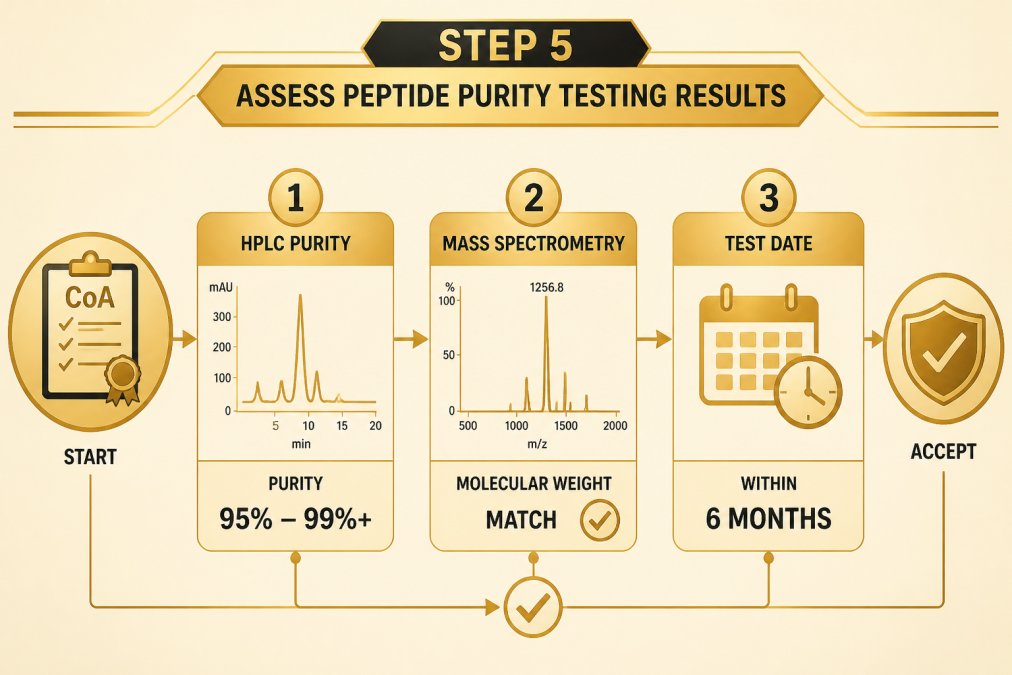
The purity percentage is the most important number on the CoA: what percentage of your peptide is the actual compound you ordered, versus impurities or degradation products.
Look for a section labeled “Purity” or “Assay” showing a percentage, typically written as “98.5%” or “99.2%”.
Higher is better. Most research-grade peptides should be 95% pure or higher; PepAlphatides commits to purity levels exceeding 99%.
Understanding HPLC and Mass Spectrometry Data
Two main testing methods appear on peptide CoAs: HPLC and mass spectrometry.
HPLC (High-Performance Liquid Chromatography) measures purity by separating the peptide from impurities and quantifying each component, your primary measure of how clean the batch is.
Mass Spectrometry (MS or LC-MS) confirms identity by measuring molecular weight and matching it to what you ordered.
On the CoA, you’ll see:
- A purity percentage from HPLC
- A molecular weight result from mass spectrometry
- A statement like “Identity Confirmed” or “Matches Expected Mass”
If purity is below 95%, question it. If mass spectrometry doesn’t confirm the correct molecular weight, do not use the batch.
Comparing Results Across Multiple Batches
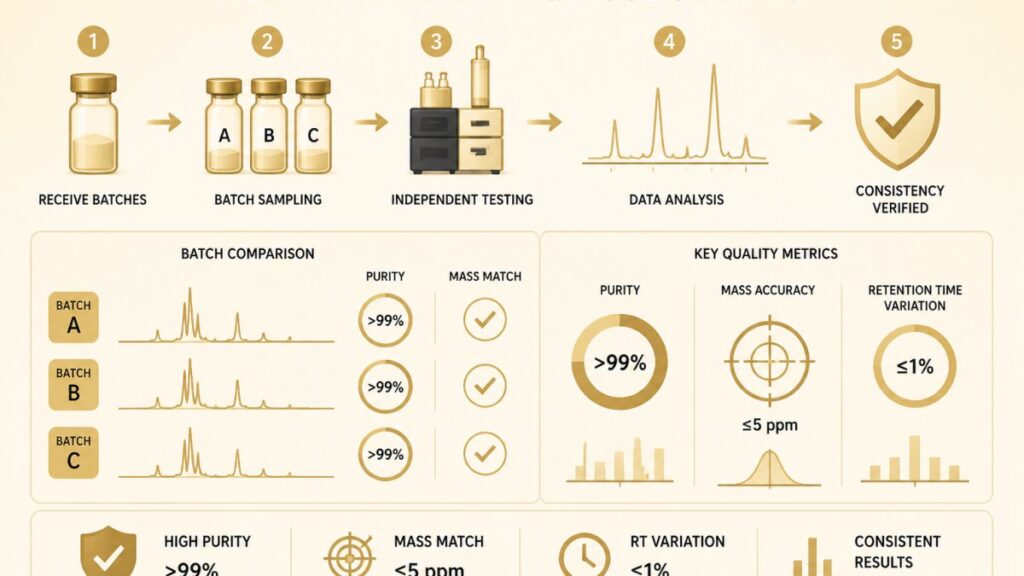
Verifying one batch tells you one vial is what it claims to be. To verify peptide batch consistency tells you whether you can trust the supplier across time, what actually protects a long-running experiment. This is where a reusable worksheet pays off.
Build a batch-comparison worksheet
Keep one row per batch, one column per field, a spreadsheet or paper log. These fields are the minimum to spot drift.
| Field | Why it matters |
|---|---|
| Supplier | Different suppliers use different labs and methods |
| Product name and sequence | Confirm you are comparing the same peptide |
| Lot / batch number | The unique key for the batch |
| Vial size and fill | Consistency in fill can signal process control |
| Test date | Older tests say less about current material |
| Lab name and report number | Lets you re-verify later |
| Method (HPLC, LC-MS, etc.) | Different methods are not directly comparable |
| Purity % | Primary consistency metric |
| Identity result (observed vs. expected mass) | Confirms the right molecule |
| Appearance / reconstitution notes | Practical consistency beyond the numbers |
| Discrepancies or flags | Your own audit trail |
Record values exactly as printed. Don’t round or “correct” them, small differences are the signal.
What ‘consistent’ looks like
There’s no universal pass/fail line, but these patterns are widely used:
- Purity: Batches within roughly 1 percentage point of each other are generally treated as consistent. A drop of 2 points or more between consecutive batches is worth investigating.
- Identity: Observed mass should match the expected mass within the method’s stated tolerance. For many peptide LC-MS methods that tolerance is on the order of ±0.5 Da; larger deviations suggest a synthesis or labeling problem.
- Method: Compare like with like. A 98.5% by one HPLC method is not directly comparable to 98.5% by a different gradient or column.
- Test date: A batch tested more than about six months before you receive it is a weaker signal about current material, because peptides can degrade in storage.
Plot purity against test date. A flat line is what you want. A slow downward slope across batches is a supplier-process signal; a single sharp drop is a batch-specific signal. The two require different responses.
Interpreting discrepancies
When two batches disagree, the cause matters more than the number.
- Purity differs by 1-2 points, identity matches. Often normal method or sample variation. Note it, keep using the batches, and watch the trend.
- Purity differs by more than 2 points. Ask the supplier for the raw chromatogram, not just the summary percentage. A single impurity peak can explain the drop.
- Identity mass is off by more than the method tolerance. Do not use the batch. Request a re-test or a replacement.
- One batch has no identity data at all. Purity without identity is incomplete. Ask for LC-MS or MS data before relying on it.
- Test dates are far apart. A batch tested a year ago and one tested last month are not directly comparable without a fresh test on the older material.
- The lab or method changed between batches. You cannot compare across methods. Ask the supplier to re-test the older batch under the current method if consistency matters.
Decide, don’t just record
A worksheet is only useful if it drives a decision. Assign each batch one of three states:
- Use, identity confirmed, purity within your threshold, test date recent, lab verified.
- Use with caution, minor purity drift or an older test date; flag it in your experimental notes so you can attribute anomalies later.
- Do not use, identity mismatch, missing identity data, purity below your threshold, or an unverifiable report.
Document the state next to the batch number. If a result later looks odd, you will know within minutes whether the batch was already flagged.
What this worksheet cannot tell you
Even a perfect batch-comparison log only reflects what was tested. It doesn’t establish sterility, endotoxin levels, residual solvents, or suitability for any use, and it doesn’t prove untested vials in the same lot match the tested sample. Treat it as a consistency check on the evidence you have, not a substitute for the testing a regulated application would require.
Consistency is a trend, not a single number. Log every batch, compare like with like, set a tolerance before you look at the data, and record a use/caution/do-not-use decision for each lot. That turns a stack of CoAs into an actual quality record.
What a Certificate of Analysis Cannot Establish
A CoA is powerful but limited. Understanding what it can’t tell you prevents misplaced trust.
A CoA does NOT confirm:
- Storage conditions: The report tells you the batch was pure when tested. It doesn’t tell you how the supplier stored it before shipping or how you stored it after arrival. Peptides degrade over time, especially if exposed to heat, light, or moisture.
- Shipping integrity: A CoA from June doesn’t guarantee the batch remained stable through months of storage. If you’re using a batch from six months ago, the purity may have declined.
- Solubility or reconstitution: The CoA confirms identity and purity in powder form. It doesn’t guarantee the peptide will dissolve easily or behave as expected in your specific solvent or application.
- Batch-to-batch equivalence: Two batches with identical CoAs are not necessarily interchangeable. Small differences in synthesis or processing can affect behavior in experiments.
Request a fresh CoA for older batches and verify test dates are recent. A CoA from 2025 for a batch used in 2026 is outdated.
Troubleshooting Discrepancies and Red Flags
Sometimes the CoA raises questions. Here’s how to handle common issues.
Red Flag: Batch number doesn’t match
If the batch number on your vial doesn’t match the CoA, do not use the peptide, it suggests a labeling error or mislabeled vial. Contact your supplier immediately.
Red Flag: Purity below 95%
Research-grade peptides should be 95% pure or higher. If your CoA shows 92%, ask your supplier why, there may be a valid explanation, or a problem with that batch.
Red Flag: Test date is old
If the CoA is dated more than six months before you received the vial, purity may have declined. Request a fresh CoA or reconsider using the batch.
Red Flag: Laboratory is unknown or unverifiable
If you can’t find the testing laboratory online or verify its credentials, be skeptical. Reputable suppliers use accredited labs.
Red Flag: CoA is vague or lacks detail
A legitimate CoA includes specific numbers: purity percentage, molecular weight, test date, and laboratory name. A generic report missing key details isn’t a complete CoA.
Discrepancy: Molecular weight is slightly off
Mass spectrometry has a small margin of error, typically ±0.5 Da. A molecular weight of 1247.2 when you expected 1247.0 is normal; a difference of 2+ Da warrants investigation.
Discrepancy: Multiple test methods show different results
Sometimes HPLC and mass spectrometry give slightly different purity estimates. This is normal. HPLC measures what percentage of the sample is your peptide. Mass spectrometry confirms identity. Both should support the same conclusion: your peptide is what you ordered and meets purity standards.
If results conflict significantly, ask your supplier for clarification. A reputable supplier will explain the discrepancy.
Verifying peptide batch consistency online takes minutes per batch and protects the integrity of your research. At PepAlphatides, every vial includes a QR code linking directly to its Certificate of Analysis, and every batch undergoes independent third-party testing to confirm purity levels exceeding 99%. Verify a batch before use and you’re investing in reliable, reproducible results. Get started with PepAlphatides and access transparent batch documentation for every order.
Frequently Asked Questions
How do I check a peptide batch number online?
Locate the batch or lot number printed on your vial label, then use your supplier’s website or QR code to access the batch-specific Certificate of Analysis. Enter the batch number into their search portal, or scan the secure QR code on the vial itself. The report will display the exact lot number, test date, and analytical results for that specific batch. If your supplier does not offer an online lookup, request the CoA directly by email with your batch number and order details.
What details should a peptide certificate of analysis include?
A complete CoA should list the batch or lot number, sample identity (peptide name and sequence), test date, purity percentage (typically from HPLC), identity confirmation (via mass spectrometry or LC-MS), the independent laboratory name and credentials, report code or reference number, and the signature or approval of the testing facility. It should also note the testing method used and any relevant quality standards. Missing elements, especially the laboratory name, test date, or purity data, are red flags for authenticity.
Can peptide purity results vary between batches?
Yes. Batch-to-batch consistency is normal, and purity can fluctuate within acceptable ranges depending on synthesis conditions, storage, and handling. Most reputable suppliers maintain purity above 98-99%, but slight variations occur. Compare your batch results to the supplier’s typical range and historical data. If one batch shows significantly lower purity than previous orders from the same supplier, request clarification. Consistent batch-to-batch data across multiple orders is a sign of reliable quality control.
How can you tell whether a peptide test report is from an independent laboratory?
Check the laboratory name, credentials, and accreditation listed on the CoA. Independent laboratories are third-party facilities not owned by the peptide supplier. Verify the lab’s credentials through industry databases or by visiting their website directly. Be cautious of reports issued by the supplier’s own internal lab, as they lack the objectivity of independent testing. The CoA should clearly state the laboratory name and contact information; if it does not, request clarification from your supplier before trusting the results.