Table of Contents
- Why Supplier Selection Matters for Research Compounds
- Verifying Supplier Legitimacy and Business Registration
- Evaluating Supplier Reputation and Customer Reviews
- Assessing Supplier Website and Business Information
- Understanding the Research Peptide Certificate of Analysis
- Comparing Chemical Catalogs and Product Availability
- Assessing Product Quality and Batch Consistency
- Checking Safety Data Sheets and Regulatory Compliance
- Evaluating Shipping Speed, Delivery Reliability, and Conditions
- Comparing Pricing and Affordability Across Suppliers
- Questions to Ask a Research Peptide Supplier
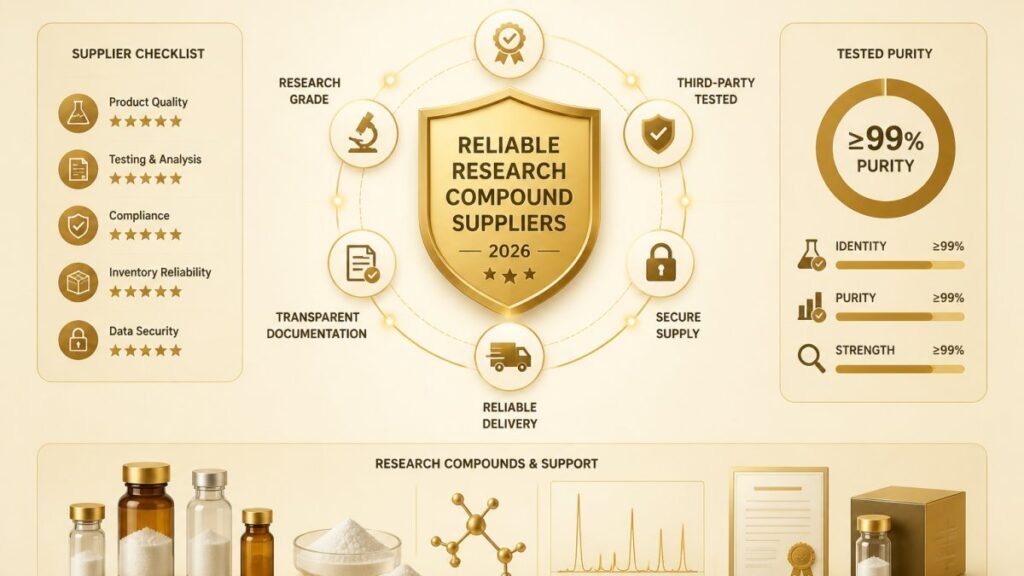
- Research Compound Supplier Checklist for Your Evaluation
- Building a Research Peptide Supplier Comparison Framework
- Secure Purchasing and Fraud Prevention
- Post-Purchase Support and Technical Documentation
- Frequently Asked Questions
Last Updated: October 12, 2026
Why Supplier Selection Matters for Research Compounds
Choosing the right research compound supplier directly impacts the quality of your experimental work.
At PepAlphatides, we understand that reliable research compound suppliers are the foundation of rigorous science. Your compounds must meet exacting standards for purity, consistency, and proper documentation.
This guide walks you through the critical evaluation criteria for choosing reliable research compound suppliers.
Verifying Supplier Legitimacy and Business Registration
The first step in evaluating any research compound supplier is confirming they’re a legitimate, registered business. This isn’t just about trust, it’s about ensuring the company has actual legal standing and operates under regulatory oversight.
Checking Independent Identity and Business Verification
Start by verifying the supplier’s business registration through independent sources. Check the Secretary of State database or equivalent business registry for your state to confirm the company is officially registered.
Search for the company on the Better Business Bureau (BBB) website.
Cross-reference the supplier’s stated address and phone number. Call the number directly and verify you reach a business line, not a personal cell or voicemail.
Confirming Regulatory Status and Compliance
Research compounds operate in a heavily regulated space. Verify that your supplier complies with the regulations that apply to their business model and product category.
Ask the supplier directly about their regulatory compliance status. A reputable research compound supplier will provide clear documentation of their licenses and registrations.
Check whether the supplier has any history of regulatory violations or enforcement actions.
Evaluating Supplier Reputation and Customer Reviews
Reputation is built over time through consistent quality and reliable service.
Search for reviews on independent platforms beyond the supplier’s website.
Pay attention to review patterns. If multiple customers mention the same issue (slow shipping, inconsistent purity, poor documentation), that’s a systemic problem.
Contact existing customers directly if possible.
Check how long the supplier has been in business and whether their reputation has improved or declined over time.
Assessing Supplier Website and Business Information
A supplier’s website reveals a lot about their professionalism and commitment to transparency.
Evaluate the quality and completeness of the website. Does it clearly describe their products, services, and company background?
Check whether the website provides detailed product information.
Review the company’s policies on their website. Look for clear information about ordering, shipping, returns, and customer support.
Understanding the Research Peptide Certificate of Analysis
The Certificate of Analysis (COA) is your proof that a compound meets stated specifications. This document is critical for validating quality and ensuring batch consistency.
What a Complete Certificate Should Include
A complete Certificate of Analysis should include the compound’s name, batch number, date of analysis, and the testing laboratory’s name and credentials.
The document should include the date the compound was manufactured or packaged, allowing you to track age and storage conditions. It should note any relevant impurities detected and their concentrations.
Look for the signature or approval mark of the testing laboratory and any accreditations they hold. Accreditations from recognized bodies (like ISO 17025) indicate the lab meets international standards for testing accuracy and reliability (NIST Quality System | NIST).
Verifying Third-Party Testing and Purity Documentation
Third-party testing by an independent laboratory is the gold standard for verifying purity claims.
Ask the supplier which laboratory performs their testing.
Review the specific testing methods used. High-performance liquid chromatography (HPLC) and mass spectrometry are standard methods for peptide and compound analysis.
Request access to the full COA before purchasing, not after.
Check whether the COA includes a batch number that ties back to your specific order.
Comparing Chemical Catalogs and Product Availability
The breadth and depth of a supplier’s catalog reflects their scale and specialization.
Review the supplier’s product catalog carefully.
Check whether the catalog includes detailed product descriptions, specifications, and usage recommendations.
Look for consistency in how products are listed and described.
Evaluate whether the supplier offers customization or special ordering for compounds not in their standard catalog.
Assessing Product Quality and Batch Consistency
Quality assurance extends beyond a single batch.
Request multiple COAs from the same compound across different batches. Compare the purity levels, impurity profiles, and test results.
Ask the supplier about their quality control procedures. How do they ensure consistency between batches?
Check how the supplier handles batches that fail quality standards.
Ask about the supplier’s batch retention policy.
Checking Safety Data Sheets and Regulatory Compliance
Safety Data Sheets (SDS) provide critical information about handling, storage, and hazard information for chemical compounds.
Verify that the supplier provides an SDS for every compound they sell.
Check the SDS for completeness.
Verify that the SDS is current. Safety information is updated periodically as new research emerges or regulations change.
Review the intended use statements on the SDS and in the supplier’s marketing materials.
Evaluating Shipping Speed, Delivery Reliability, and Conditions
How a supplier ships compounds matters as much as the compounds themselves.
Ask the supplier about their standard shipping timeframe.
Inquire about their shipping methods and conditions. Are compounds shipped in temperature-controlled containers?
Ask whether the supplier provides tracking information for shipments.
Check the supplier’s handling of damaged or delayed shipments.
Research the carrier the supplier uses.
Comparing Pricing and Affordability Across Suppliers
Price is a factor in supplier selection, but it should never be the primary one. Extremely low prices usually signal that quality corners are being cut somewhere in the supply chain, often in testing, documentation, or cold-chain handling. The goal is not the cheapest compound; it is the lowest total cost of a valid, reproducible experiment.
Build a Total Cost of Ownership Model, Not a Price Comparison
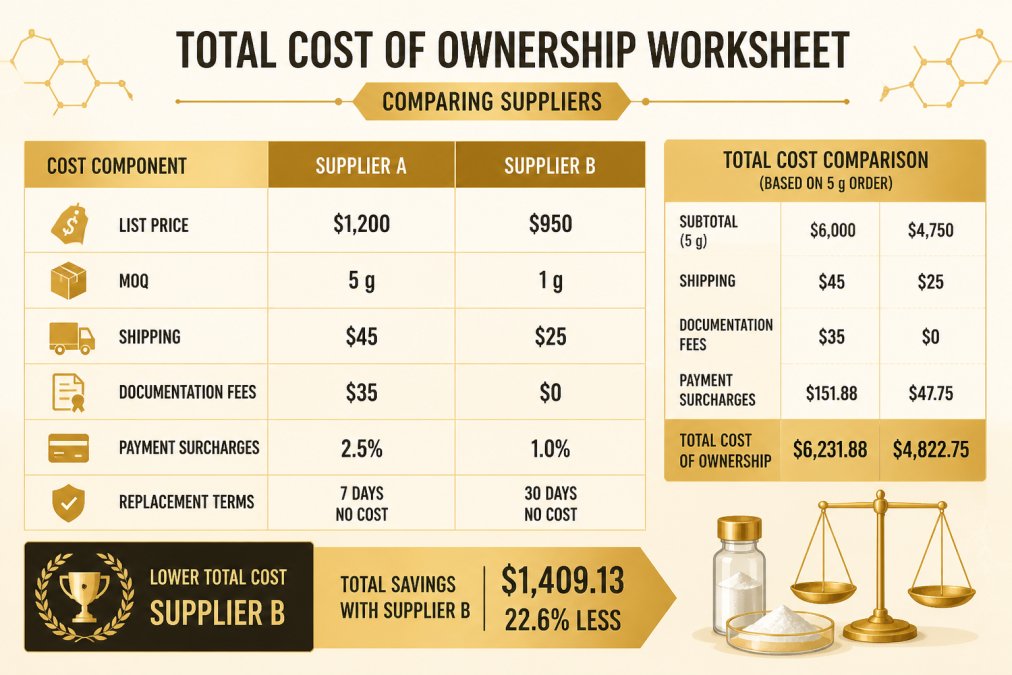
Most buyers compare the listed per-unit price and stop there. That number is only one line in the real cost equation. A practical total cost of ownership (TCO) model for a research compound order includes:
- List price per unit (per milligram, per vial, or per gram, normalize units before comparing)
- Minimum order quantity (MOQ) and whether it forces you to buy more than your protocol needs
- Shipping and handling, including any cold-chain or dry-ice surcharge
A supplier with a 15% higher list price but free cold-chain shipping, COAs included, and a documented replacement policy for nonconforming batches is frequently cheaper per valid experiment than a discount supplier that forces you to reorder.
Normalize the Unit Before You Compare
Suppliers quote in different units, per milligram, per 5 mg vial, per 10 mg vial, per gram, or per kit.
Also separate the price of the compound from the price of purity. A 98% pure material and a 99%+ pure material are not the same product, and the price gap should roughly track the analytical and manufacturing effort behind the higher grade.
Ask for a Complete, Written Quote
Request a written quote that itemizes every line above. Hidden fees are one of the most common sources of post-purchase friction. A complete quote should state:
- The compound, batch or lot number if already assigned, and fill weight
- Purity specification and the test method used to establish it
- Unit price and any volume tier applied
If a supplier will not put these terms in writing before payment, that is a qualification issue, not a pricing issue.
Volume Tiers, Standing Orders, and Institutional Pricing
If your lab orders the same compounds on a recurring basis, ask about volume tiers and standing-order pricing. Many suppliers publish tiered pricing that reduces the per-unit cost as quantity increases. For institutional procurement, ask specifically whether the supplier offers:
- A purchase-order (PO) workflow with net terms, rather than prepayment only
- A written quote valid for a defined period, so you can route it through internal approvals
- A single point of contact for reorders and batch traceability
These are the terms that matter to a procurement team comparing candidates side by side, and they are rarely visible on a public product page.
Where Price Should and Should Not Drive the Decision
Use price as a tiebreaker among suppliers that already pass your legitimacy, documentation, and quality checks, not as the first filter. A useful rule of thumb: if two suppliers are within roughly 10-20% on normalized, all-in cost and both have clean batch-specific COAs from an independent lab, price can decide. If one supplier is dramatically cheaper, the burden of proof shifts to that supplier to explain why, with documentation.
Compare suppliers on normalized cost per milligram at a stated purity, plus shipping, documentation, and replacement terms, not on the headline list price. The cheapest quote is frequently the most expensive experiment.
Questions to Ask a Research Peptide Supplier
Before placing a large order, contact the supplier directly and ask these questions.
Ask about their testing methodology: “Which laboratory performs your third-party testing, and what accreditations do they hold?” A supplier that can name their testing partner and describe their qualifications is transparent and confident in their process.
Inquire about batch consistency: “Can you provide COAs from three recent batches of [specific compound]?
Ask about customization: “Can you synthesize compounds to custom specifications?
Request documentation: “Are COAs available before purchase, or only after?
Clarify compliance: “Which regulations govern your operations?
Ask about support: “What’s your response time for technical questions?
Research Compound Supplier Checklist for Your Evaluation
Use this checklist to systematically evaluate potential suppliers before committing to an order.
- Business is registered and verified through state business databases
- Company has a presence on the Better Business Bureau with acceptable rating
- Physical address and phone number are verified and legitimate
Building a Research Peptide Supplier Comparison Framework
Evaluating multiple suppliers simultaneously requires a structured approach. This framework helps you compare suppliers objectively across key criteria.
Scoring Suppliers on Key Criteria
Create a scoring matrix that rates each supplier on the most important factors. Assign each criterion a weight based on its importance to your research.
Score each supplier on a scale of 1-5 for each criterion.
Sum the weighted scores to get a total supplier score. This numerical approach removes bias and makes it easy to compare suppliers objectively.
Include criteria beyond price in your scoring.
Common Warning Signs of Unreliable Suppliers
Certain red flags indicate a supplier is not trustworthy.
Evasiveness about testing and documentation is a major warning sign.
Pressure to purchase quickly or in large quantities without allowing time for evaluation is suspicious.
Inconsistent information across different communication channels is a red flag.
Unwillingness to provide references or connect you with existing customers suggests they have something to hide.
Extremely low pricing compared to competitors is suspicious.
Secure Purchasing and Fraud Prevention
Fraud in the research-compound market rarely looks like an obvious scam. It usually looks like a polished website, a plausible catalog, and a payment request that is just unusual enough to be inconvenient. Protecting yourself means verifying the seller’s legal identity independently, understanding which payment methods give you recourse, and recognizing the specific patterns that precede a loss.
Verify the Seller’s Legal Identity Before You Pay
Do not rely on the supplier’s own website, testimonials, or social media presence to confirm who they are. Verify independently:
- Business registry. Look up the company name in the appropriate state business registry (often the Secretary of State’s business search) to confirm the legal entity exists, its formation date, its registered agent, and its status (active, dissolved, suspended).
- Address reality check. Cross-reference the stated business address against mapping tools and, where possible, the registry filing. Mail drops, virtual offices, and residential addresses presented as laboratories are common in fraudulent listings.
- Phone verification. Call the number listed on the registry filing or an independent directory, not the number on the supplier’s homepage, and confirm you reach a business line that can answer specific product and order questions.
If any of these checks fail or cannot be completed, treat the supplier as unqualified until the discrepancy is resolved in writing.
Understand Which Payment Methods Give You Recourse
Payment method determines whether you can recover funds if the order never arrives or does not match the description.
- Credit cards. Under the Fair Credit Billing Act, consumers generally have the right to dispute billing errors, and card networks maintain chargeback processes for goods not received or not as described. These protections are strongest when you pay the supplier directly and keep documentation of the order, the quote, and the correspondence.
- Payment platforms with buyer protection. Some platforms offer dispute resolution for eligible transactions. Read the specific terms, because coverage varies by transaction type and category.
- Wire transfers, gift cards, and cryptocurrency. These are effectively irreversible. They offer little to no recourse if the transaction goes wrong, and they are the payment methods most commonly requested in impersonation and advance-fee schemes.
- Peer-to-peer transfers. Treat these like cash. Once sent, recovery is generally not available.
A supplier that insists on an irreversible payment method for a first order, or that changes the payment instructions after you have agreed on terms, is exhibiting a classic fraud pattern.
Recognize the Common Fraud Patterns
Most losses in this market follow a small number of recognizable scripts:
- Impersonation of a known supplier. A fraudulent actor copies a legitimate supplier’s branding, catalog, and even reviews, then directs buyers to a lookalike domain or a new payment address. Always confirm the payment destination against the supplier’s independently verified contact information.
- Last-minute payment redirection. Mid-order, the ‘supplier’ emails to say the bank details have changed. Verify any change by calling a known-good number, never by replying to the email.
- Pressure and scarcity. Urgency (‘this batch is almost gone,’ ‘price increases tomorrow’) is used to short-circuit your verification process.
- Counterfeit or substituted product. The order arrives, but the material does not match the COA, the labeling is inconsistent, or the packaging looks repackaged. This is why batch-specific documentation and a small first order matter.
De-Risk the First Order
A short, low-cost first order is the single most effective fraud control. Use it to confirm:
- The product matches the batch-specific COA you were shown before purchase
- Packaging, labeling, and any cold-chain handling match what was promised
- The supplier responds to questions after payment, not just before
- Invoicing and order confirmations come from the verified business identity
Only after a successful first order should you consider larger quantities, standing orders, or net terms.
Keep a Paper Trail
Save the written quote, the order confirmation, the batch-specific COA, the SDS, the shipping tracking, and all correspondence. If you need to open a dispute or a chargeback, this documentation is what supports your claim. It also gives you a record to compare against future batches from the same supplier.
Never send an irreversible payment to a supplier whose legal identity, physical address, and business registration you have not independently verified. If the seller resists verification or changes payment instructions mid-order, stop and re-verify before proceeding.
State business registry search to verify a supplier’s legal entity and registration status
Post-Purchase Support and Technical Documentation
Quality supplier relationships extend beyond the initial purchase.
Verify that technical support is accessible and responsive.
Request detailed technical documentation for each compound.
Ask about troubleshooting support if you encounter issues with a compound.
Confirm the supplier’s policy on batch retention and future testing.
Establish a relationship with a specific contact at the supplier if possible.
Frequently Asked Questions
How can researchers evaluate a reliable research compound supplier?
Start by verifying the supplier’s business registration and independent identity through state records. Check customer reviews on multiple platforms and examine their website for transparent business information. Request a sample Certificate of Analysis to confirm third-party testing and purity documentation. Compare their chemical catalog against your research needs, evaluate shipping speed and delivery conditions, and assess pricing relative to quality documentation. Ask direct questions about their testing protocols, compliance status, and post-purchase support before committing to an order.
What should a complete research peptide certificate of analysis include?
A thorough Certificate of Analysis must show the compound’s identity verified through analytical methods like HPLC or mass spectrometry, purity percentage (ideally 99% or higher for research use), batch number and manufacturing date, expiration or stability information, and the independent third-party laboratory’s name and credentials. It should include detailed testing methodology, any detected impurities with their percentages, storage instructions, and a unique identifier or QR code linking to the full report. Avoid suppliers who provide generic COAs without batch-specific data or who refuse to share documentation before purchase.
Why should research compounds be tested by an independent laboratory?
Independent third-party testing eliminates conflicts of interest and provides objective verification of purity, identity, and potency. A supplier’s own lab has financial incentive to report favorable results, whereas an accredited independent laboratory has no stake in the outcome and follows standardized protocols. This separation ensures data integrity critical for reproducible research. Academic institutions and serious researchers require independent testing documentation because it meets institutional procurement standards and strengthens the validity of experimental results. It also protects you legally by creating an auditable record of product specifications at the time of purchase.
What are warning signs of an unreliable research compound supplier?
Red flags include refusing to provide Certificates of Analysis before purchase, offering prices significantly below market rates without explanation, lacking verifiable business registration or physical address, providing vague or generic COAs without batch-specific data, no clear communication channels or slow response times, and making unsubstantiated purity claims without third-party documentation. Be cautious of suppliers with no customer reviews, unclear shipping policies, or unwillingness to answer direct questions about testing protocols and compliance. Suppliers that pressure you to purchase quickly or discourage questions about product documentation are typically unreliable.
How do you compare research compound suppliers beyond price?
Create a weighted evaluation framework assessing legitimacy (business verification, regulatory compliance), reputation (customer reviews, industry standing), catalog breadth (product variety for your research), documentation quality (COA completeness and third-party testing), batch consistency (historical data on purity ranges), shipping reliability (delivery speed and condition preservation), and technical support (post-purchase assistance). Price should be one factor among many; a slightly higher cost often reflects superior quality assurance and documentation. Compare total value: a cheaper supplier with incomplete COAs or slow shipping may cost more in wasted research time and failed experiments.
What documentation should a research compound supplier provide?
Essential documentation includes a complete Certificate of Analysis for each batch showing identity verification, purity percentage, and third-party testing credentials; Safety Data Sheets covering handling, storage, and hazard information; batch-specific manufacturing dates and expiration information; and clear intended-use statements for laboratory and research applications. Reliable suppliers also provide storage and handling guidelines, technical support contact information, and transparent policies on refunds or replacement for quality issues. All documentation should be accessible before purchase, ideally through secure QR codes or direct download, allowing you to verify compliance with your institutional or research requirements.
How can you verify a compound’s purity and identity?
Request the Certificate of Analysis and confirm it includes results from analytical methods such as HPLC (High-Performance Liquid Chromatography) or mass spectrometry performed by an accredited independent laboratory. Cross-check the reported purity percentage against industry standards for your compound type and verify the testing methodology matches recognized protocols. Confirm the COA includes the independent lab’s credentials and accreditation status. For critical research, consider requesting a sample batch for your own preliminary testing before committing to bulk orders. Always verify that the COA is batch-specific with unique identifiers, not a generic template, to ensure the documentation applies to the actual product you receive.
What’s the difference between a certified and uncertified research compound supplier?
A certified supplier has undergone independent verification of their testing methods, facility standards, and documentation practices, often holding accreditations from organizations that oversee laboratory quality. Certified suppliers typically provide auditable Certificates of Analysis from third-party labs and maintain documented compliance with relevant regulations. Uncertified suppliers may offer lower prices but provide no independent verification of purity or identity, increasing risk of inconsistent batches or mislabeled compounds. For institutional research, academic projects, or reproducible studies, certified suppliers are essential because their documentation meets procurement standards and strengthens experimental validity. Uncertified suppliers should only be considered for preliminary or non-critical research where batch variation is acceptable.