Table of Contents
- Why Verified Peptide Reports Matter for Research
- Understanding the Peptide Certificate of Analysis
- How to Verify a Peptide COA Before Purchase
- Step 1: Request the Report Before Ordering
- Step 2: Independently Verify the Laboratory’s Existence and Credentials
- Step 3: Check the Report Date, Batch Number, and Sample Identification
- Step 4: Confirm Analytical Methods and Assess Their Appropriateness
- Step 5: Look for Signs of Document Alteration or Inconsistency
- Step 6: Document Your Verification and Approve the Purchase
- Third-Party Tested Peptides: What Independent Testing Means
- Interpreting Peptide Purity Test Results
- Finding Suppliers With Transparent Testing Documentation
- A Practical Report Verification Checklist
- Common Mistakes When Evaluating Peptide Documentation
- Mistake 1: Accepting General Product Certifications as Batch-Specific Verification
- Mistake 2: Trusting Supplier Claims Without Independent Laboratory Verification
- Mistake 3: Ignoring the Testing Date and Assuming Peptides Don’t Degrade
- Mistake 4: Not Verifying That the Laboratory Actually Exists or Is Legitimate
- Mistake 5: Accepting Reports With Suspiciously Perfect or Identical Results Across Batches
- Mistake 6: Skipping Verification Because It Feels Time-Consuming
- Mistake 7: Not Asking What the Report Cannot Establish
- Frequently Asked Questions
Last Updated: October 11, 2026
Why Verified Peptide Reports Matter for Research
Verified peptide reports provide documented evidence that your purchased compounds match supplier claims. Without verification, you’re conducting experiments on unknown materials.
At PepAlphatides, every batch comes with independent third-party testing documentation.
Suppliers providing verified peptide reports enable reproducible, defensible results. Without them, you cannot distinguish whether data variations stem from methodology or material inconsistency.
Request the full Certificate of Analysis before you order. If a supplier won’t provide it upfront, that’s a red flag. Legitimate providers share this documentation freely because it’s their competitive advantage.
Understanding the Peptide Certificate of Analysis
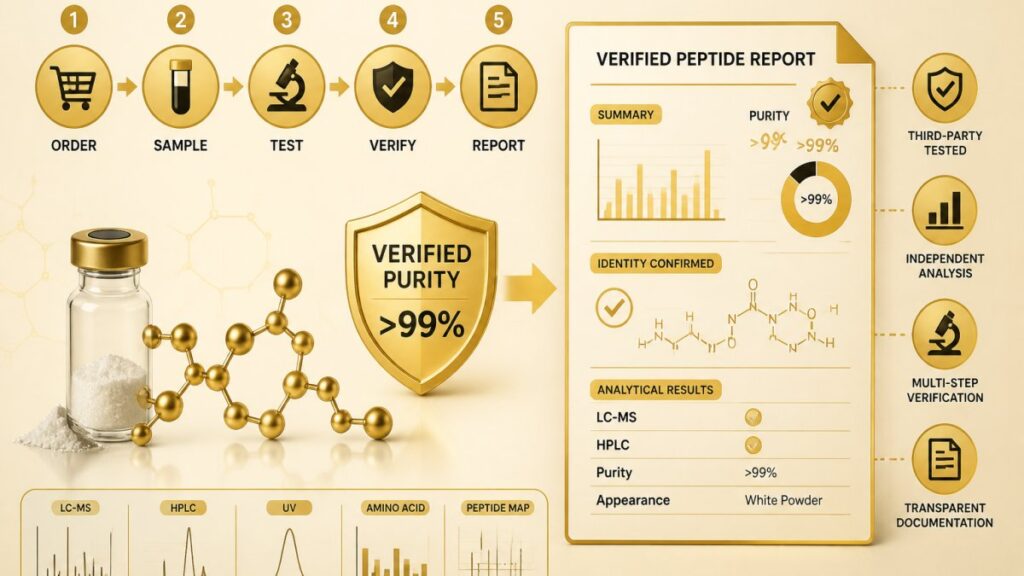
A Certificate of Analysis (COA) is a laboratory document confirming identity, purity, and quality of a peptide batch, the official record of independent testing results.
What a COA Should Include
A complete COA lists the batch number, testing date, laboratory name, and analytical methods used (HPLC, mass spectrometry, etc.).
The report should state measured purity percentage (typically exceeding 99% for research-grade peptides) and identify the sample by full chemical name or catalog number.
A quality COA includes the testing facility’s signature or seal and contact information for verification.
Why Batch-Specific Documentation Matters
Batch-specific documentation proves that your specific batch was tested and meets stated standards, accounting for normal synthesis variations.
Batch-specific verified peptide reports let you confirm you’re using identical material across repeated experiments. Without them, you cannot verify batch consistency.
Some suppliers provide only general product certifications, which prove nothing about your specific batch. Insist on batch-specific reports.
How to Verify a Peptide COA Before Purchase
Verification checks that the report is real, current, matches your batch, and comes from a legitimate independent laboratory, protecting against stale, mismatched, or fabricated documentation.
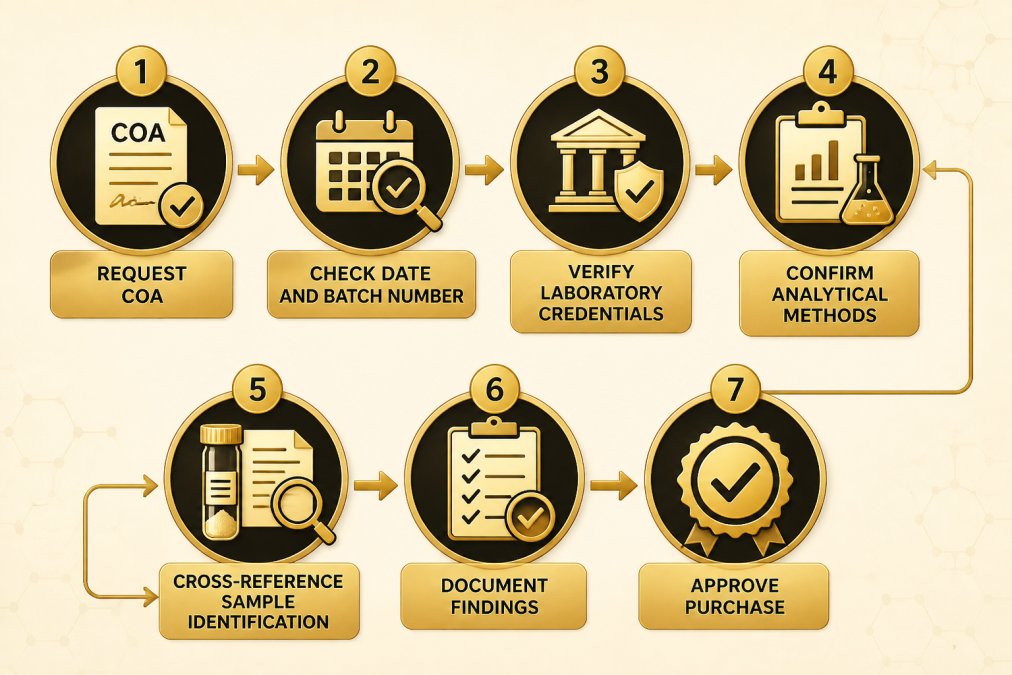
Step 1: Request the Report Before Ordering
Request the full Certificate of Analysis for your specific batch. Reputable suppliers provide it without delay.
Verify the batch number on the report matches your product. Mismatched numbers indicate documentation for a different batch.
Step 2: Independently Verify the Laboratory’s Existence and Credentials
Search for the lab’s official website. Legitimate facilities maintain web presence with contact information, credentials, and equipment descriptions. If you cannot find the lab online, that’s a warning sign.
Check for ISO/IEC 17025 accreditation or ACLASS listing. These credentials indicate the lab follows standardized protocols.
Call the lab’s main number (from their website, not the supplier) and ask to confirm: whether they tested this batch, the receipt date, methods used, result accuracy, and turnaround time. If the lab has no record of the batch, the report is fraudulent or mismatched.
Ask the lab whether they conduct the methods listed on the report (HPLC, mass spectrometry, etc.) and what equipment they use. Legitimate labs can describe their instrumentation; inability to answer indicates the lab may not perform the claimed testing.
Step 3: Check the Report Date, Batch Number, and Sample Identification
Reports within 30-60 days of purchase provide better assurance the batch hasn’t degraded. Reports older than 90 days warrant questions about storage conditions.
The batch number on the COA must match the product label and invoice. If any differ, resolve the mismatch before purchase.
Confirm the sample identification matches your peptide exactly. Vague language like “research peptide” indicates the documentation may not apply.
Stale reports are a common red flag. If a supplier is still selling from a batch tested months ago, ask why. Storage conditions matter. A peptide tested three months ago might have degraded if stored improperly. Also watch for batch numbers that appear on multiple COAs with identical test results, this pattern suggests reports may be recycled or fabricated.
Step 4: Confirm Analytical Methods and Assess Their Appropriateness
Common methods include HPLC (measures purity but not identity), mass spectrometry (confirms molecular weight and identity but not purity), and NMR (provides structural information but is less common for peptides).
Complete reports use multiple complementary methods (e.g., HPLC for purity and mass spectrometry for identity). Single-method reports or vague language like “tested for quality” is insufficient.
HPLC establishes purity but not biological activity. Mass spectrometry confirms molecular weight but not purity or degradation products. Neither establishes sterility, safety, endotoxin levels, or regulatory approval.
Step 5: Look for Signs of Document Alteration or Inconsistency
Examine reports for signs of tampering: missing official seal or signature, inconsistent formatting, missing or vague data (e.g., “exceeds 99%” instead of specific numbers), and contact information that doesn’t match the lab’s website.
Step 6: Document Your Verification and Approve the Purchase
Document your verification: lab name and contact, date contacted, batch confirmation, methods used, and any concerns. Proceed only if all steps check out.
Independent verification of the laboratory, not just trusting the report, is the only meaningful protection against fraudulent or mismatched documentation. Spending time on a verification call can help prevent wasted research time if the peptide quality is poor or the report is fabricated.
Third-Party Tested Peptides: What Independent Testing Means
Independent testing means an unaffiliated laboratory conducted the analysis, removing the conflict of interest inherent in supplier self-testing.
How Independent Laboratories Verify Peptide Quality
Independent labs follow standardized protocols with blind testing to reduce bias, documenting sample receipt, storage, procedures, and results.
The lab issues a report under their letterhead with credentials and contact information, a third-party assertion about quality, not a supplier claim.
Reputable labs maintain ISO certification or other industry standards, indicating rigorous protocols and proper equipment maintenance.
Red Flags in Testing Claims
Avoid suppliers claiming peptides are “tested” without independent verification. Vague language like “quality assured” is insufficient without documentation.
Be skeptical of suspiciously perfect results. Real testing produces variation.
If a supplier won’t provide batch-specific reports before purchase, that’s a warning.
Independent testing from a third-party laboratory is a key verification step. Supplier claims without independent documentation should be reviewed carefully.
Interpreting Peptide Purity Test Results
Purity percentages indicate the proportion of target peptide versus impurities (e.g., 99% purity means 99% target peptide, 1% other compounds).
What Purity Percentages Actually Tell You
Higher purity can improve reproducibility. A 99% pure sample contains more active peptide per unit weight than a 95% pure sample when dosing by weight.
Purity measures chemical composition, not biological activity. A 99% pure peptide can be biologically inactive if degraded or misfolded.
Purity requirements can vary by application.
Qualitative vs. Quantitative Analysis in Reports
Quantitative analysis provides specific measurable values (e.g., “purity: 99.2%” or “molecular weight: 1,234.56 Da”).
Qualitative analysis describes characteristics without precise numbers (e.g., “sample appears homogeneous”). These observations support but don’t replace quantitative data.
Complete verified peptide reports include both quantitative measurements and qualitative observations for full confidence in results.
Finding Suppliers With Transparent Testing Documentation
Suppliers vary in how they treat verified peptide reports. Some make documentation central to their business; others treat it as an afterthought. This difference significantly affects your research.
What to Look for in a Supplier’s Testing Practices
Transparent suppliers make COAs easily accessible via QR codes, email, or other mechanisms. The mechanism matters less than the commitment to sharing documentation.
Verify the supplier provides batch-specific reports, not general product certifications. Batch-specific documentation is the gold standard.
Check whether the supplier uses the same laboratory consistently or rotates between labs.
Ask whether the supplier tests every batch or only samples.
Batch-Specific Reporting and QR Code Verification
QR codes on product vials can pull up batch-specific COAs directly, making verification instant and reducing report-batch mismatches.
QR code systems work only if maintained properly with current, accurate reports.
Combining QR codes with email delivery ensures you have documentation even if one system fails.
Scan QR codes yourself to confirm the batch number, lab name, and testing date match your purchase.
A Practical Report Verification Checklist
Use this checklist every time you evaluate a verified peptide report before purchase. Check off each item to ensure you’re making an informed decision.
- Report includes batch number matching your product order
- Testing date is recent (within 30-60 days for most peptides)
- Laboratory name and location are clearly stated
- Lab contact information is provided for independent verification
- Analytical methods are named specifically (HPLC, mass spectrometry, etc.)
- Purity percentage is stated as a specific number (e.g., 99.2%, not “exceeds 99%”)
- Molecular weight or identity confirmation is included
- Report includes lab letterhead, signature, or official seal
- Batch number on report matches batch number on product label
- No signs of document alteration or inconsistencies
- Sample identification matches your peptide’s chemical name or catalog number
- Report addresses storage conditions or stability information
- You can contact the laboratory independently to verify testing
Complete this checklist before making a purchase. If you can’t check off all items, contact the supplier and ask for clarification.
Common Mistakes When Evaluating Peptide Documentation
Researchers often make predictable errors when reviewing verified peptide reports. These mistakes can lead to purchasing compounds with inadequate documentation or undetected quality issues.
Mistake 1: Accepting General Product Certifications as Batch-Specific Verification
A report for “Peptide X” without a batch number proves nothing about your batch. It may describe testing from a batch made months ago.
The report must include a specific batch number matching your purchase order. If the report lacks a batch number or the number differs from your product label, request a batch-specific report.
Why it matters: Batch-to-batch variation is normal in peptide synthesis. Even the same supplier using the same protocol can produce batches with slightly different purity levels or impurity profiles. A report for a different batch tells you nothing about the material you’re actually receiving.
Mistake 2: Trusting Supplier Claims Without Independent Laboratory Verification
If a supplier states their peptides are “99% pure” or “independently tested,” that’s a marketing claim, not evidence. An independent laboratory report stating 99% purity is evidence. Don’t confuse claims with documentation.
What to look for: The report must be issued under the letterhead of an independent laboratory (not the supplier’s own facility), include the lab’s contact information, and be signed or sealed by an authorized lab representative. If the report is hosted only on the supplier’s website with no way to verify it independently, treat it as a claim.
Why it matters: Suppliers have financial incentive to overstate quality. An independent lab has no stake in the sale and is legally liable for false results.
Mistake 3: Ignoring the Testing Date and Assuming Peptides Don’t Degrade
A report from a year ago doesn’t prove your current batch meets standards. Peptides can degrade over time, especially if stored improperly (exposed to heat, light, or moisture). A purity of 99% at the time of testing doesn’t mean the peptide is still 99% pure today.
What to look for: The report should be dated within 30-60 days of your purchase. If the report is older than 90 days, ask the supplier about storage conditions and whether the batch has been re-tested. If a supplier is still selling from a batch tested six months ago without recent re-testing, that’s a point to consider.
Why it matters: Peptide degradation is invisible. You cannot tell by looking at a vial whether the peptide has degraded. If you use degraded material, your experimental results may be unreliable, and you’ll waste time troubleshooting a problem caused by material quality, not your methodology.
Mistake 4: Not Verifying That the Laboratory Actually Exists or Is Legitimate
Spending two minutes searching for the lab’s website or calling to confirm they conducted the test is quick due diligence that catches fraud. Some fraudulent reports cite laboratories that don’t exist, have closed, or don’t actually perform peptide testing.
What to look for: Search for the lab’s name online. Can you find their website? Do they list their address, phone number, and staff? Can you call and reach someone who can confirm they tested your batch? If the lab cannot be independently verified, the report may be fraudulent.
Why it matters: Fraudulent reports can occur in the peptide market. Unscrupulous suppliers may fabricate test results to appear legitimate. Independent verification of the lab’s existence and credentials is a key defense against this fraud.
Mistake 5: Accepting Reports With Suspiciously Perfect or Identical Results Across Batches
A purity of exactly 99.5% across multiple batches is unlikely. Real testing produces variation. Reports with identical results across different batches, identical purity percentages, or results that seem too good to be true should be reviewed carefully.
What to look for: Legitimate reports show realistic variation. One batch might be 99.2% pure, another 99.7%. Impurity profiles differ slightly between batches. If every report from a supplier shows identical results, ask the lab directly whether they actually tested multiple batches or whether the supplier is reusing the same report.
Why it matters: Fabricated reports often use the same numbers repeatedly because the supplier didn’t bother to vary the data. Real testing produces real variation. Suspiciously perfect consistency is a point to consider.
Mistake 6: Skipping Verification Because It Feels Time-Consuming
The time spent checking a COA and calling the lab to verify it can help prevent wasted research time if the peptide quality is poor or the report is fraudulent. Verification is important for serious research.
What to look for: Create a simple checklist (see the verification checklist section above) and work through it before every purchase. If you can’t check off all items, contact the supplier and ask for clarification. Legitimate providers will address every point without hesitation.
Why it matters: A single batch of low-quality or misidentified peptide can impact experimental work. The cost of verification is often minimal compared to the cost of discovering a problem after you’ve already conducted experiments.
Mistake 7: Not Asking What the Report Cannot Establish
A purity report proves chemical composition but does not establish safety, suitability for human use, sterility, biological activity, or regulatory approval. Some researchers assume a high-purity report means the peptide is safe or effective. It doesn’t.
What to look for: Understand the scope of the testing. HPLC purity testing measures chemical composition. It does not measure:
- Sterility: Whether the peptide is free from bacterial or fungal contamination. Sterility requires specific testing (e.g., USP <71> Sterility Tests) not typically included in standard purity reports.
- Endotoxin levels: Whether the peptide contains bacterial endotoxins that could trigger immune responses. Endotoxin testing requires LAL (Limulus Amebocyte Lysate) assay, which is separate from purity analysis.
- Biological activity: Whether the peptide actually functions as intended in cells or organisms. A pure peptide can be biologically inactive if it’s misfolded or degraded.
- Safety for human use: Purity testing does not establish safety. Regulatory approval (FDA, EMA) requires extensive safety and efficacy data beyond a purity report.
- Stability over time: A report shows purity at the time of testing, not how long the peptide will remain stable under your storage conditions.
Why it matters: Researchers sometimes make claims about peptide safety or efficacy based solely on a purity report. A purity report is one data point, not a a comprehensive quality assessment. Understand what it does and does not prove.
Verification is an important step for reproducible research. The most common mistakes stem from assuming the supplier’s claims are true or the report is authentic without independent confirmation. Spend the time to verify.
Frequently Asked Questions
How can I verify that a peptide certificate of analysis is authentic?
Cross-reference the batch number on your vial with the batch number on the report, check that the report date is recent (within 6 months of your purchase), verify the laboratory’s credentials through independent sources, and confirm the analytical methods match what the supplier claims. Request the COA before ordering when possible. Some suppliers provide secure QR codes on vials that link directly to the batch-specific report, adding an extra layer of verification.
What should a peptide certificate of analysis include?
A complete COA must contain the peptide’s chemical name and molecular weight, the batch number and report date, the measured purity percentage with the analytical method used (HPLC, mass spectrometry, etc.), the laboratory’s name and credentials, the sample identification matching your batch, and results from both qualitative (identity confirmation) and quantitative (purity measurement) analysis. Missing sections suggest incomplete or unreliable testing.
Are verified peptide reports reliable?
Verified reports from independent third-party laboratories are reliable when they come from accredited facilities and include batch-specific documentation with recent test dates. Always verify the lab’s independence and request documentation before purchase rather than relying solely on supplier claims.
What does peptide purity on a lab report mean?
Purity percentage indicates the proportion of the desired peptide compound versus impurities or byproducts in the sample. A 99% purity reading means the sample is 99% the target peptide and 1% other substances. The analytical method used (HPLC or mass spectrometry) determines how precisely purity is measured. Higher purity generally indicates better quality, but the report must specify which method was used and whether the measurement is quantitative (precise weight-based measurement) or qualitative (identity confirmation only).