Last Updated: November 7, 2026
Quick Summary
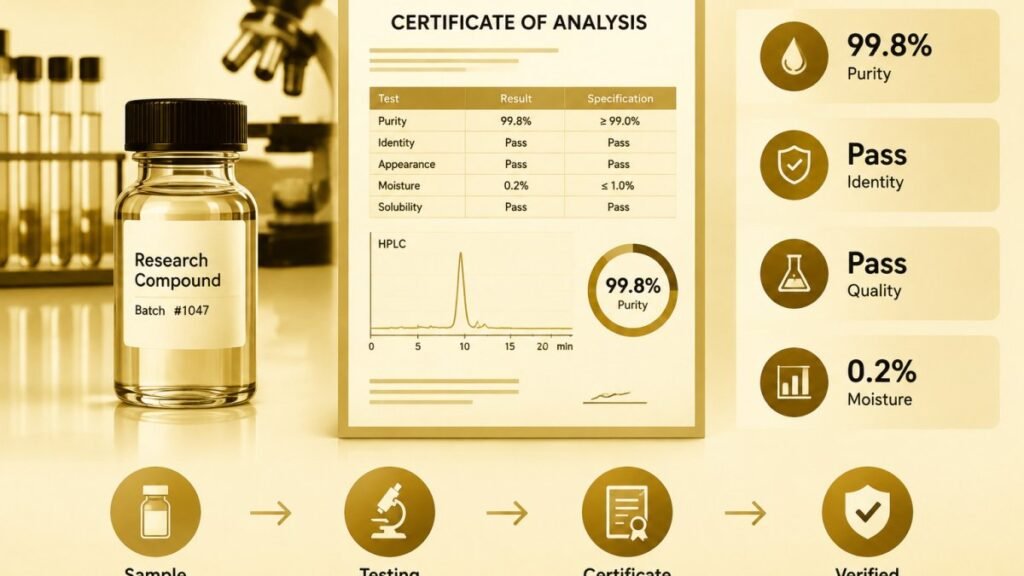
A certificate of analysis (CoA) is a document reporting the measured test results for a specific batch or lot of a product, compared against its specification. It shows what a laboratory found, whether each result met its limit, and which batch the results apply to.
- Confirm the batch or lot number on the certificate matches the code on your product exactly.
- Check the laboratory name, accreditation status, and analyst signature before relying on the results.
- Read each result alongside its specification, method, units, and detection limit, not the pass/fail label alone.
- A CoA reports results for the tested sample only, so sampling method and chain of custody matter.
Table of Contents
- What a Certificate of Analysis Is and Why It Matters
- What Information a Certificate of Analysis Contains
- Product Identity, Composition, Purity, and Potency Explained
- Laboratory Testing Methods and Detection Limits
- Specifications, Acceptance Criteria, and Pass/Fail Results
- Certificate of Analysis Example: An Annotated Walkthrough
- How Batch and Lot Numbers Link a CoA to Your Product
- Certificate of Analysis Lookup: How to Find the Report for Your Batch
- How to Get a Certificate of Analysis Before You Buy
- Difference Between a COA and a COC
- CoA vs. Safety Data Sheet, Certificate of Conformity, and Test Report
- How to Verify Authenticity and Spot an Unreliable Certificate
- Sampling, Chain of Custody, and Limits of What a CoA Proves
- Digital CoAs, QR Codes, and Data Integrity Standards
- Requesting Your Batch’s Certificate of Analysis from PepAlphatides
- Frequently Asked Questions
What a Certificate of Analysis Is and Why It Matters
A certificate of analysis (CoA) is a document that reports the measured test results for a specific product, material, batch, or lot. It tells you what a laboratory actually found when it tested a sample, compared against the specification the product was meant to meet.
The value of a CoA depends entirely on what was tested and whether the report matches the material you are reviewing. A certificate covering one batch says nothing reliable about a different batch from the same manufacturer. Buyers who treat a CoA as a general promise about a brand usually misread it.
Our guidance is to read a CoA as a batch-specific record of analytical findings. A quality guide from JMP Precision Labs, “What Is a Certificate of Analysis? (COA) Quality Guide” explains this framing well: the report is only as useful as the tests it documents. For a fuller checklist on which tests, lot details, and limits make a certificate meaningful, see which tests and limits make a certificate meaningful.
What Information a Certificate of Analysis Contains
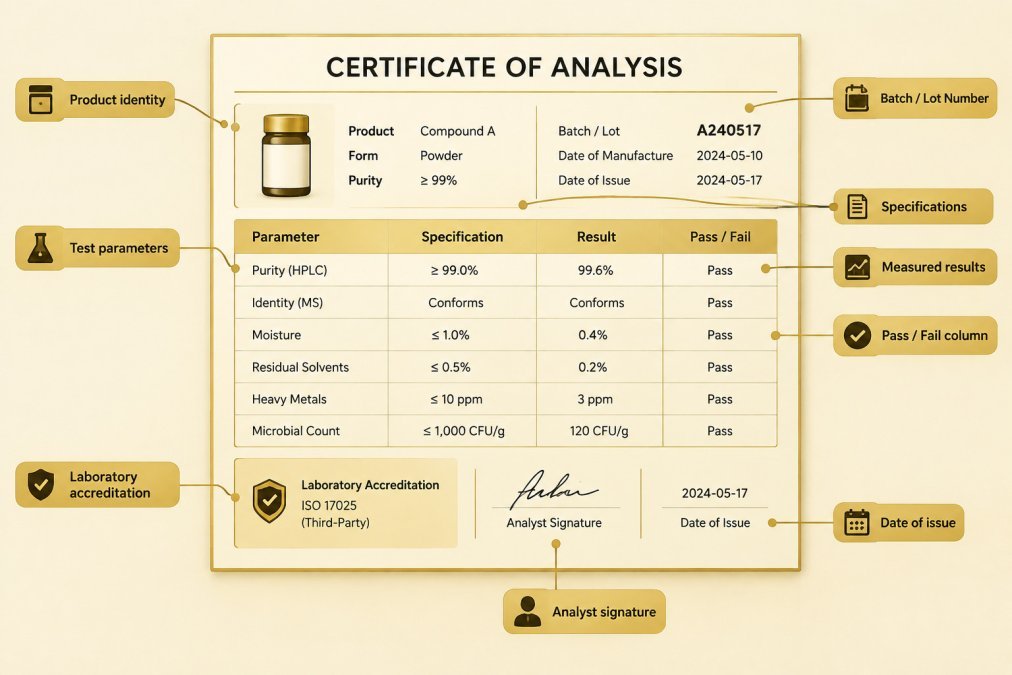
Most CoAs share a common structure, even though the layout varies between laboratories and suppliers. Knowing where each field sits helps you read a report quickly.
- Product identity: the name, grade, and description of the material tested
- Batch or lot number: the identifier that links the report to specific units
- Test parameters: the properties or contaminants measured, such as identity, purity, or potency
- Specifications: the acceptable range or limit for each parameter
- Measured results: the value the laboratory recorded for each parameter
- Pass/fail determination: whether each result met its specification
- Laboratory details: the testing facility, its accreditation status, and the analyst’s signature
- Date of analysis and date of issue: when testing was done and when the report was finalized
A CoA is described by Quickvee’s 2026 guide to reading CoAs as a document you can check for batch numbers, lab accreditation, and pass/fail results. Those three checks alone catch many incomplete or mismatched reports.
!Annotated diagram of a certificate of analysis showing labeled fields for product identity, batch number, test parameters, specifications, results, pass/fail column, laboratory accreditation, and analyst signature
Product Identity, Composition, Purity, and Potency Explained
These four terms appear constantly on CoAs, and they measure different things. Confusing them is one of the most common reading errors.
Identity confirms that the material is what its label says it is. An identity test checks the chemical or structural fingerprint of the sample, not how much of it is present.
Composition describes what the material is made of, including the proportion of each component where that is relevant.
Purity measures how much of the target material is present relative to unwanted substances. A higher purity figure means fewer impurities, but the CoA should also state which impurities were measured.
Potency measures the amount of active material present, often expressed as a concentration or a percentage of the labeled amount.
A product can be pure but under-potent, or potent but poorly identified. This is why a complete CoA reports several of these parameters rather than a single headline number.
Laboratory Testing Methods and Detection Limits
The testing method determines what a result can and cannot tell you. Each analytical method has a detection limit, the lowest amount of a substance it can reliably register. A result reported as “not detected” means the substance fell below that limit for that method, not that it is absent in an absolute sense.
When reading a CoA, check three things:
- The method name, so you know which technique produced the number
- The detection limit or reporting limit, so you know the smallest value the test could measure
- The units, since a result in parts per million and a result in percent are not directly comparable
A common mistake is comparing results from two CoAs without checking whether they used the same method and units. Two reports can look contradictory when they simply measured differently.
Specifications, Acceptance Criteria, and Pass/Fail Results
A specification is the target range a product must meet for each tested parameter. Acceptance criteria define how strictly that specification is applied, including whether a result exactly at a limit passes.
On a CoA, the pass/fail column records whether each measured value fell within its specification. Read the specification alongside the result rather than relying on the pass/fail label alone. A result marked “pass” against a loose specification tells you less than a result marked “pass” against a tight one.
We recommend checking that every parameter listed has both a specification and a result. A parameter with a result but no specification leaves you unable to judge whether the value is acceptable.
Certificate of Analysis Example: An Annotated Walkthrough
Most CoAs follow the same skeleton, but the fields only become useful when you see them filled in.
| Field | Example entry | What to check |
|---|---|---|
| Product identity | Peptide name, sequence, and molecular weight | Matches the label and the sequence you ordered |
| Batch/lot number | Alphanumeric code, e.g., a two-letter prefix plus a numeric run | Matches the code on your vial exactly |
| Appearance | White to off-white powder | Consistent with the specification |
| Identity (mass) | Theoretical vs. observed mass in daltons (Da) | Observed mass within the stated tolerance of theoretical |
| Purity | Percentage by area from chromatographic analysis, with the method named | Value meets the specification and the method is stated |
| Impurities | Each named impurity with its own limit and result | Every impurity has both a limit and a measured value |
| Potency or content | Percentage of labeled amount, or a concentration in mg/mL | Result falls within the acceptance range |
| Moisture or residual solvents | Percentage by weight, or parts per million (ppm) | Below the stated limit |
| Microbial limits | Colony-forming units per gram (CFU/g) or absence | Meets the stated limit |
| Method | Named technique for each test, e.g., high-performance liquid chromatography (HPLC) or mass spectrometry (MS) | Method is identified for every parameter |
| Specification | The acceptance range or limit for each parameter | Present for every parameter, not just some |
| Result | The measured value with units | Units match the specification |
| Pass/fail | Conforms or does not conform per parameter | Consistent with the result and specification |
| Laboratory | Facility name and accreditation details | Named lab with accreditation information |
| Analyst and approver | Signatures or electronic equivalents | Signed and dated |
| Date of analysis and date of issue | Two distinct dates | Issue date is on or after the analysis date |
Read the table as a checklist, not a menu. A complete report fills every row for the parameters that apply to that product. If a row is blank, the report is incomplete for that parameter, and you should ask for a corrected version before relying on it.
A few field-level details deserve attention because they are where readers most often misjudge a report:
- Identity by mass. The theoretical mass is calculated from the molecular formula; the observed mass comes from the instrument. The report should state the tolerance, and the observed value should fall inside it. A mass that is close but outside the stated tolerance is a finding, not a rounding difference.
- Purity by chromatographic area. Purity is usually reported as the percentage of the total chromatographic area accounted for by the main peak. That number depends on the method, the wavelength, and the integration parameters, which is why the method must be named. A purity figure with no method attached cannot be compared with another report.
- Impurity limits. Each named impurity should have its own limit and result. A single aggregate impurity figure hides which substances were measured and at what levels.
- Units. Percentages, ppm, mg/mL, and Da are not interchangeable. A result reported in one unit against a specification written in another is a reading error waiting to happen.
- Dates. The analysis date is when the sample was tested; the issue date is when the report was finalized. An issue date earlier than the analysis date is a red flag.
Watch out: a report can look complete at a glance and still be unusable if the batch number on the certificate does not match the batch number on your vial, so verify that field first before reading any result.
!Annotated sample certificate of analysis showing a filled-in product identity, batch number, identity-by-mass result in daltons, purity percentage with method, impurity limits, specification column, measured results, pass/fail column, laboratory accreditation, and analyst signature and date of issue
How Batch and Lot Numbers Link a CoA to Your Product
The batch or lot number is the bridge between a report and the physical product in your hands. Without a match, a CoA describes some other material.
Find the batch number printed on your vial, package, or label, and confirm it appears on the CoA exactly as written. Small differences in formatting, such as a missing hyphen or a transposed digit, can point to a report that belongs to another production run.
Because batch numbers are how traceability works, secure QR codes on vials link to the analytical report for that specific batch.
Certificate of Analysis Lookup: How to Find the Report for Your Batch
Start with the batch number on your product. Use it to locate the matching report through the QR code on the vial or through the documentation provided with your order. The lookup should return a report with the same batch identifier.
If you cannot find a report for your batch, do not assume one exists for a neighboring batch will apply. Contact the supplier and ask for the report tied to your specific lot number.
How to Get a Certificate of Analysis Before You Buy
Many buyers want to review the report before placing an order. Ask the supplier whether the CoA for the batch being sold is available in advance, and whether it is supplied with the order or only on request.
At PepAlphatides, the CoA for each product is available through the batch documentation and QR-coded reports. Pricing depends on quantity, dates, and delivery, so check the website or request a quote for current figures. Where you have a question about a specific batch, contact us before purchase.
Difference Between a COA and a COC
The terms COA and COC are sometimes confused. A certificate of analysis (COA) reports test results for a specific batch. A certificate of conformity (COC) states that a product meets specified requirements, often without listing the measured values. The COC is a declaration of conformance, while the COA is the evidence behind a result.
Some suppliers provide both. When both are available, the COA supports the claim made in the COC, and reviewing them together gives the fullest picture.
CoA vs. Safety Data Sheet, Certificate of Conformity, and Test Report
These documents serve different purposes, and treating them as interchangeable leads to misreading.
- Certificate of analysis: batch-specific measured results against a specification
- Safety data sheet (SDS): hazard information, handling, storage, and emergency measures for a substance, not batch results
- Certificate of conformity: a statement that a product meets requirements, usually without the underlying numbers
- Test report: the detailed record of a single test or study, which may be broader or narrower than a CoA
An SDS tells you how to handle a material safely. A CoA tells you what was measured in a specific batch. You generally need both for different questions, and neither replaces the other.
How to Verify Authenticity and Spot an Unreliable Certificate
A certificate of analysis is only as trustworthy as the chain that produced it. Verification is a separate step from reading the results: first confirm the document is genuine and belongs to your batch, then judge whether the results are adequate. The checklist below covers both questions.
Issuer identity
- The laboratory is named in full, not just a logo or initials.
- Contact details for the laboratory are present and independently findable, not only on the certificate itself.
- The accreditation body is identified, and the accreditation is current for the tests listed. Accreditation is granted for specific methods, so a lab accredited for one technique is not automatically accredited for another.
Batch and sample identifiers
- The batch or lot number on the certificate matches the code on your vial or package exactly, including prefixes, hyphens, and digit order.
- The sample identifier, where shown, is consistent with the batch and with the sampling record.
- The product description, grade, and quantity match what you ordered.
Signatures and dates
- The report carries an analyst signature and, where the laboratory uses one, an approver or reviewer signature.
- The analysis date and the issue date are both present, and the issue date is on or after the analysis date.
- The report has not expired under the supplier’s own retest or shelf-life policy.
Results integrity
- Every parameter has a specification, a method, a result with units, and a pass/fail entry.
- Detection or reporting limits are stated for any test reported as not detected.
- The results are specific to this batch and are not a template reused across products.
Independent confirmation
- The most reliable check is to contact the laboratory directly using contact details you found independently, not the ones printed on the certificate, and ask whether it issued a report for that batch number.
- Where the supplier provides a QR code or lookup portal, confirm that the report it returns matches the batch number on your vial and carries the same issue date as the copy you were given.
- For high-value or regulated purchases, ask the supplier for the laboratory’s raw data package or a copy of the report sent directly from the laboratory to you.
Common failure patterns
- No batch or lot number, or a number that does not match your product.
- No laboratory name, accreditation information, or analyst signature.
- Results with no units, no method, or no detection limits.
- Identical reports reused across multiple batches or products.
- Pass/fail labels with no specifications listed.
- Dates that do not make sense, such as an issue date before the analysis date.
- A certificate that is a screenshot or image only, with no way to confirm the underlying record.
Watch out: a forged or reused certificate often passes a visual scan because the layout looks professional, so always confirm the batch number against your vial and, for anything consequential, verify issuance with the laboratory directly rather than relying on a copy supplied by the seller.
Verification does not end with authenticity. A genuine certificate for the wrong batch, or one whose sampling was not representative, still tells you little about the material in your hands. Treat authenticity, batch match, and sampling adequacy as three separate checks, and require all three before relying on a report.
Sampling, Chain of Custody, and Limits of What a CoA Proves
A CoA reports results for the sample that was tested. It does not automatically prove that every unit in a batch matches those results. The sample was drawn at a particular point, under particular conditions, and the report reflects only that sample.
Sampling method matters. A sample taken from the top of a container may not represent material at the bottom. Chain of custody, the documented record of who handled the sample and when, shows whether the tested material was the material that was later sold.
A CoA is a useful piece of evidence, not a guarantee. Read it as the laboratory’s account of one sample, and weigh it alongside the supplier’s sampling and handling records.
Digital CoAs, QR Codes, and Data Integrity Standards
Digital CoAs are increasingly common, and QR codes link a physical product to its report. Convenience introduces its own questions about data integrity. A digital report should be tamper-evident, clearly dated, and traceable to the issuing laboratory, so that the version you view is the version that was signed.
When evaluating a digital CoA, check that the file identifies the batch, carries a signature or verification mechanism, and shows an issue date. A QR code is only as reliable as the record it points to, so confirm the report it returns matches your batch number.
Requesting Your Batch’s Certificate of Analysis from PepAlphatides
Every PepAlphatides product is supplied with an individual certificate of analysis, and the batch number on your vial links to its QR-coded analytical report. Products are tested by independent third-party laboratories, and documentation is available so researchers can verify it directly.
If you need the report for a specific batch, locate the batch number on your product and use the QR code, or contact us with that number and we will help you find the matching documentation. You can also explore our product catalog to see current availability. ADD TO CART
PepAlphatides provides research compounds for laboratory and analytical use. All products are for research purposes only.
Frequently Asked Questions
What is the purpose of a certificate of analysis?
A certificate of analysis documents the results of laboratory tests performed on a specific batch or lot of a product. It states the identity, composition, purity, and other measured properties of that batch and compares them against a stated specification, showing whether the material passed or failed. Buyers and researchers use it to confirm that the material they receive matches what was tested. It does not automatically guarantee every property of a product, because it only reflects the samples tested and the methods used. Reviewing the batch number, test methods, and laboratory details helps you judge how much weight the document deserves.
How do I get a certificate of analysis?
Many suppliers provide a CoA on request, and some publish them alongside each product. At PepAlphatides, each product has an individual Certificate of Analysis linked through the secure QR code on the vial, so you can review the batch report directly. If a report is not available for the batch you are considering, contact the supplier and ask for the CoA matching your specific batch or lot number before purchasing. Pricing and availability depend on the product, quantity, and delivery details, so check the website or request a quote for current information.
What is the difference between a COA and a COC?
A certificate of analysis (COA) reports measured test results for a specific batch or lot, showing whether it met defined specifications. A certificate of conformity (COC) is a statement that a product meets specified requirements, often a regulatory or standards-based requirement, and it may be issued by a manufacturer or a certification body rather than a lab based on test data for one batch. In practice, a CoA is about what testing found, while a COC is about declaring that requirements were met. Some supply chains request both, so check which document your purchaser or regulator expects.
How do you verify a certificate of analysis?
Start by checking that the batch or lot number on the CoA matches the product you received. Confirm the laboratory name and accreditation details, the date of analysis and date of issue, and the test methods used. Compare the reported results against the listed specifications to confirm the pass/fail outcome is consistent with the numbers. Be cautious of documents with missing fields, generic templates, mismatched batch numbers, or results that do not reference any analytical method. If something is unclear, ask the supplier for the original laboratory report or clarification directly.