Last Updated: November 8, 2026
Quick Summary
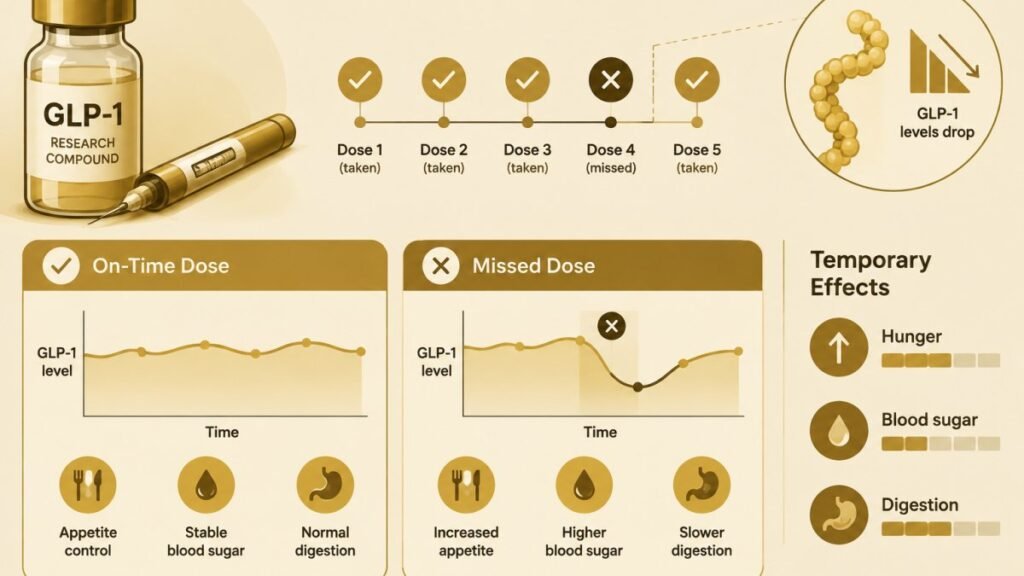
A missed GLP-1 dose lowers the amount of drug in circulation rather than erasing it at once, and the size of the drop tracks the drug’s half-life. A 2026 pharmacokinetic analysis found some GLP-1 therapies may be more sensitive to a missed GLP-1 dose, likely because they have shorter half-lives.
- A single missed weekly dose typically produces a small, often undetectable change in group averages.
- Repeated missed doses correlate with drift in glycemic control and with regained appetite.
- Restarting at the same dose after a gap is linked to gastrointestinal side effects.
- Documentation should record the restart decision, not just the missed dose count.
- The research does not establish a universal clinical effect or restart rule for all GLP-1 medications.
Table of Contents
- What a Missed GLP-1 Dose Does to Drug Levels in Studies
- GLP-1 Medication Adherence in Clinical Trials
- GLP-1 Missed Dose Effects on Study Outcomes
- Missed Dose Protocol Deviation Documentation
- How Interruption Length Changes the Evidence
- GLP-1 Treatment Interruption and Restart Guidance
- What the Research Does Not Establish
- Sourcing Research-Grade Compounds for Adherence Studies
- Frequently Asked Questions
What a Missed GLP-1 Dose Does to Drug Levels in Studies
A missed GLP-1 dose does not erase the drug from your body at once. Instead, it lowers the amount of drug in circulation, and how fast that drop happens depends on the medication. Research on what happens if GLP-1 dose is missed in studies points to one clear finding: the size of the effect tracks the drug’s half-life. Adherence is one of the hardest variables to control in any metabolic study.
Half-life is the time it takes for half of a drug to leave the body. A short half-life means drug levels fall faster between doses. A long half-life means the drug stays steady for longer.
A 2026 pharmacokinetic analysis found that some GLP-1 receptor agonist therapies may be more sensitive to missed doses, likely because they have shorter half-lives (pharmacokinetic analysis of missed GLP-1 doses). That is the core mechanism behind most missed-dose effects. Less drug in the blood means less receptor stimulation, and the gap widens with each skipped dose.
Half-Life Differences Between GLP-1 Therapies
Half-life varies widely across this drug class, and that variation drives everything else. A weekly injection with a long half-life can absorb one late dose with little change in drug levels. A therapy with a shorter half-life gives the body less buffer.
This is why the 2026 analysis treats missed doses as a drug-specific problem, not a class-wide one. The same one-day delay can mean very different things depending on the molecule.
For researchers, that has a practical consequence. Any study design that allows dose interruptions must record which compound each participant received. Pooling adherence data across different GLP-1 therapies can hide the effect you are trying to measure.
If your protocol compares incretin-based compounds, the cagrilintide 10mg research compound page lists specifications for one amylin receptor option. The mazdutide 100mg listing covers a separate GLP-1-related compound for parallel review.
GLP-1 Medication Adherence in Clinical Trials
GLP-1 medication adherence in clinical trials is measured, not assumed. Trials track dose timing, missed doses, and discontinuation as separate variables because each one affects the data differently.
A 2026 study suggests early GLP-1 receptor agonist discontinuation is often driven by modifiable access barriers, especially out-of-pocket costs and insurance coverage (study on early GLP-1 discontinuation). That finding matters for adherence research. A participant who stops because of cost is not the same as one who forgets a dose, and the two produce different gaps in the data.
Three adherence measures show up most often in trial reporting:
- Dose timing: how close each dose lands to the scheduled window
- Missed dose count: how many doses were skipped per participant
- Treatment discontinuation: whether the participant stopped entirely
Each measure answers a different question. A trial can show strong dose timing and still lose participants to discontinuation. Reporting only one of the three gives a misleading picture of how well the treatment held up in practice.
GLP-1 Missed Dose Effects on Study Outcomes
The keyword asks what happens in studies, so this section separates what trials actually measured from what clinicians infer. Most top-ranking articles answer the practical question, take, skip, or resume, without summarizing the trial evidence behind missed-dose effects. That is the gap this section fills.
In registered trials of weekly GLP-1 receptor agonists for type 2 diabetes, missed doses are not usually a primary endpoint. Instead, adherence is captured as a secondary or exploratory variable, and the effect of a missed dose is inferred from pharmacokinetic (PK) sub-studies and from exposure-response analyses. The practical consequence: a single missed dose rarely produces a statistically detectable change in group-level A1C or weight, because the trial was not powered to detect it. What the trials do show is that sustained gaps, several consecutive missed doses, correlate with drift in glycemic control and with regained appetite.
Three outcome domains appear most often in the literature:
- Glycemic control: In diabetes trials, A1C is the primary efficacy measure, and missed doses are handled through adherence-adjusted analyses rather than as a standalone event. A single missed weekly dose typically produces a small, often undetectable change in group averages; repeated missed doses produce measurable drift. The effect is larger for medications with shorter half-lives, where drug levels fall faster between doses.
- Appetite and hunger: Appetite is usually a secondary or patient-reported outcome. Trials report mean changes in hunger scores and caloric intake, not the effect of one skipped dose. Patient-facing guidance describes increased hunger after missed doses, but that is an inference from the drug’s mechanism, less receptor stimulation, rather than a directly measured trial endpoint.
- Weight: Weight loss is the primary endpoint in weight-management trials and a secondary endpoint in diabetes trials. A single missed dose does not typically cause immediate weight regain in trial data; repeated interruptions are associated with slower progress. Restarting at the same dose after a gap is linked to gastrointestinal side effects, which can be misread as treatment failure rather than a dosing artifact.
A 2023 special report on GLP-1 shortages includes medication-specific missed-dose and reinitiation guidance (special report on GLP-1 missed-dose guidance). One excerpt describes giving a missed dose within one hour before the next meal, though the excerpt does not name the medication involved. That specificity is the point: the rule changes with the drug, the formulation, and the titration stage.
For study outcomes, the pattern matters more than any single event:
- One missed dose: small, often undetectable change in group averages
- Repeated missed doses: measurable drift in appetite and glycemic control
- Restart at full dose after a gap: higher chance of gastrointestinal side effects
That last point is where study design gets tricky. If participants restart at their previous dose after an interruption, side effects can be misread as treatment failure rather than a dosing artifact. Trials that prespecify restart rules, same dose versus stepped-down dose, produce cleaner comparisons than those that leave the decision to investigators after the fact.
A 2026 pharmacokinetic analysis found that some GLP-1 receptor agonist therapies may be more sensitive to missed doses, likely because they have shorter half-lives (pharmacokinetic analysis of missed GLP-1 doses). That is the core mechanism behind most missed-dose effects: less drug in the blood means less receptor stimulation, and the gap widens with each skipped dose. The analysis treats missed doses as a drug-specific problem, not a class-wide one, the same one-day delay can mean very different things depending on the molecule.
What the trials do not establish is a universal threshold. No single missed-dose count applies across the class, and the size of the effect on weight and glycemic control varies by indication. Anyone citing this research should separate what the studies measured from what a clinician would advise. Those are different claims, and mixing them weakens both.
Missed Dose Protocol Deviation Documentation
Missed dose protocol deviation documentation is the record that ties an unplanned dose gap to the study data.
Documentation should capture four things for every event:
- The scheduled dose date and the actual dose date
- How many doses were missed in the sequence
- Whether the participant restarted at the same dose or a lower one
- Any symptoms reported during the gap or after restart
A common mistake is logging only the missed dose count. The restart decision changes the safety picture, and it belongs in the record. Two participants with the same gap can have very different outcomes depending on whether they resumed at full dose or stepped back down.
What most guides miss is the timing detail. A dose taken a few hours late is a different event from a dose skipped entirely, and the documentation should say which one happened.
How Interruption Length Changes the Evidence
Interruption length is the variable that most changes what the evidence shows. A single late dose and a multi-week gap are not the same event, and studies treat them differently.
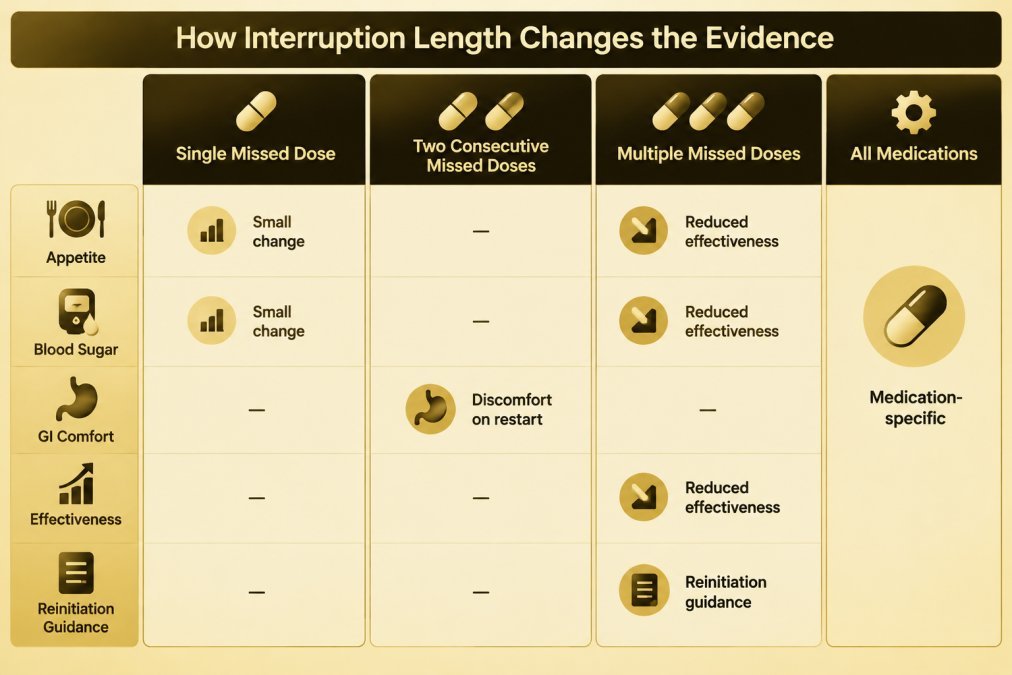
The 2023 special report on GLP-1 shortages includes medication-specific missed-dose and reinitiation guidance (special report on GLP-1 missed-dose guidance). One excerpt describes giving a missed dose within one hour before the next meal, though the excerpt does not name the medication involved. That level of specificity is the point: the rule changes with the drug.
Here is how the evidence lines up by gap length:
| Interruption length | Documented outcome | Restart guidance |
|---|---|---|
| One late dose | Small change in drug levels | Take it if the window allows |
| One missed dose | Little to no immediate effect | Resume normal schedule |
| Two consecutive missed doses | Possible GI discomfort on restart | Consider prescriber input |
| Multiple missed doses | Reduced effectiveness reported | Reinitiation guidance applies |
The key takeaway from the table is that no single rule covers every row. Each one depends on the medication and the person.
GLP-1 Treatment Interruption and Restart Guidance
GLP-1 treatment interruption and restart decisions belong with the prescriber, not with a general article. Still, the published guidance gives a clear shape to what happens next.
The 2023 special report gives reinitiation guidance for particular missed-dose intervals. That means restart instructions are tied to how long the gap lasted, not to a single universal rule. A short gap may allow a return to the regular schedule. A longer gap may call for a lower starting dose.
For a study, the restart decision should be written into the protocol before enrollment. If the rule is set after the fact, the data cannot be compared across participants.
What the Research Does Not Establish
The research does not establish a universal clinical effect or restart rule for all GLP-1 medications. That is not a flaw in the evidence, it is a feature of how the studies were designed. Most trials were built to measure efficacy under protocol-specified dosing, not to quantify what happens when a dose is missed. Missed-dose effects are therefore inferred from pharmacokinetic sub-studies, exposure-response analyses, and adherence-adjusted secondary endpoints rather than from randomized comparisons of missed versus taken doses.
Three limitations deserve to be stated plainly:
- Missed doses are rarely a primary endpoint. Trials track adherence as a secondary or exploratory variable, often through pill counts, injection logs, or electronic monitoring. Each method measures something different: a pill count captures whether the dose left the bottle, not whether it was taken; an injection log captures self-report; electronic monitoring captures opening events. None of these directly measures drug exposure, which is why PK sub-studies matter.
- Adherence is measured inconsistently across trials. Some trials report dose timing, some report missed-dose counts, and some report discontinuation. Pooling these measures across studies can hide the effect you are trying to measure, because a participant who stops for cost is not the same as one who forgets a dose.
- Long-term outcomes after repeated interruptions are not well characterized. The available excerpts do not give enough detail to generalize one rule across products, and the effect of repeated interruptions on weight and glycemic control over months to years is sparse.
A 2026 study suggests early GLP-1 receptor agonist discontinuation is often driven by modifiable access barriers, especially out-of-pocket costs and insurance coverage (study on early GLP-1 discontinuation). That finding matters for interpreting adherence data: a participant who stops because of cost produces a different kind of gap than one who forgets a dose, and the two should not be pooled without adjustment.
The 2026 pharmacokinetic analysis describes differences tied to half-life, and the missed-dose guidance varies by oral versus injectable formulation (pharmacokinetic analysis of missed GLP-1 doses). The available excerpts do not give enough detail to generalize one rule across products. That gap is worth stating plainly: study limitations and uncertainty are part of the evidence, not a flaw in it.
Anyone citing this research should separate what the studies measured from what a clinician would advise. Those are different claims, and mixing them weakens both. A trial that reports a mean A1C change under protocol-specified dosing is not the same as a recommendation for what to do after a missed dose, the first is a measured outcome, the second is clinical judgment applied to an individual. Keeping that distinction clear is what makes the evidence usable.
Sourcing Research-Grade Compounds for Adherence Studies
Adherence research lives or dies on consistency. If the compound itself varies between batches, a missed-dose effect and a purity problem can look identical in the data.
This is where sourcing discipline pays off. A research-grade supplier should give you a Certificate of Analysis for each batch, not a single document reused across products. Independent third-party testing should confirm purity, and the report should be traceable to the specific vial in your study.
PepAlphatides states that every batch undergoes independent third-party testing to verify purity levels exceeding 99%. Each product is supplied with its own Certificate of Analysis, and secure QR codes on the vials link to the batch report.
For a reader planning this kind of work, the 2026 guide to choosing reliable research compound suppliers walks through the criteria that matter. If you want to understand what the purity grade actually means, analytical grade peptide purity explained breaks it down.
Adherence studies ask a lot of your materials: consistent purity, batch transparency, and documentation you can defend. PepAlphatides supports that work with independent third-party testing, a Certificate of Analysis for every product, and QR-coded batch reports you can check before you buy. Research members get a 10% discount, and orders over $250 ship free. Get started with PepAlphatides and build your next adherence study on compounds you can trace.
Frequently Asked Questions
What happens if a participant misses a GLP-1 dose during a study?
The immediate effect depends on the medication and how much time has passed. Some GLP-1 receptor agonist therapies may be more sensitive to missed doses, particularly those with shorter half-lives. Repeated gaps can reduce treatment effectiveness. Researchers should record the missed GLP-1 dose, the interval since the scheduled dose, and any subsequent symptoms rather than assuming a uniform outcome across products.
How should researchers document a missed dose in a trial?
Missed dose protocol deviation documentation should capture the scheduled date and time, the actual date and time of administration if any, the number of consecutive doses missed, and whether the participant self-reported or the site detected the gap. Record the medication name, dose, and formulation, since oral and injectable products carry different missed-dose guidance. Note any adverse events reported after the gap, including nausea or gastrointestinal side effects after restarting. This detail lets reviewers separate a single late dose from a true treatment interruption when analyzing adherence data.
Can a missed GLP-1 dose affect study results?
Yes, though the size of the effect varies. GLP-1 missed dose effects on study outcomes depend on interruption length, the specific drug’s half-life, and the endpoint being measured. Missed doses can be associated with returning hunger and changes in blood sugar, and resuming the same dose after multiple missed doses may cause gastrointestinal discomfort. Access barriers such as out-of-pocket costs and insurance coverage can confound adherence analysis if not tracked separately from deliberate nonadherence.
Do missed-dose instructions differ between semaglutide and tirzepatide?
Research and guidance consistently emphasize that missed-dose effects and restart instructions are medication-specific rather than uniform across all GLP-1 drugs. Missed-dose and reinitiation guidance is generally medication-specific, and sensitivity to missed doses can differ with half-life. Because the available excerpts do not generalize one rule across products, researchers should consult the current prescribing information and package insert for the specific agent under study rather than applying a single protocol to every GLP-1 receptor agonist.