Quick Summary
To handle GLP-1 research compounds safely, verify each lot against its own Certificate of Analysis, store lyophilized powder cold, dry and protected from light, and record every step from receipt to disposal. Treat these materials with care because they have not been reviewed for safety, quality or effectiveness the way medicines are.
- Match each vial’s lot number to its own Certificate of Analysis, not a generic product COA.
- Store lyophilized powder at the temperature on the COA and protect vials from light.
- Let sealed vials reach room temperature before opening to avoid moisture entering the powder.
- Use fresh single-use tips and gloves, and mark dedicated tools for each compound.
- Label every container with lot number, dates, storage location and handler initials.
Table of Contents
Why GLP-1 research compounds need different handling than medicines: the way you handle a research compound matters
Learning how to handle GLP-1 research compounds is not the same as handling a prescription medicine. Medicines pass through review for safety, strength and quality before patients use them. Research-use-only materials usually do not. The U.S. Food and Drug Administration (FDA) warns consumers against buying or using GLP-1 products marketed for research purposes or labeled “not for human use,” because those products have not been reviewed for safety, effectiveness or quality (FDA warning on unapproved GLP-1 drugs used for weight loss). PepAlphatides writes this guide to help qualified researchers treat these materials with the care their unknown status demands.
That difference shapes every step that follows. A lab cannot assume the label is accurate, that the vial is clean or that the content matches what is printed on the box. Careful handling is the only control a lab has at the bench.
Compounded versions of these drugs also deserve attention. A pharmacovigilance study using FDA adverse event reporting data found a higher likelihood of reported adverse effects, including abdominal pain, nausea and diarrhea, for compounded GLP-1 receptor agonists (pharmacovigilance study of compounded GLP-1 receptor agonists). The study does not explain every mechanism, but it is a reason to treat unverified sources with caution.
Medicines come with a regulated supply chain. Research compounds often do not. Most lack a clear chain of custody from maker to bench, which is why traceability is part of safe handling here. Our approach: never assume a material is safe because it is available. Verify it, store it correctly and record every step.
Verifying identity, purity and documentation before use
Before you open a vial, confirm what you have and how to handle GLP-1 research compounds safely at the bench. Start with the lot number. Match it to the Certificate of Analysis (COA) for that exact lot. A generic COA for the product line is not enough. Each lot should have its own analytical data.
Check the COA for three things: identity, purity and the methods used. For a step-by-step walkthrough of confirming purity levels, see how to verify peptide purity levels. Identity should be confirmed by a method such as mass spectrometry. Purity is usually measured by high-performance liquid chromatography. Ask whether the testing lab is independent of the seller. PepAlphatides batches undergo independent third-party testing and each product includes an individual Certificate of Analysis (COA), so you can review the data for your lot before you buy. For the full checklist, read our guide on how to verify peptide identity before research and our COA authenticity checks for research materials.
Look for red flags. Missing lot numbers, unsigned reports, identical results across different lots and vague method descriptions all deserve questions before use. If the documentation is weak, do not assume the contents are fine.
Keep a copy of every COA in your project file. Compare the lot number on the vial, the label and the report. Any mismatch is a reason to stop and ask.
GLP-1 peptide storage conditions that protect sample integrity
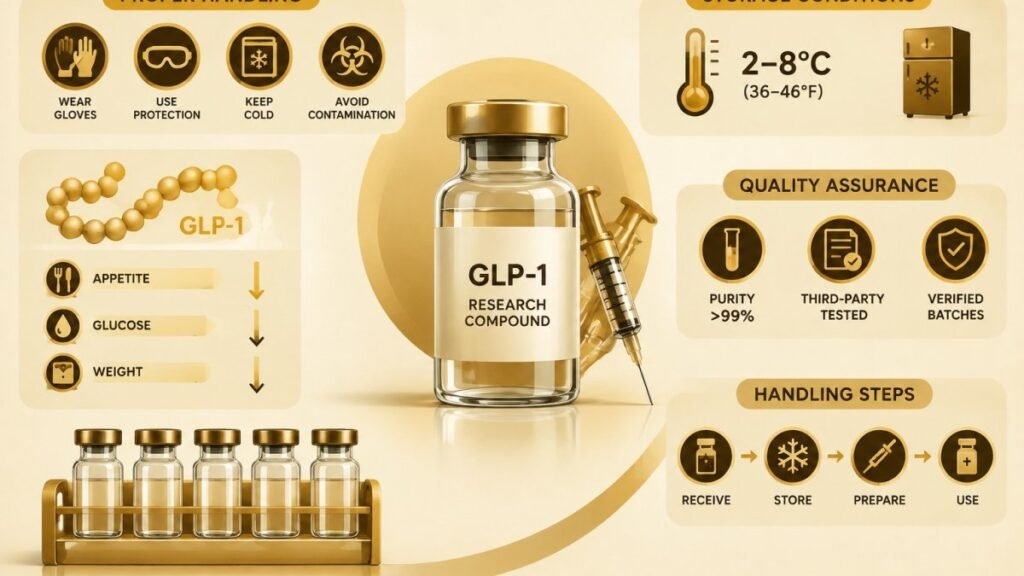
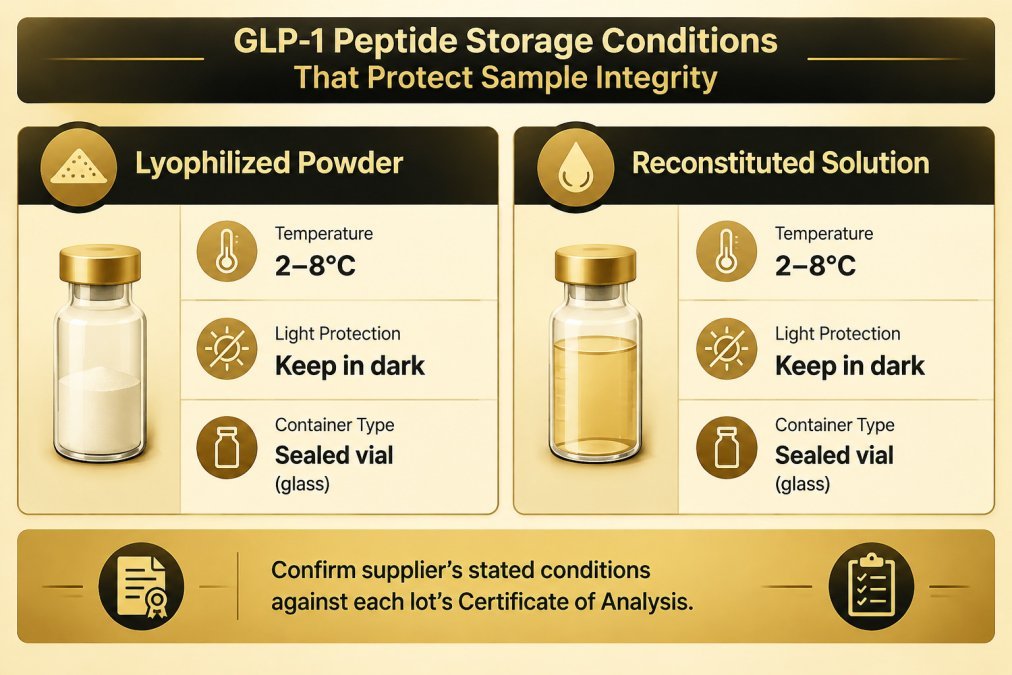
Storage is where many samples quietly lose quality. Keep lyophilized powder cold, dry and protected from light. Store unopened vials at the temperature stated on the COA or product documentation. Confirm the exact condition for your product before you store it.
Reconstituted solutions are less stable than dry powder. Use them within the time frame your documentation supports. If you cannot find that information, treat the solution as short-lived and prepare only what you need.
Protect samples from temperature swings. Repeated freeze-thaw cycles and long periods at room temperature can change a sample. Aliquot material into single-use portions where practical so the main stock is not repeatedly opened.
Use a monitored storage unit. Log temperatures daily or set alarms, and record any excursion. A simple log helps you decide whether a sample is still trustworthy.
- Store lyophilized powder at the temperature on the COA
- Protect vials from light with amber containers or cartons
- Aliquot to limit freeze-thaw cycles
- Log storage temperatures and any excursions
- Label every container with lot number and date opened
Peptide sample handling best practices step by step
Good handling starts before the vial leaves storage. Plan the work so the sample is out of the cold for as little time as possible.
Step 1: Let sealed vials reach room temperature before opening. Opening a cold vial pulls moisture in and can affect the powder. Allow the vial to equilibrate in a closed state first.
Step 2: Work in a clean, controlled area. Use a clean bench, gloves and tools that have not touched other materials. Keep the workspace free of clutter.
Step 3: Use calibrated equipment. Pipettes and balances should be calibrated and recorded. Inaccurate measurements change concentration and undermine the entire experiment.
Step 4: Reconstitute with the specified solvent. Use the solvent named in your documentation. Add it slowly down the vial wall rather than directly onto the powder, and mix gently.
Step 5: Record everything. Write down the lot number, the solvent, volumes, time and date. Good records are your best defense when results look strange later.
Preventing research peptide contamination during preparation
Contamination can enter at any point: the vial, the tools, the air or your own hands. Prevention means limiting every route.
Wear gloves and change them when they touch anything unclean. Work near a clean area, not in a busy corridor. Use sterile, single-use tips and containers where possible. Avoid touching the inside of caps and the tip of any pipette.
Keep the bench disinfected before and after each session. Do not reuse tips across different materials. Mark dedicated tools for each compound to prevent cross-contamination.
Sterility matters most when a sample will be used in a biological system. If your study needs sterile material, confirm that the product documentation supports it. Many research materials are not supplied as sterile.
Common mistake: reusing a syringe or pipette tip because it looked clean. Visible cleanliness does not prove sterility or purity. Use fresh single-use items.
GLP-1 sample labeling and documentation requirements
A label is part of your evidence. Every vial and aliquot should show the compound name, lot number, concentration if reconstituted, date prepared, date opened, storage location and handler’s initials.
Keep a logbook or electronic record that links each lot to its COA, storage history and every preparation. If a result looks wrong, you need to trace the sample back to its source quickly.
Store documentation with the sample record, not in a separate folder no one checks. Review labels regularly for fading or smudging, and replace any label that becomes hard to read.
Good labeling also supports safety. A clearly marked vial is less likely to be mistaken for another compound or used by someone unfamiliar with it.
Recognizing possible degradation in stored peptide samples
Degradation can be hard to see. Some signs are obvious: discoloration, cloudiness, particles or a change in texture in the powder. Others only show up in results, such as lower activity or unexpected readings on analysis.
Be suspicious if a sample looks different from earlier lots, if it has been stored outside its documented conditions or if repeated analyses drift over time. Do not use a sample you believe has degraded. Quarantine it, record what you observed and check the storage log.
Test a small retained portion against the original COA data when your lab has the capability. Retained samples help you tell whether a change happened in storage or in your own process.
Spill response, waste disposal and incident reporting
Plan for accidents before they happen. Keep spill kits stocked, know where they are and train staff to use them. For a small spill, wear appropriate gloves and eye protection, cover the area with absorbent material, clean the surface and place contaminated materials in a sealed waste container.
Dispose of waste according to your institution’s hazardous-waste rules and local regulations. Do not pour research compounds down the drain or throw them in ordinary trash unless your safety office approves it.
Report incidents promptly. Record what happened, which material was involved, who was exposed and what steps you took. Review each incident to change procedures so it does not happen again. Serious exposure needs medical attention and notification of your safety officer.
Setting up your handling checklist and training your team
A written checklist turns good intentions into routine. Include verifying the lot against its COA, checking storage temperature, equilibrating vials before opening, using calibrated tools, labeling aliquots and logging every step.
Train everyone who touches the material. Cover the boundary between research compounds and medicines, how to read a COA, spill response and waste rules. Refresh training regularly and after any change in procedure.
Assign clear roles. Someone should own inventory, someone should own documentation and someone should check that the checklist is followed. Review the checklist after each project and update it based on what went wrong or nearly went wrong.
PepAlphatides offers research compounds with an individual Certificate of Analysis (COA) for every product and secure QR codes on vials for batch transparency. Review the documentation for your lot before you buy, and handle every sample with the controls described here. Explore our best practices for peptide storage and learn how to store peptide powders to keep your samples stable.
Get started with PepAlphatides and review batch-level documentation before your next project. Shop ADD TO CART.
Frequently Asked Questions
Are research-use-only GLP-1 compounds approved for human use?
No. The U.S. Food and Drug Administration has warned consumers against buying or using GLP-1 products marketed for research purposes or labeled “not for human use.” The FDA states these products have not been reviewed for safety, effectiveness, or quality. Laboratory research compounds are intended for analytical and experimental work only, and they should never be treated as medicines for personal use. Any lab that receives such materials should keep them strictly within research settings and document their intended use.
How should GLP-1 research compounds be stored?
Storage requirements depend on the form of the material and the conditions stated on its Certificate of Analysis, so always check that document for each lot before storing it. In general, protect samples from light, keep containers tightly sealed, and control temperature consistently rather than relying on a single freezer or refrigerator without monitoring. Record storage temperatures over time, and do not assume a material is stable if its temperature history is unknown. Stability guidance from your supplier should guide the specific temperature and duration limits you apply.
How can you tell whether a research peptide may have degraded?
Visual changes such as discoloration, clumping in a powder that was previously free-flowing, or cloudiness in a solution can signal a problem, though many degradation processes produce no visible sign. Compare the current material against its original Certificate of Analysis and your storage log, and note any temperature excursions. If you have access to analytical methods such as HPLC, a purity re-test can confirm whether the material still meets its stated specification. When degradation is suspected, quarantine the sample and do not use it in experiments until its status is confirmed.
What should researchers do if a GLP-1 compound is spilled?
Stop work, alert others in the area, and wear appropriate personal protective equipment such as gloves, eye protection, and a lab coat. Contain the spill with absorbent material, clean the area with an appropriate decontamination agent, and place all contaminated materials in a labeled waste container. Follow your institution’s chemical waste procedures and the guidance in the material’s safety data sheet. Document the incident, including the compound, quantity, time, and actions taken, and report it through your organization’s incident reporting channel.